Replacement Power Adapters for Laptops, Phones & More

Category: Device-Specific Guides

Replacement Speaker Power Adapter
How to Find the Perfect Replacement Speaker Power Adapter

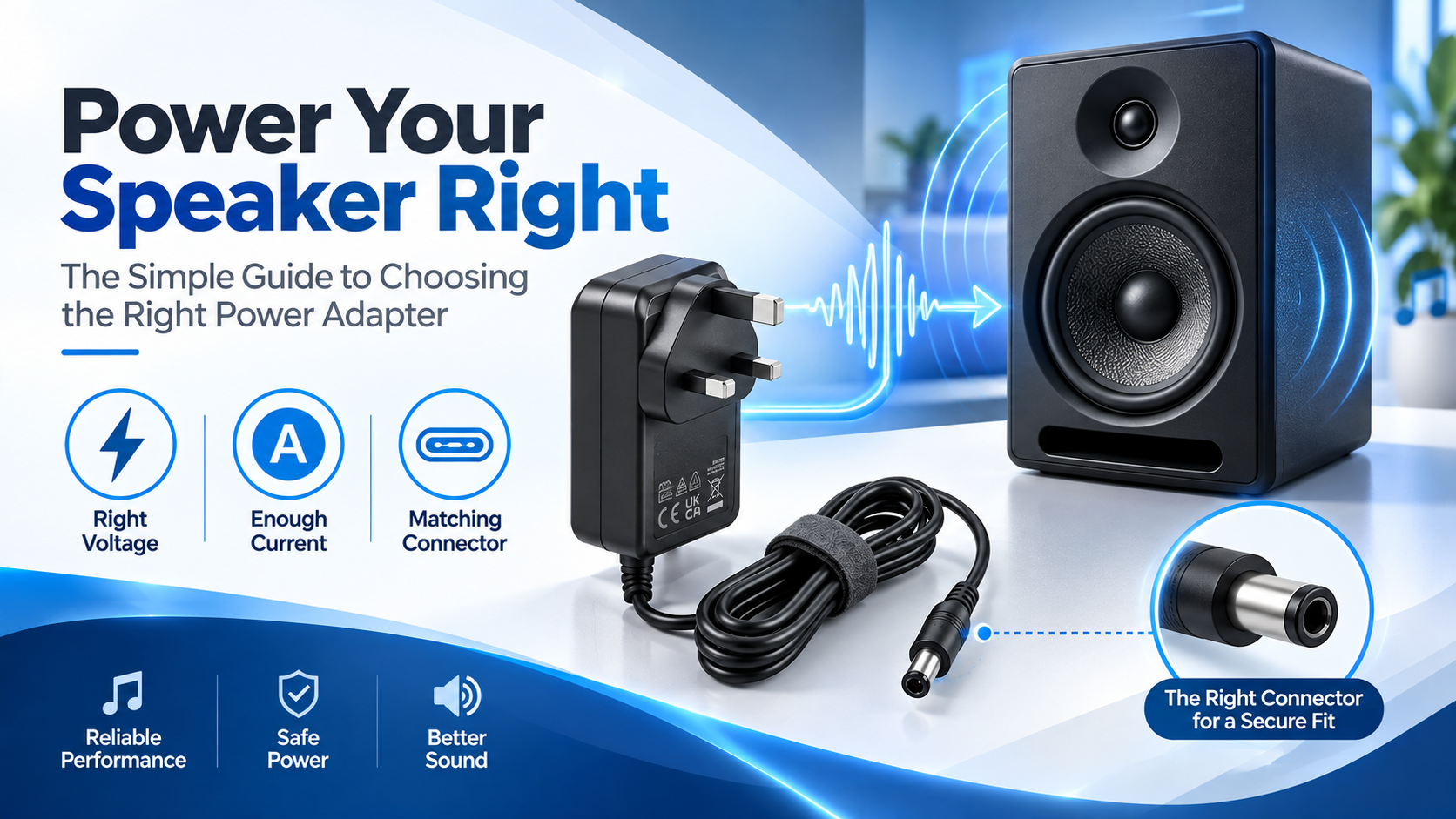
Lost the power adapter for your speaker, or has the original stopped working? Finding a replacement speaker power adapter does not have to leave you staring at a page full of almost identical black power bricks. Getting the right match is much simpler than it looks.

The key is to look beyond the plug and check the complete electrical specification. You need to confirm the speaker model, voltage, current, connector and polarity. Once these details match, choosing a compatible replacement becomes much easier.
Read More »
powered speaker keeps turning off
Powered Speaker Keeps Turning Off? Causes & Proven Fixes

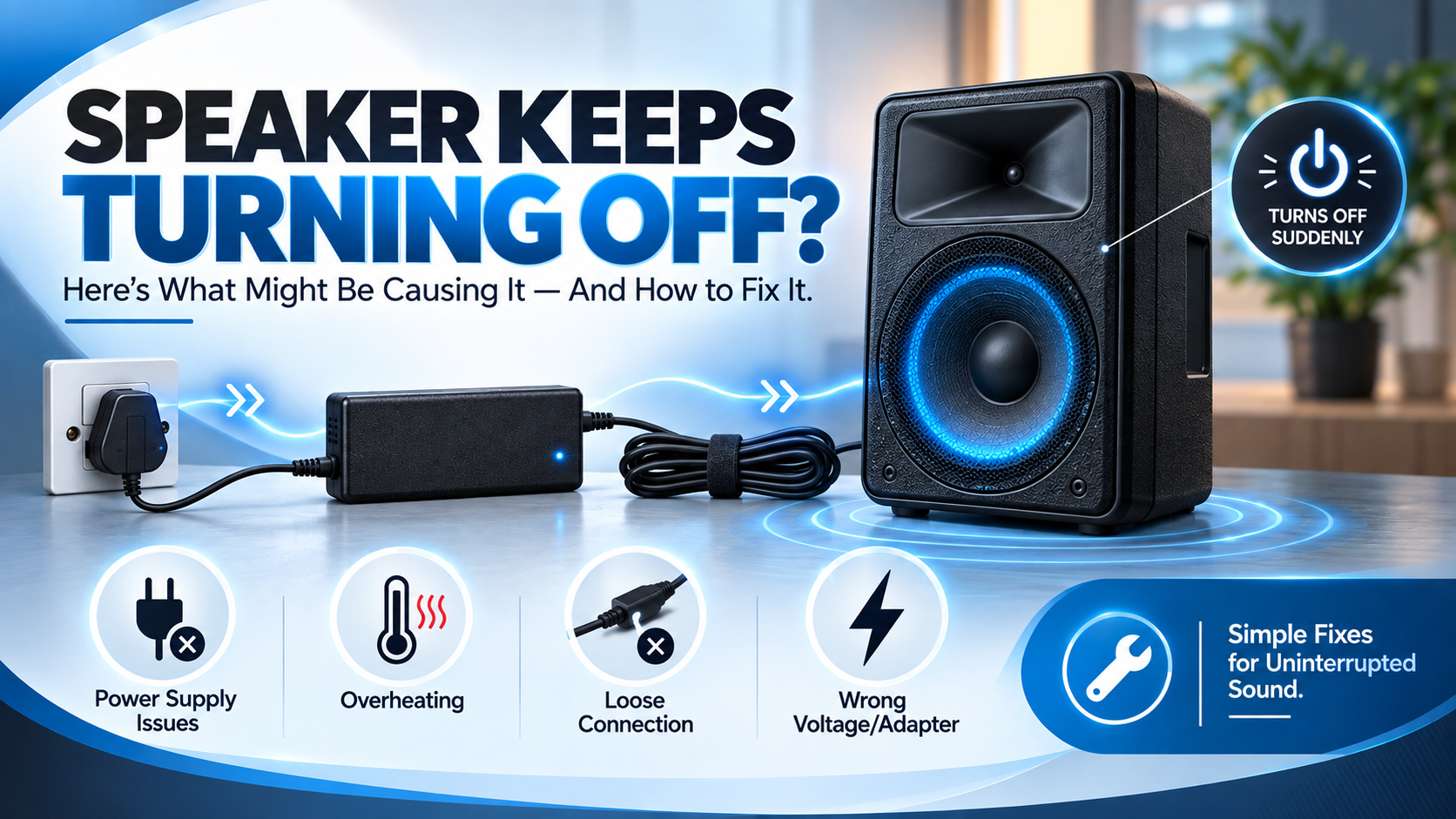
If your powered speaker keeps turning off during music, rehearsals or events, the cause could be a loose connection, a struggling power adapter, overheating or an internal fault.

The good news is that you can often narrow down the problem without immediately assuming the speaker is broken. Start with the power source and adapter, then consider when and how the speaker shuts down.

Read More »
higher-amp powered speaker adapter
Can You Safely Use a Higher-Amp Powered Speaker Adapter?

Yes, you can generally use a higher-amp powered speaker adapter, provided the voltage is correct and the connector size and polarity match. A higher current rating does not normally force extra current into the speaker. It means the adapter has more available capacity.

For example, if your powered speaker requires 12V 2A, a compatible 12V 3A adapter may be suitable. However, a 15V or 24V adapter should not be used simply because it has enough current capacity.

Understanding the difference between voltage and amperage is essential when choosing a replacement.

Read More »
powered speaker need
What Power Adapter Does a Powered Speaker Need? Best Guide

Finding a replacement power adapter for a powered speaker can be confusing. Numbers, connector sizes and polarity symbols all need to match correctly. Whether you are setting up a portable PA system or replacing a failed adapter, choosing the wrong power supply can cause poor performance or damage the equipment.

A powered speaker needs a power adapter that matches its specific electrical requirements. The four key specifications are voltage, current, connector size and polarity. Voltage must match the manufacturer’s requirement exactly, while the adapter’s current rating should normally meet or exceed the speaker’s requirement.

If the original adapter is missing or damaged, do not choose a replacement simply because the plug fits. Two adapters can use similar-looking barrel connectors while having completely different electrical specifications.

Read More »
Powered Speaker Adapter
Powered Speaker Adapter: Best Replacement Guide

Finding the correct powered speaker adapter for your portable PA units, studio monitors, and smart practice amps saves you from costly equipment failures and unexpected mid-set dropouts. When a power supply breaks down or goes missing, buying a generic replacement straight off an online marketplace can look tempting. Yet, plugging in the wrong unit risks frying sensitive audio circuits, introducing maddening ground loop hums, or permanently bricking your favourite speaker.

Selecting the correct replacement power supply means looking past generic physical plug shapes and digging into the precise electrical specifications required by your gear. Taking the time to evaluate these details protects your financial investment and ensures uninterrupted audio performance, whether you are running a live mobile DJ gig, practising in a home studio, or setting up a backyard event space. Beyond just keeping the music playing, understanding the synergy between your power adapter and active speaker architecture prevents dangerous thermal events, stabilises low-end frequency reproduction, and extends the operational life of sensitive digital audio components that are otherwise vulnerable to dirty or fluctuating line power.

Read More »
External HDD Power Adapter
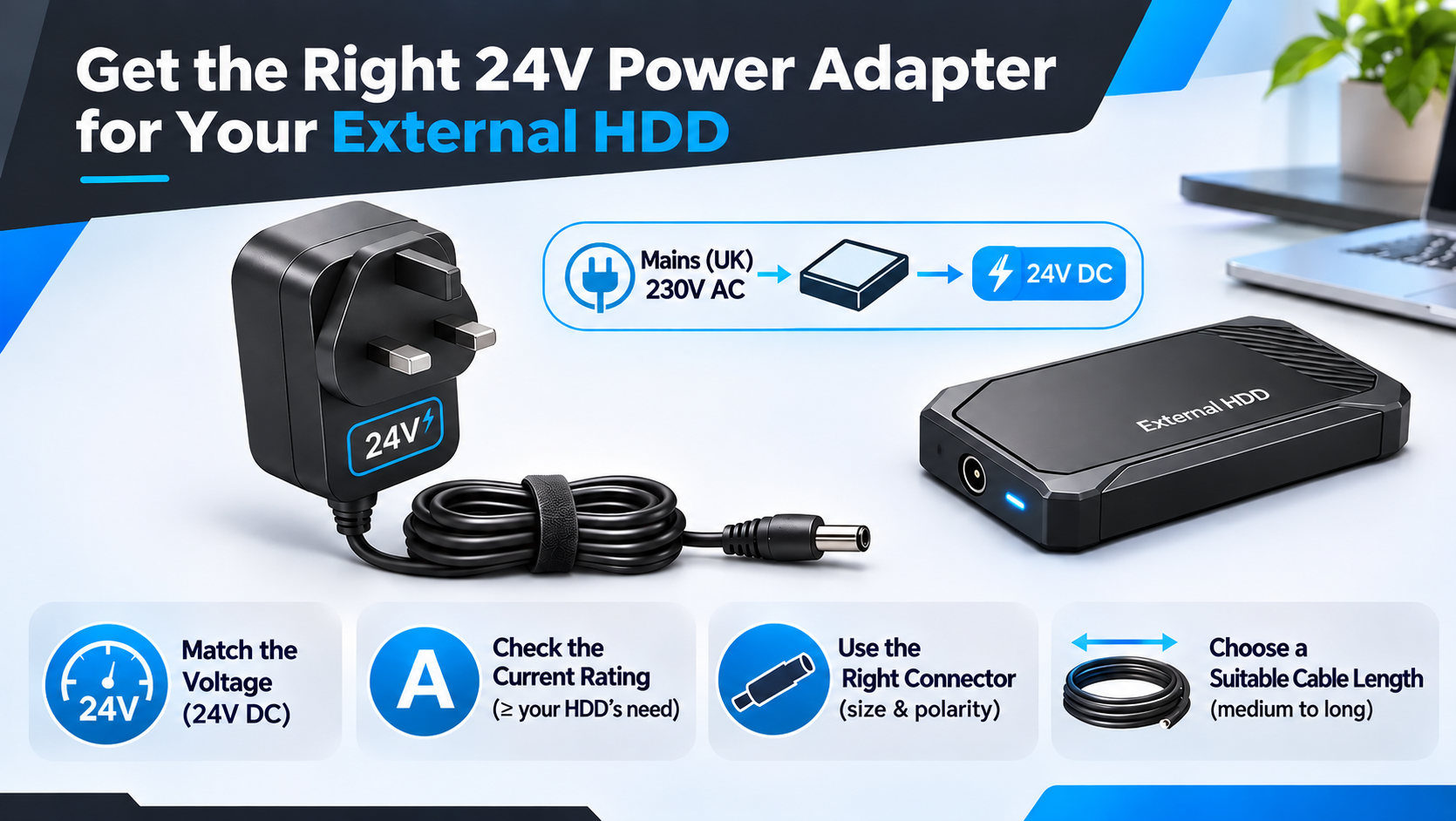
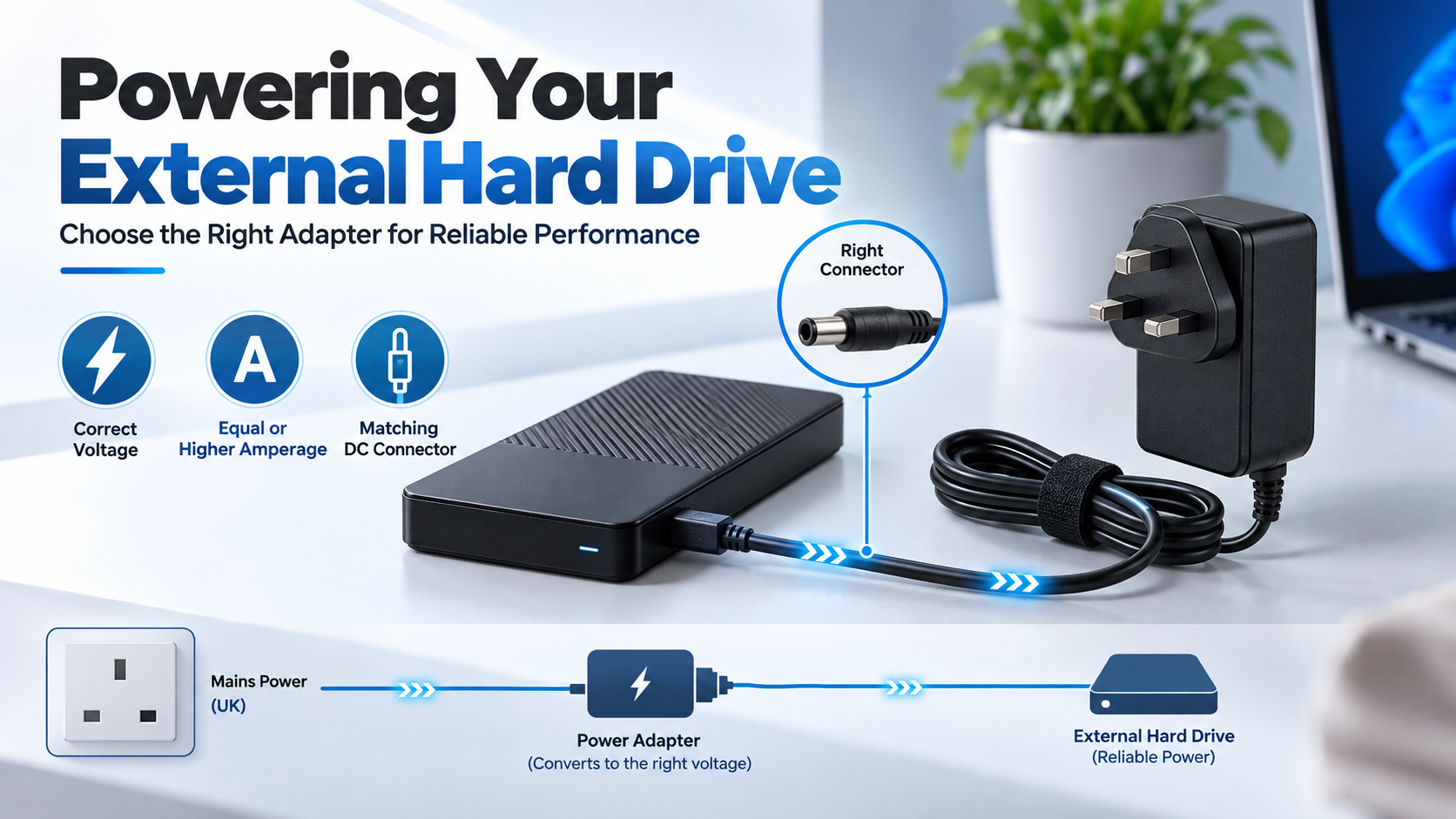
How to Find the Perfect External HDD Power Adapter

Losing or breaking your External HDD Power Adapter can instantly trigger panic, especially if you have gigabytes of irreplaceable photos, work documents, or a media library trapped inside an enclosure that refuses to power on. Your instinct might be to race online, type ’12V hard drive power supply’, and buy whatever cheap generic brick shows up first with a matching plug.

Resist that urge. Buying a random power supply just because it physically plugs into your external HDD is the quickest way to fry internal components, corrupt data, or cause intermittent drive dropouts during a file transfer. External hard drives demand precision when it comes to their electrical diet.

Finding a safe replacement isn’t a guessing game; it is a matching process. By understanding core electrical specifications such as voltage, current, connector dimensions, and polarity, you can easily hunt down a trustworthy replacement that brings your backup drive back to life and keeps data secure.

Read More »
external hard drive keep disconnecting
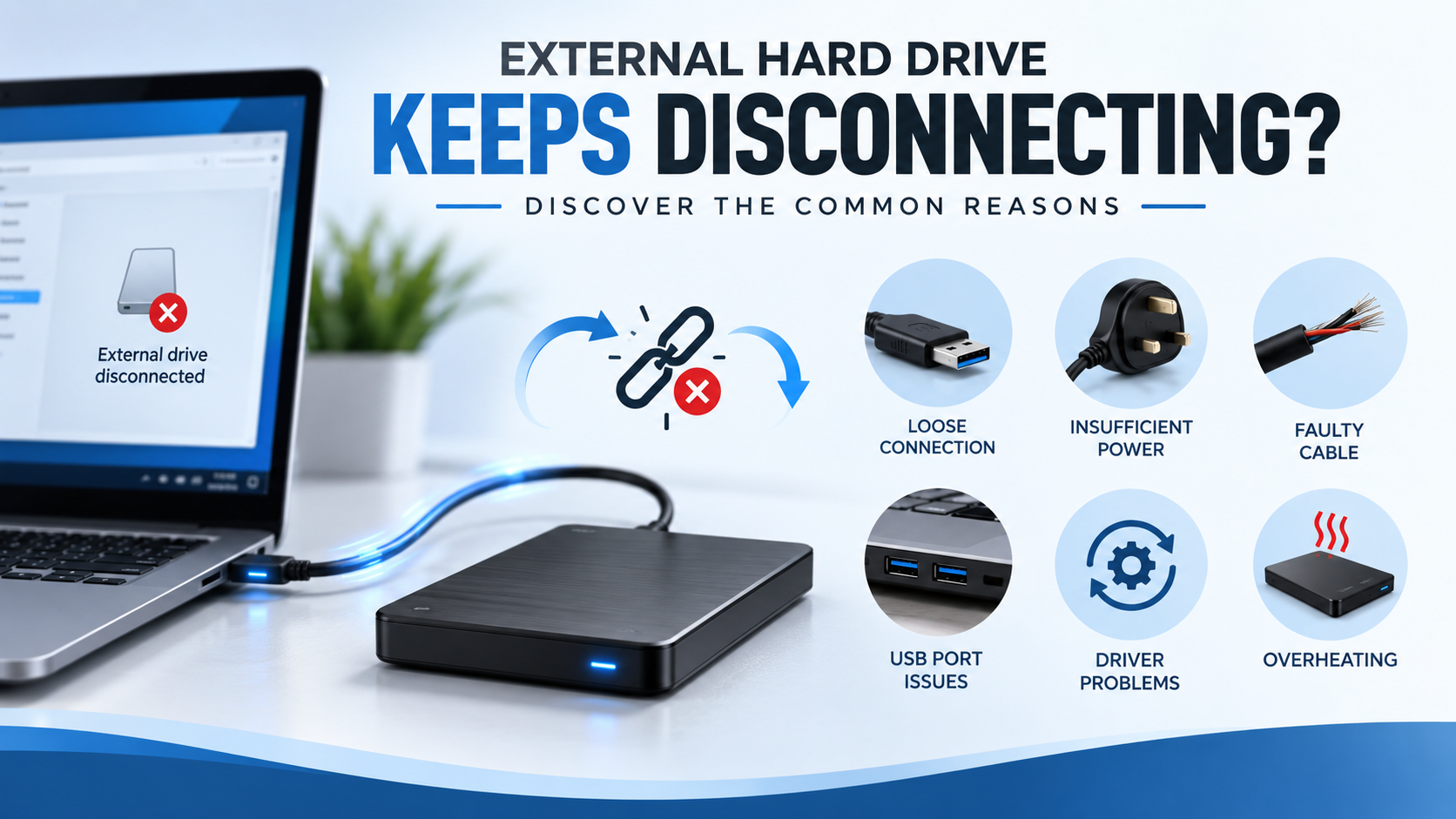
External Hard Drive Disconnecting? Proven Adapter Fixes

Are you dealing with an external hard drive disconnecting right in the middle of copying important files? It is an instantly stressful moment, but thankfully, a random disconnect doesn’t always mean your drive is dying. Often, it is just a loose connection, a power hiccup, or a bit of overheating.

Here is how you can systematically troubleshoot and fix the issue before you even think about throwing your drive away. Taking the time to properly diagnose each component can save you both money and valuable lost data.

Read More »
wrong power adapter
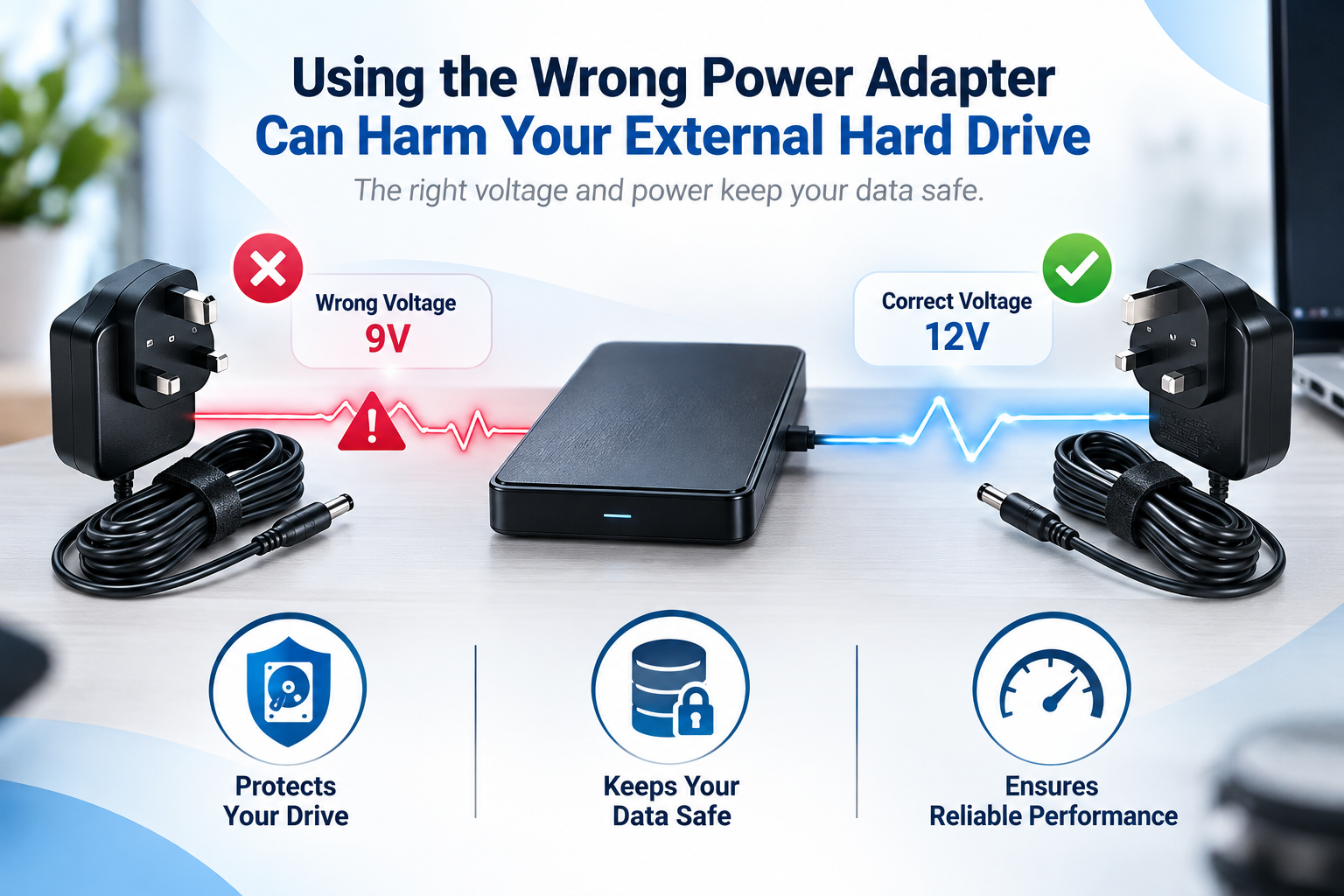
Can the Wrong Power Adapter Damage an External Hard Drive?

Yes, the wrong power adapter can damage an external hard drive, particularly if the supply delivers incorrect voltage or uses the wrong polarity. An unsuitable brick can also cause erratic performance, sudden overheating, or constant shutdowns when its current rating falls short of what the hardware demands.

The good news is that you can easily prevent these hardware disasters by reviewing four core specifications before plugging in a replacement: voltage, amperage, connector dimensions, and polarity. Checking your specific storage model also ensures seamless compatibility.

Read More »
External Hard Drive
What Power Adapter Does an External Hard Drive Need?

Dealing with a missing or broken power supply for an external hard drive can be frustrating, especially when you are worried about losing precious data. An external hard drive often relies on a separate AC/DC power adapter, particularly if it is a desktop-style unit or houses a larger 3.5-inch drive inside an enclosure. Getting a replacement isn’t just about finding something that plugs into the wall; the correct adapter strictly depends on the drive’s required voltage, current draw, DC connector size, and polarity. Before clicking buy on a random online listing, take a moment to look at the specification label on your drive or original adapter and match every detail carefully to prevent permanent hardware damage.

Read More »
Buying a safe and compliant UK-certified replacement monitor power adapter.
External Hard Drive Power Adapters: Best Replacement Guide

When you suddenly need to replace external hard drive power adapters, buying a brand new storage drive is rarely necessary. Many desktop external hard drives and multi-drive storage enclosures can keep working reliably for years with a correctly matched replacement power supply.

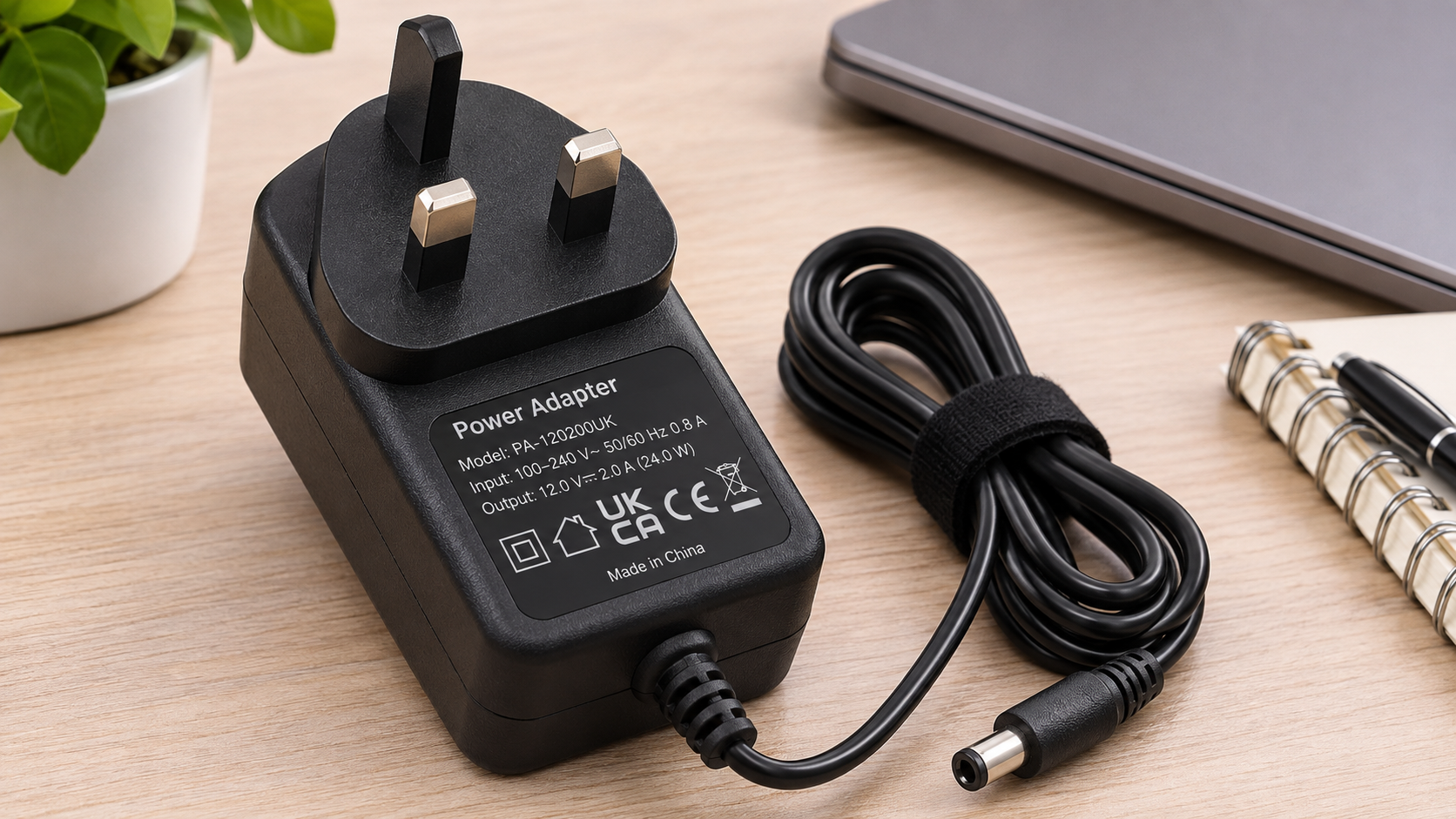
The most important element of this process is absolute compatibility. Before buying a random generic power brick off the internet, you need to check the required voltage, current rating, DC barrel connector dimensions, polarity, and exact device model number. A replacement listing that only says “12V” is never automatically suitable.

Read More »
replacement monitor power adapter
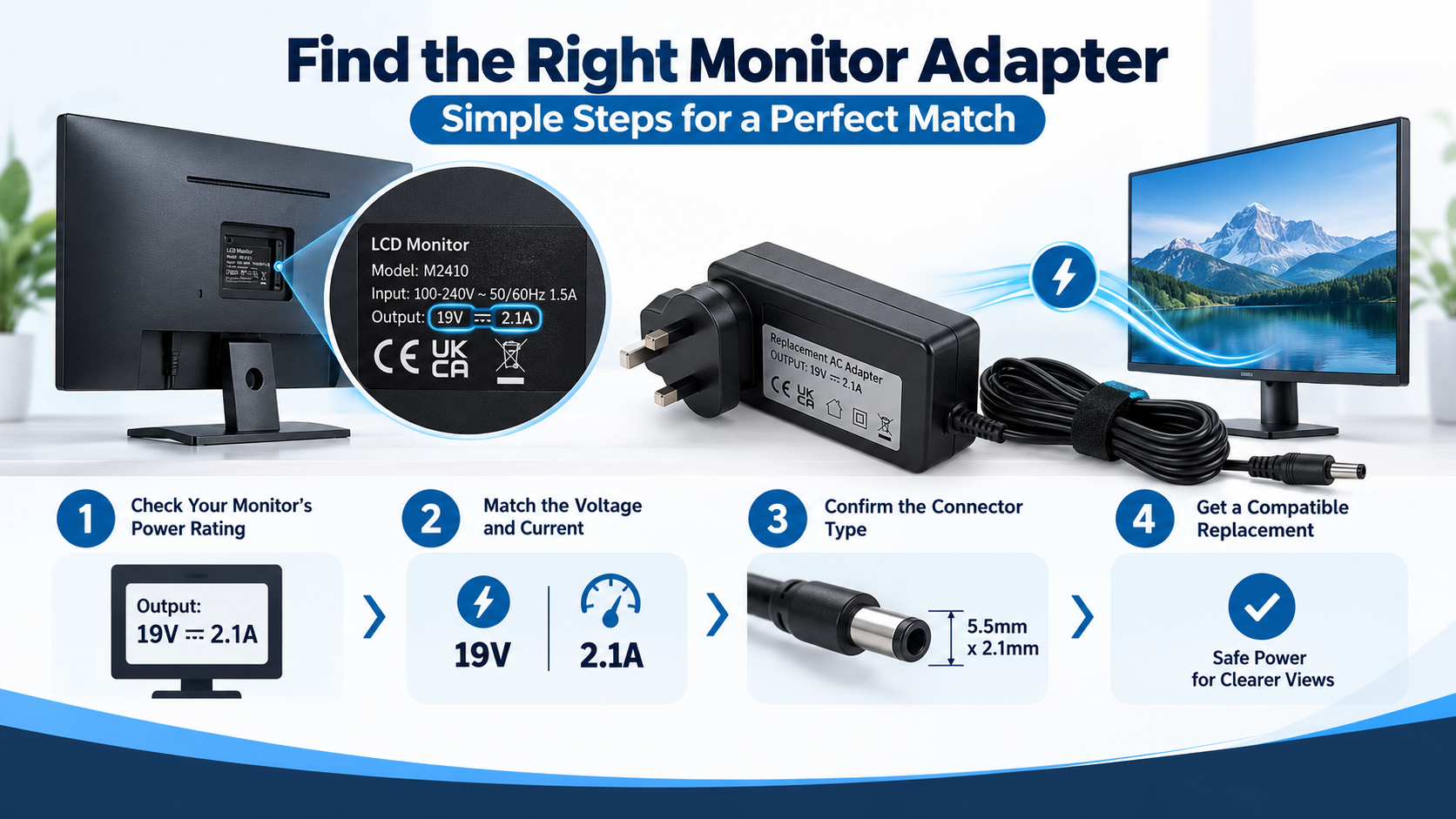
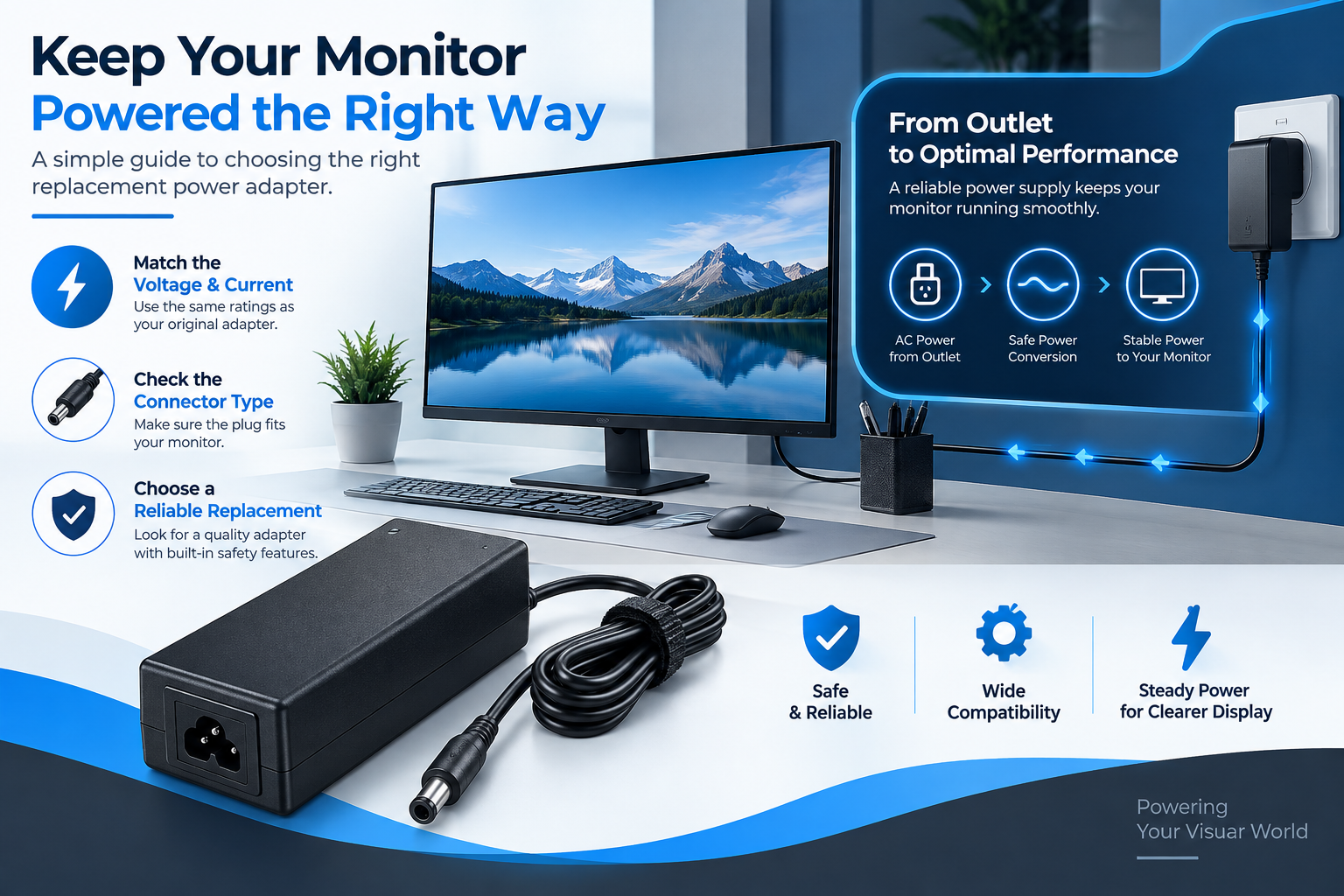
How to Find the Perfect Replacement Monitor Power Adapter

Finding the correct replacement monitor power adapter is much easier once you know which specifications actually matter. Whether your original power brick stopped working, vanished during a move, or got damaged, choosing a replacement just because the plug looks similar is a fast track to screen flickering or hardware failure.

The safest approach is straightforward: check your monitor specification label or original adapter, confirm the voltage, current, connector size, and polarity, and verify your exact monitor model number. Your replacement does not necessarily have to carry the original manufacturer logo, but it must match the display electrical and physical requirements down to the millimeter.

Read More »
monitor turns off with a replacement
Monitor Turns Off With a Replacement Adapter? Proven Fixes

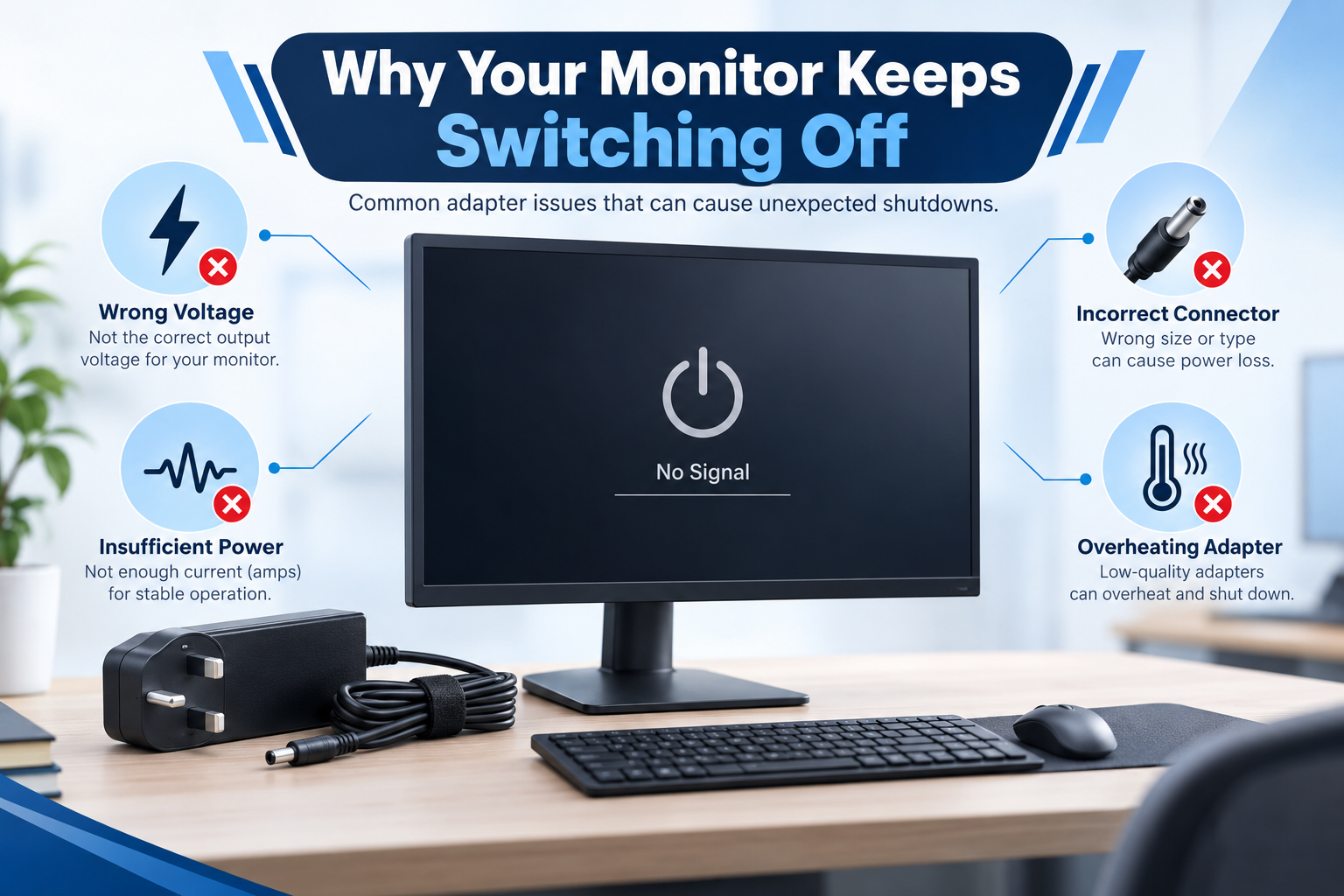
Dealing with a situation where your monitor turns off with a replacement power adapter is incredibly frustrating. While it is easy to assume the new brick is broken, the issue is usually a specification mismatch between what your screen demands and what the adapter delivers.

Traditional monitor chargers output a fixed stream of electricity; if any single variable is misaligned, the display’s internal logic board will shut down instantly to protect itself. To function safely, a replacement must perfectly match five critical criteria: exact output voltage, sufficient current capacity, a properly sized DC connector, matching polarity, and clean direct current.

Read More »
higher-amp monitor power adapter
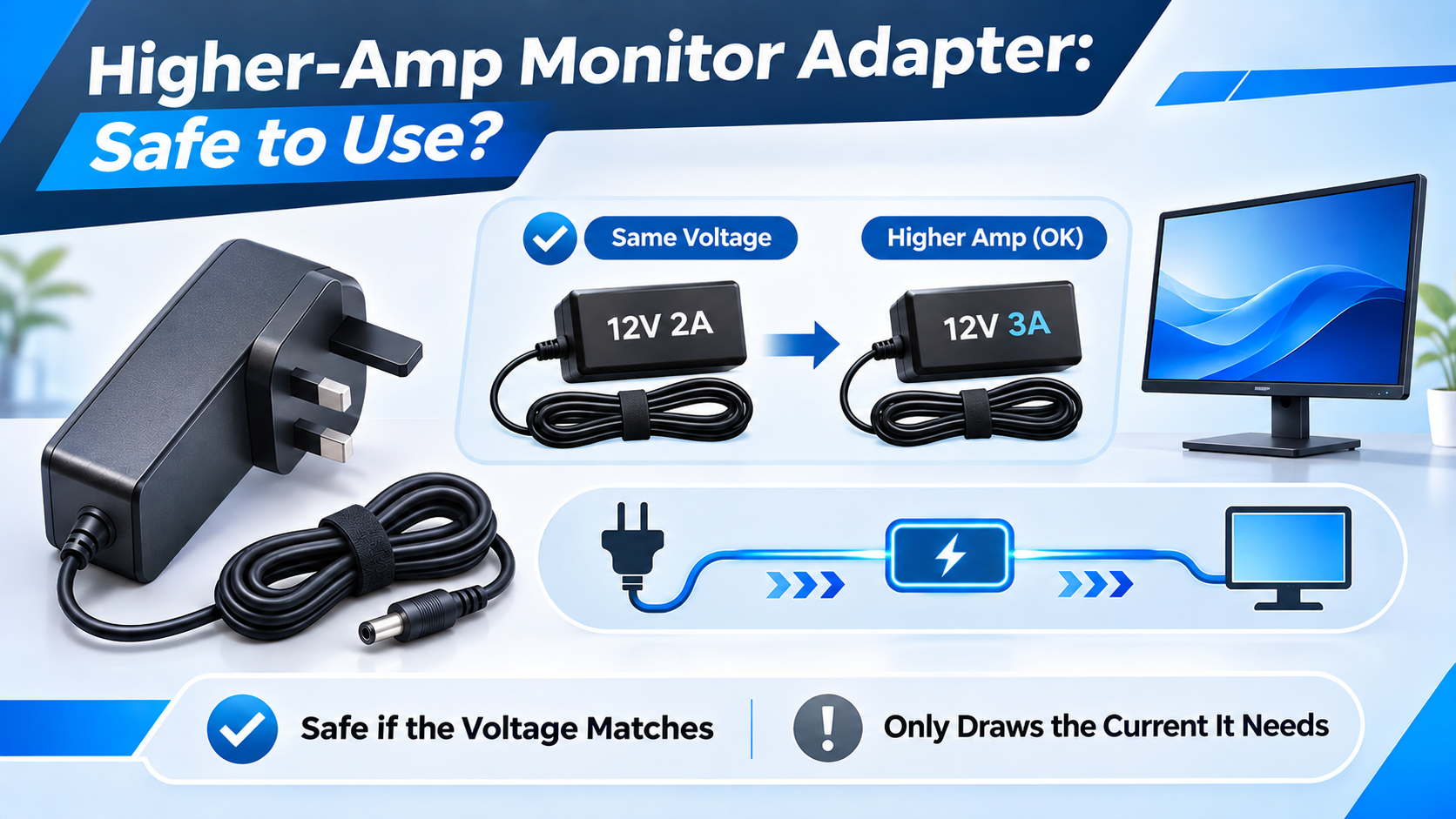
Can You Safely Use a Higher-Amp Monitor Power Adapter?

Yes, a higher-amp monitor power adapter can usually be used with a 12V screen if its output voltage, connector, polarity and supply type match the monitor’s requirements. The adapter’s current rating must be equal to or higher than the monitor’s stated requirement.

For example, if a monitor requires 12V DC and 2A, a compatible 12V DC, 3A adapter may be suitable. The 3A figure describes the maximum current the adapter can provide under specified conditions. It does not force 3A into the monitor.

However, a higher current rating does not make every 12V adapter interchangeable. Check the complete specification and the exact monitor model before connecting a replacement.

Read More »
19V power adapter does a monitor need
19V Monitor Power Adapter: Best Replacement Guide

Finding a completely compatible 19V monitor power adapter might seem straightforward, but picking up a random power brick can easily end in disappointment or a fried display. When you look at the back panel of your display and see a rating like “19V,” you are only looking at one piece of the puzzle. Finding a completely compatible power supply means you also need to ensure the adapter provides enough current, features the exact physical connector size, and uses the correct electrical polarity.

Whether you are looking to replace a lost power brick, swap out a failed adapter, or set up a second-hand display, taking the time to verify these specifications first will save you from major technical headaches and potential safety hazards.

Read More »
monitor power adapter
Monitor Power Adapters: The Best Replacement Guide

If your monitor power adapter is missing, damaged, or no longer working, replacing it is not simply a matter of finding a plug that fits. Getting this wrong can cause screen flickering, erratic behavior, or permanent electrical damage. To find a safe replacement, you need to match the exact voltage, ensure the current rating is sufficient, use the right connector shape, verify polarity, and check the output type. Start by checking your monitor model and original power requirements before committing to a purchase.

Read More »
keyboard adapter voltage polarity
How to Match a Replacement Keyboard Adapter to Voltage and Polarity

Finding a replacement power supply is not simply about choosing a plug that fits. You must match the correct keyboard adapter voltage polarity, while also providing sufficient current and using the correct connector and output type. A visually identical adapter can still be electrically incompatible.

If your original adapter is missing or damaged, start with the keyboard model and its power requirements. Then compare the replacement specification carefully before connecting it.

Read More »
keyboard powers on then shuts down
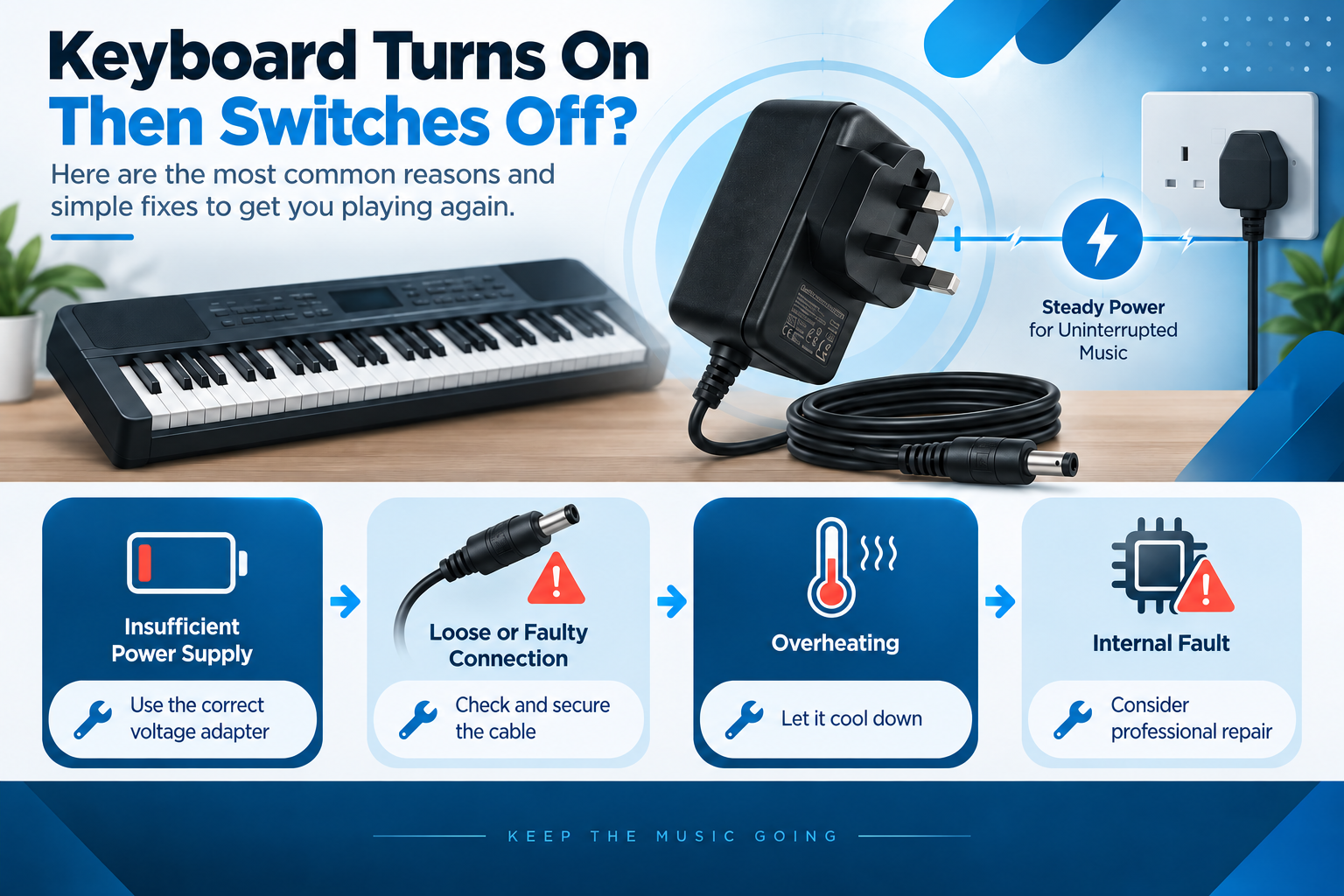
Keyboard Powers On Then Shuts Down? Causes & Proven Fixes

When a keyboard powers on then shuts down, it is a common issue that often points to a problem with its power adapter, cable, connector, battery, overheating protection or internal electronics. In many cases, the instrument receives power briefly but cannot maintain a stable supply. Before replacing the keyboard or adapter, check the power source and the adapter specifications.

Read More »
Electric Keyboard Power Adapter
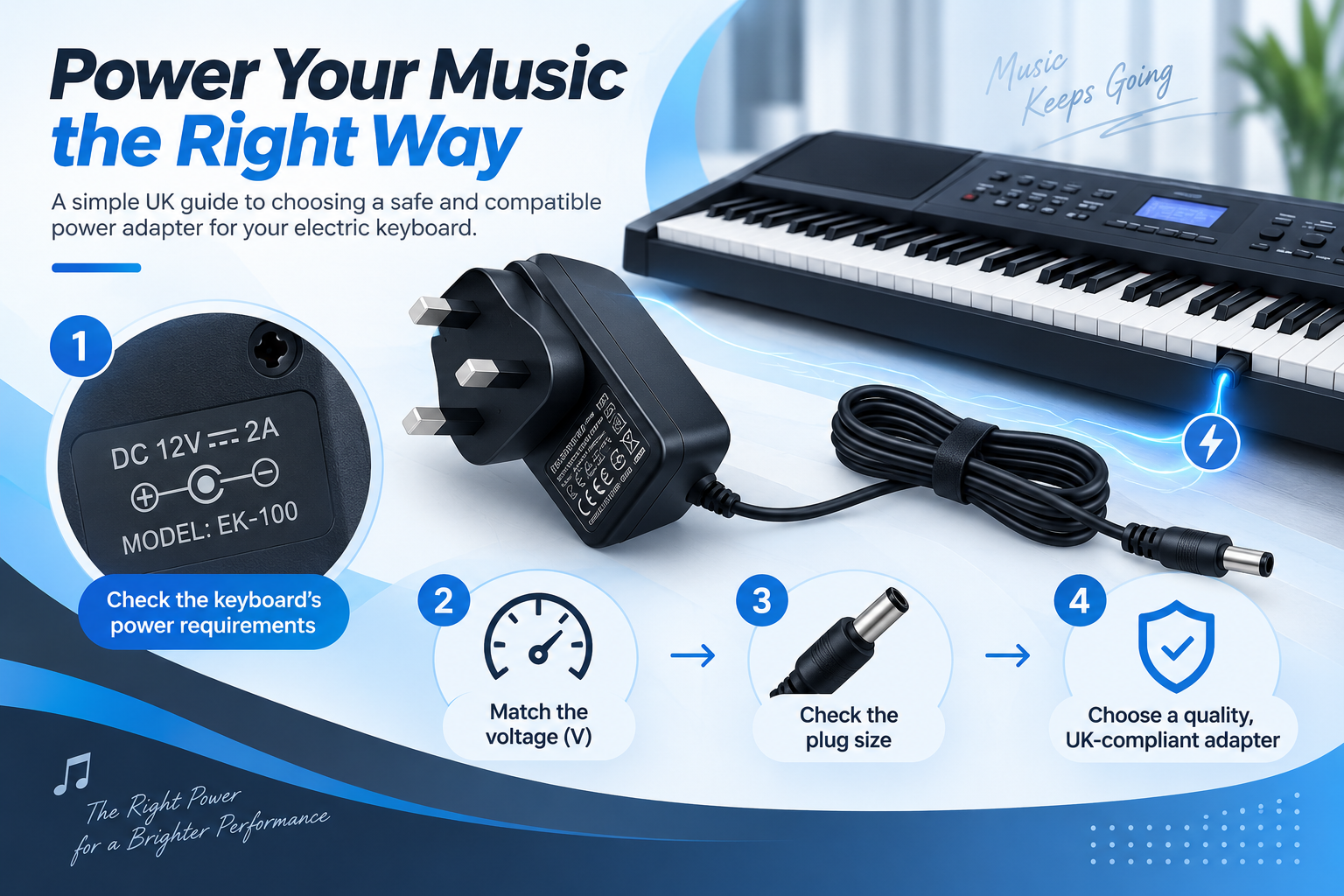
How to Find the Perfect Electric Keyboard Power Adapter

Finding the correct Electric Keyboard Power Adapter protects sensitive internal sound modules, digital synthesisers, and vintage workstations from costly electrical damage. Whether you play a professional digital piano, a stage keyboard, or a portable arranger model during live performances and home practice sessions, matching exact voltage, current capacity, polarity orientation, and physical barrel plug dimensions ensures your instrument receives clean, stable, and regulated power every time you switch it on. Taking the time to understand these technical specifications safeguards your electronic equipment against premature hardware failure, short circuits, and erratic power behaviour.

Read More »
digital piano power adapter
Digital Piano Power Adapter: Perfect UK Replacement Guide

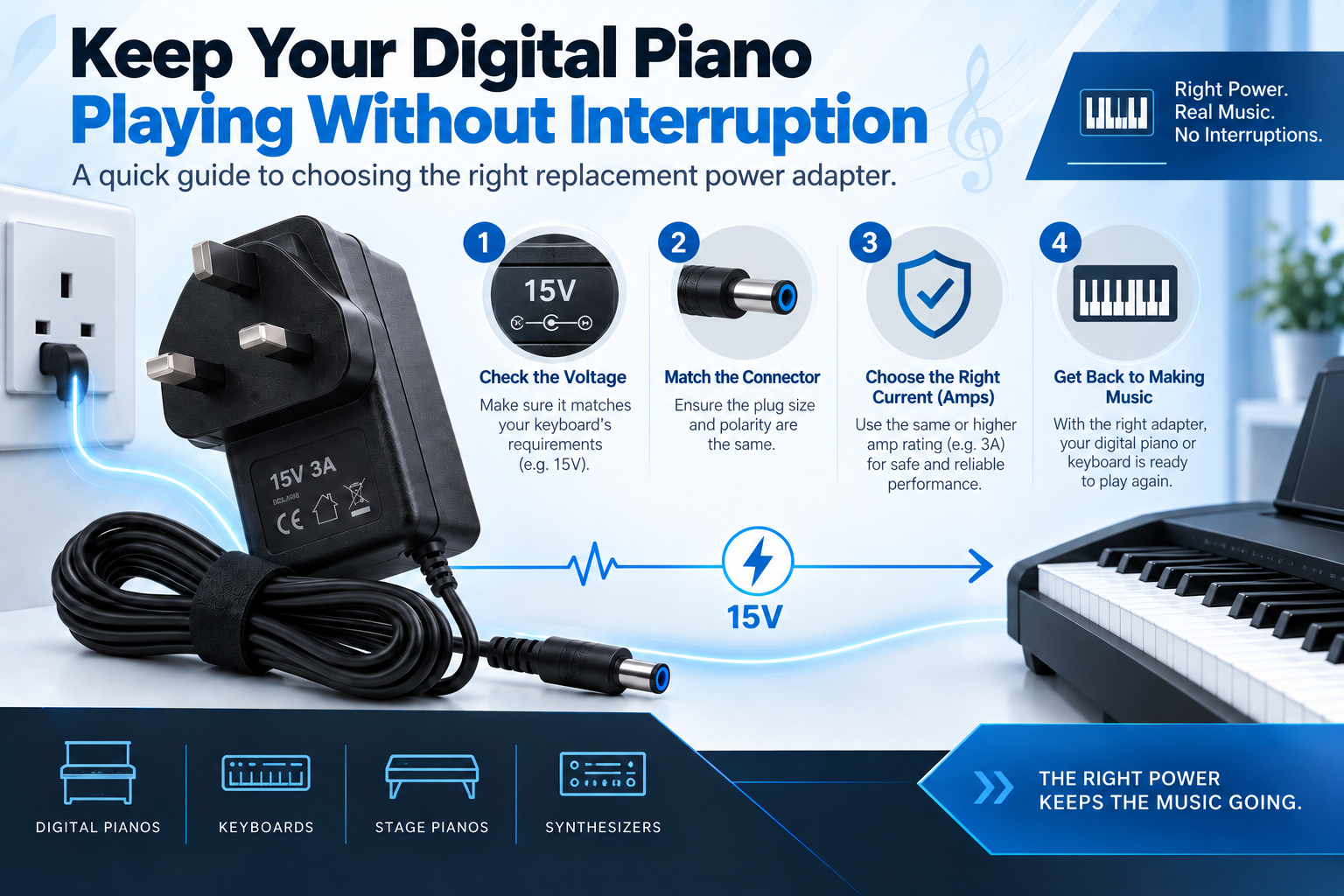
Finding the correct replacement digital piano power adapter protects your instrument’s internal sound modules and prevents electrical damage. Whether you play a Yamaha, Casio, or Roland keyboard, understanding voltage, amperage, and polarity ensures you select a safe, reliable power supply that keeps your music playing seamlessly. By avoiding the hidden dangers of cheap universal chargers, you can confidently invest in a proper UK certified solution.

Read More »
Digital piano & keyboard power adapter
Digital Piano & Keyboard Power Adapter: Best Buying Guide

Your digital piano keyboard power adapter is the lifeline of your instrument, and losing or damaging it can abruptly halt your daily practice sessions or live performances. Finding a dependable replacement requires more than just plugging in any cable that fits; it demands careful attention to electrical specifications like voltage, current capacity, and plug polarity. This guide explains how UK musicians and hobbyists can safely select the ideal replacement unit to keep their instruments running smoothly whilst protecting sensitive internal audio components from damage, supported by guidelines from the Electrical Safety First UK Organisation.

Read More »
Guitar Pedal Power Adapter
Guitar Pedal Power Adapter: Find the Perfect Replacement

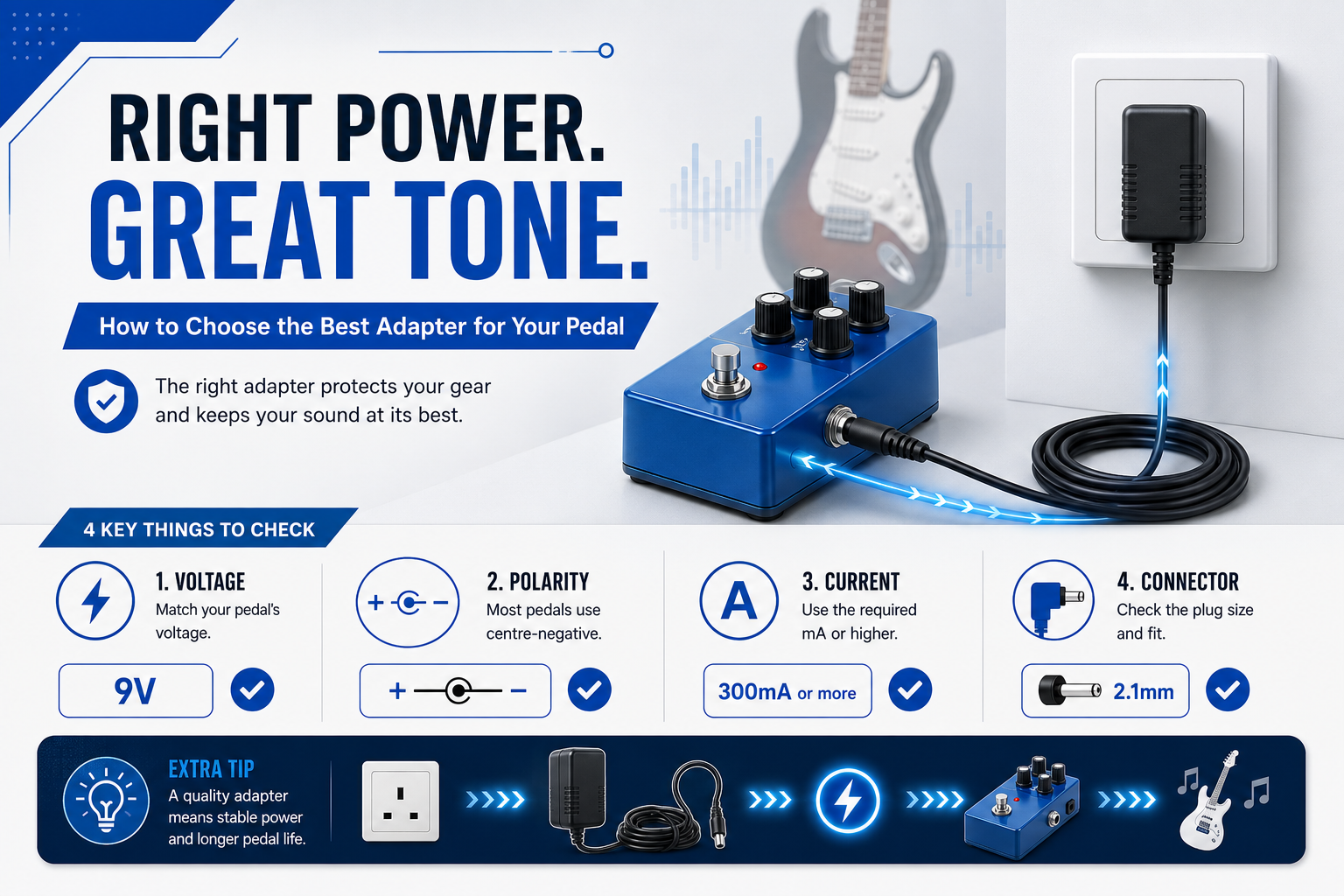
Losing, damaging, or misplacing a guitar pedal power adapter is a rite of passage for almost every guitarist, but grabbing a random household mains adapter and hoping for the best is a fast track to a fried circuit board and a silent rehearsal. Because guitar effects pedals possess unique electrical specifications and sensitivity profiles compared to standard household electronics, you can never judge compatibility by barrel plug size alone.

Understanding how your stompbox draws power protects your vintage investments, prevents frustrating mid-gig audio dropouts, and eliminates ground hum. This comprehensive step-by-step guide will teach you how to decode your pedal’s power requirements and source a safe, reliable, and noise-free UK replacement.

Read More »
wrong 9v adapter on a guitar pedal
Wrong 9V Adapter on a Guitar Pedal? Warning Signs & Safety Facts

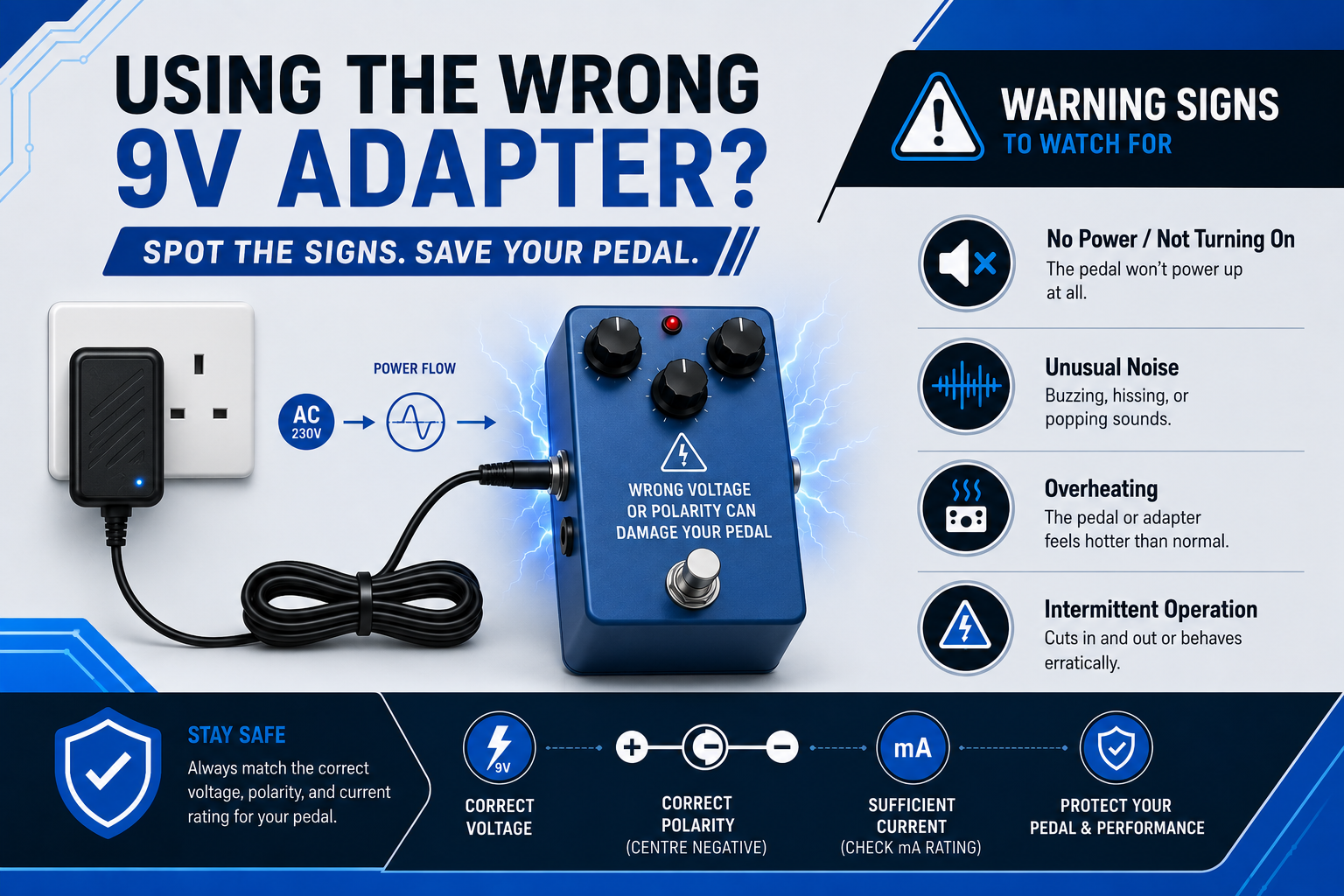
Every guitarist has experienced the panic of setting up for a gig or practice session, only to realise their dedicated power supply is missing. In a rush, it is tempting to grab the nearest household plug from a broadband router or electronic keyboard and hope for the best. However, using the wrong 9v adapter on a guitar pedal is one of the fastest ways to permanently destroy your favourite stompbox.

While some power mismatches might only cause a temporary loss of sound or an unbearable background hum, others will instantly fry sensitive internal processors and leave you with a costly repair bill. In this guide, we will break down exactly what happens when you mismatch voltage, polarity, or current, and how to safely power your rig without risking your hardware.

Read More »
9V 2A adapter for guitar effect pedals
Is It Safe to Use a 9V 2A Adapter for Guitar Effect Pedals?

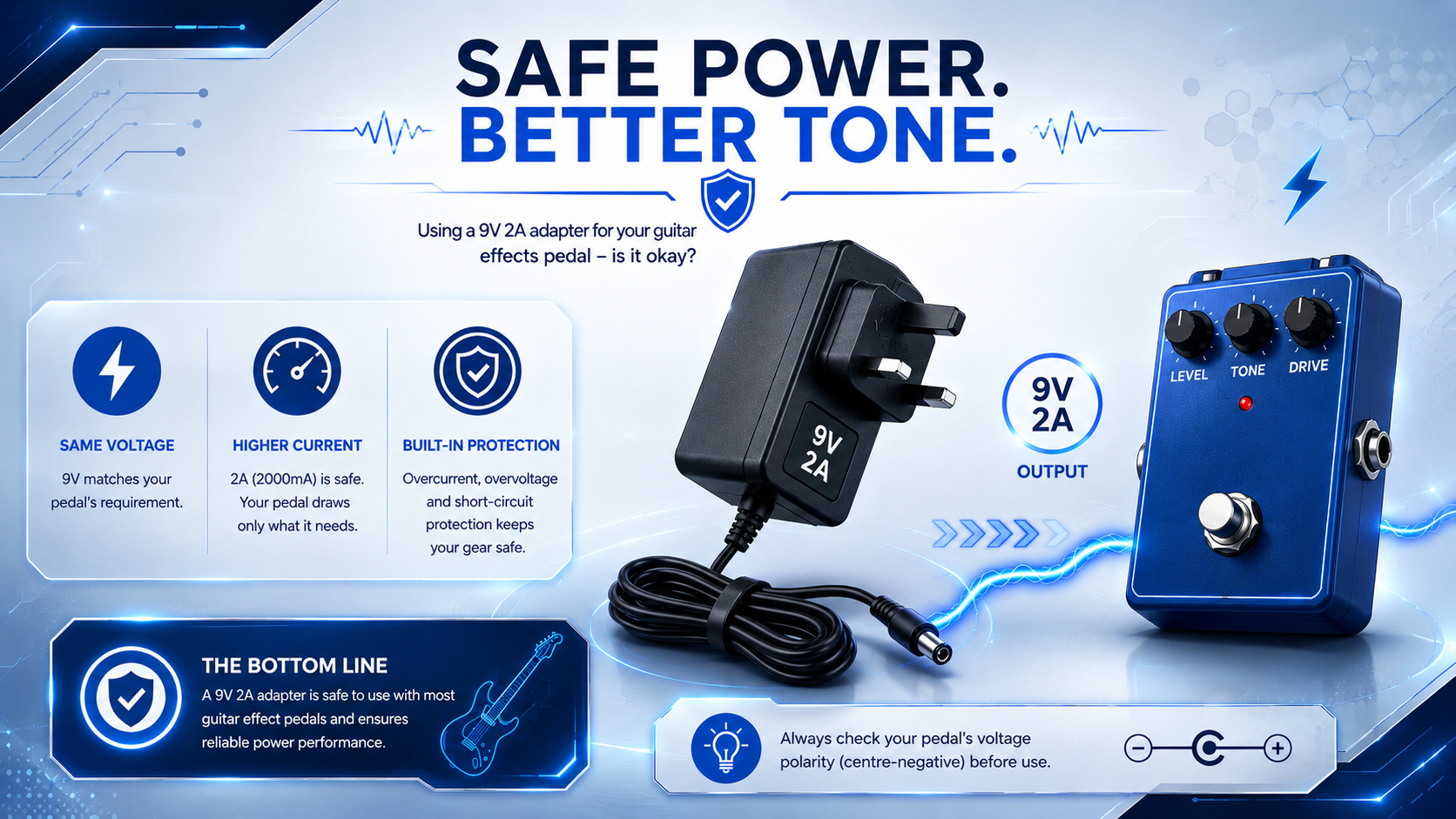
Using a 9V 2A adapter for guitar effect pedal is often perfectly safe if the pedal requires 9V DC, but the number “2A” is not enough to determine compatibility. The pedal and adapter must agree on voltage, polarity, connector type and current requirements. Understanding how these ratings work can prevent a simple replacement purchase from turning into a power problem.

A 2A adapter does not automatically push 2A into a pedal. The pedal normally draws the current its circuit requires.

Read More »
9v centre-negative guitar pedal
The Best 9V Centre-Negative Guitar Pedal Power Adapter: Why It’s Essential

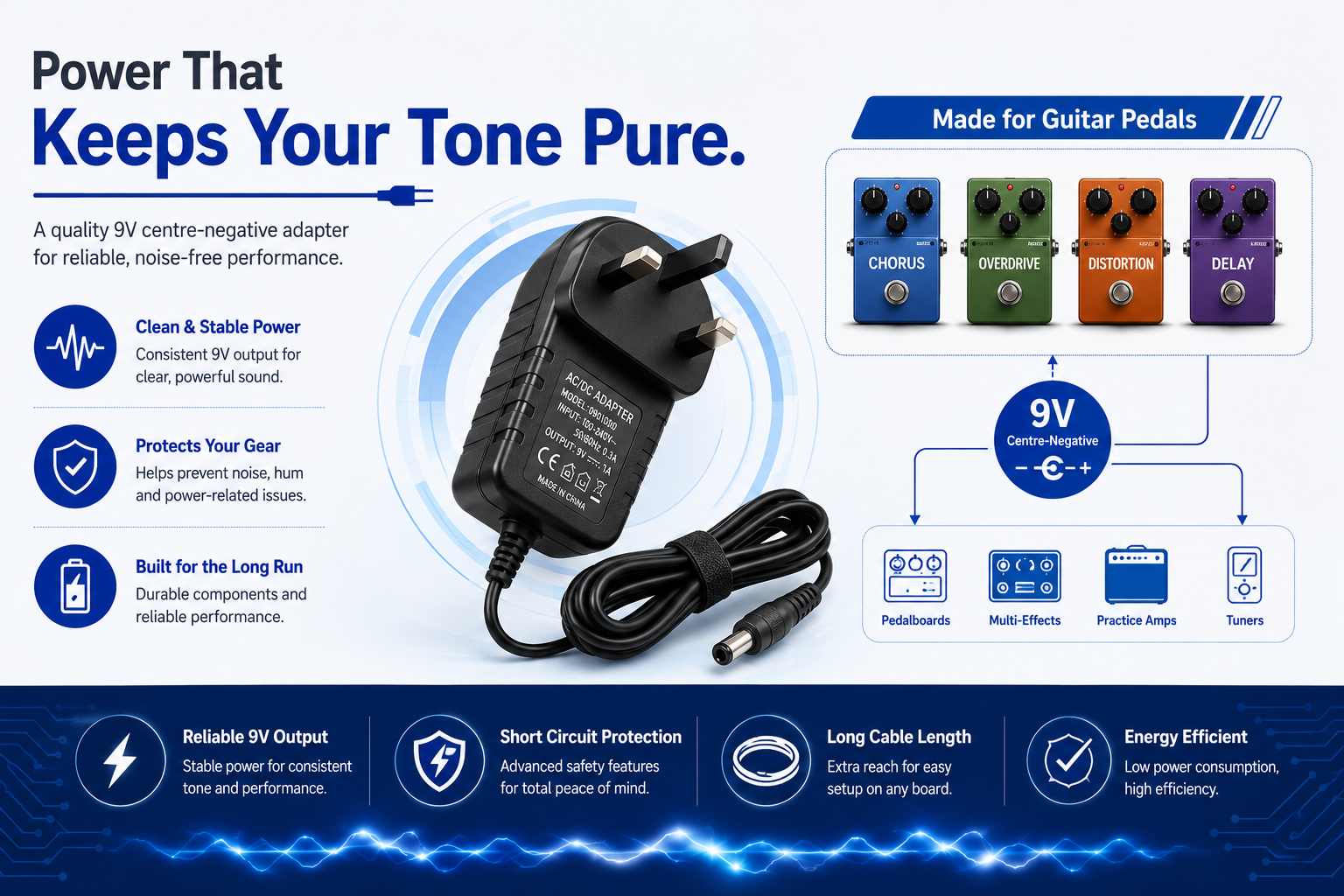
If you have searched for a 9V centre-negative guitar pedal power adapter, you have probably noticed how common this specification is. Many guitar effects pedals use 9V DC power with centre-negative polarity, making it one of the most familiar power configurations for musicians.

But why is centre-negative so common?

Centre-negative became widely adopted across guitar effects pedals and pedalboard power systems. As more manufacturers used the same configuration, compatible power supplies became easier to produce and use.

However, 9V centre-negative is not a universal rule. Some pedals require a different polarity, connector or current rating. Checking the complete power specification before connecting an adapter is essential.

Read More »
9V guitar effects pedal power adapter
Best 9V Guitar Effects Pedal Power Adapters: Complete Buying Guide

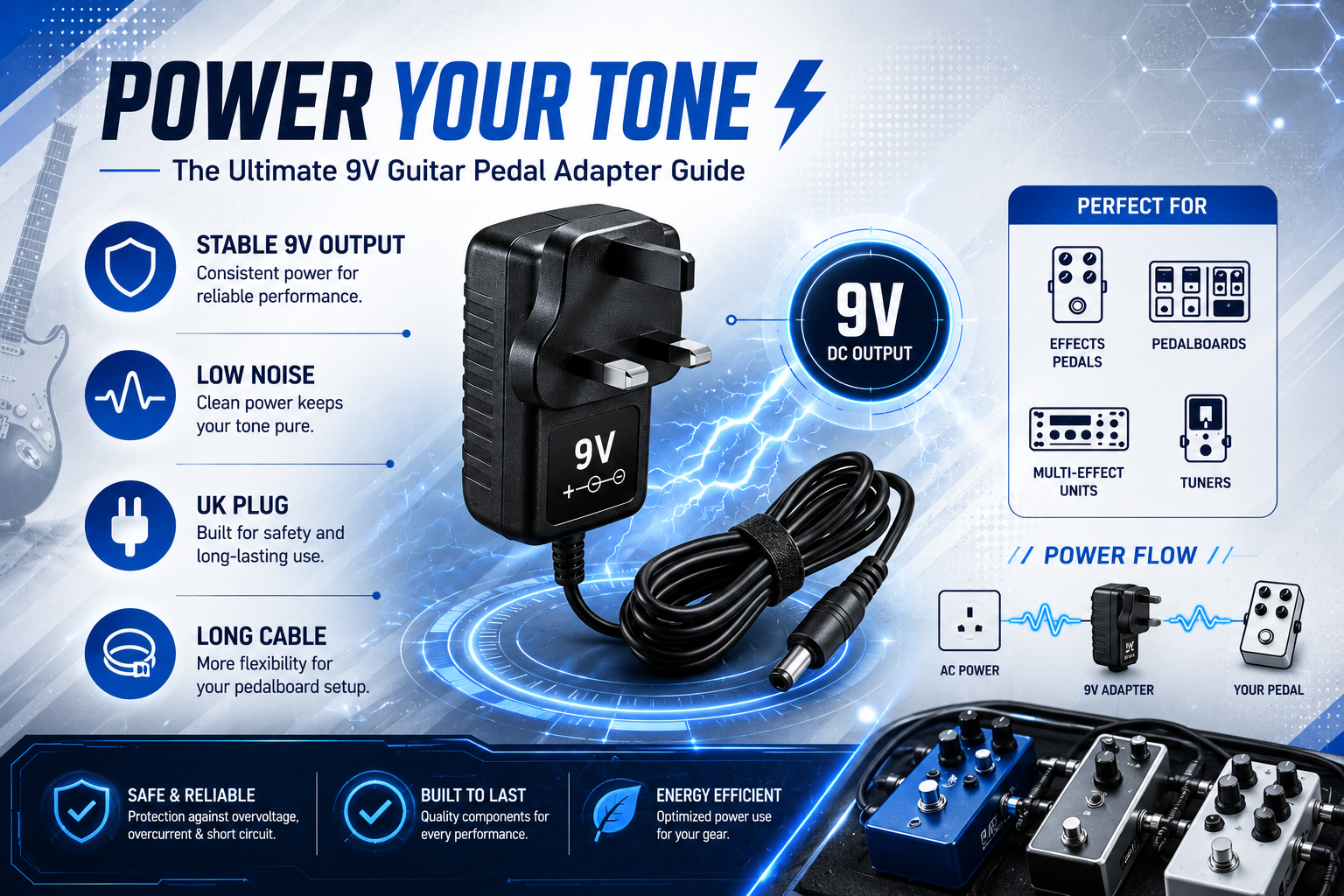
Choosing a 9V guitar effects pedal power adapter sounds simple until you discover that several pedals can use 9V while still needing different connector sizes, polarity arrangements, or current requirements. The voltage alone does not tell you whether an adapter is suitable.

If you are replacing a lost or damaged pedal power supply, start with the pedal model and its power requirements. Then check the voltage, current, connector size, polarity and UK mains plug.

Read More »
12V power adapter for an old router
Replacement 12V Power Adapter for an Old Router: Finding the Perfect Match

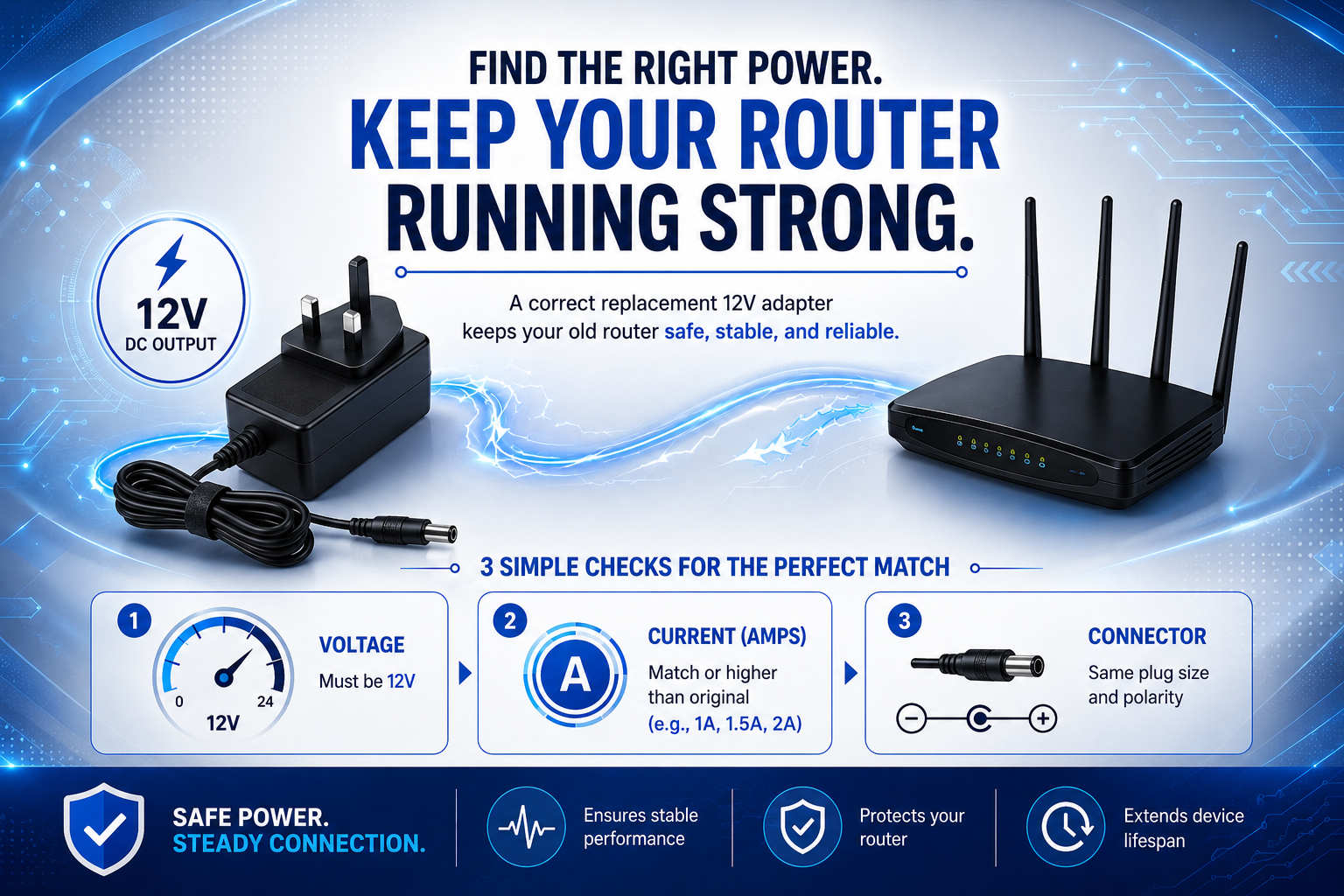
Finding a replacement 12V power adapter for an old router can be more difficult than it first appears. The router may still work perfectly, but its original adapter could be damaged, missing or no longer available.

Searching for “12V router adapter” can bring up dozens of similar-looking products. However, 12V is only one part of the specification. You also need to confirm the current rating, DC connector, polarity and router model.

Read More »
12V Router Suddenly Keep Losing Power?
Why Does a 12V Router Suddenly Keep Losing Power?

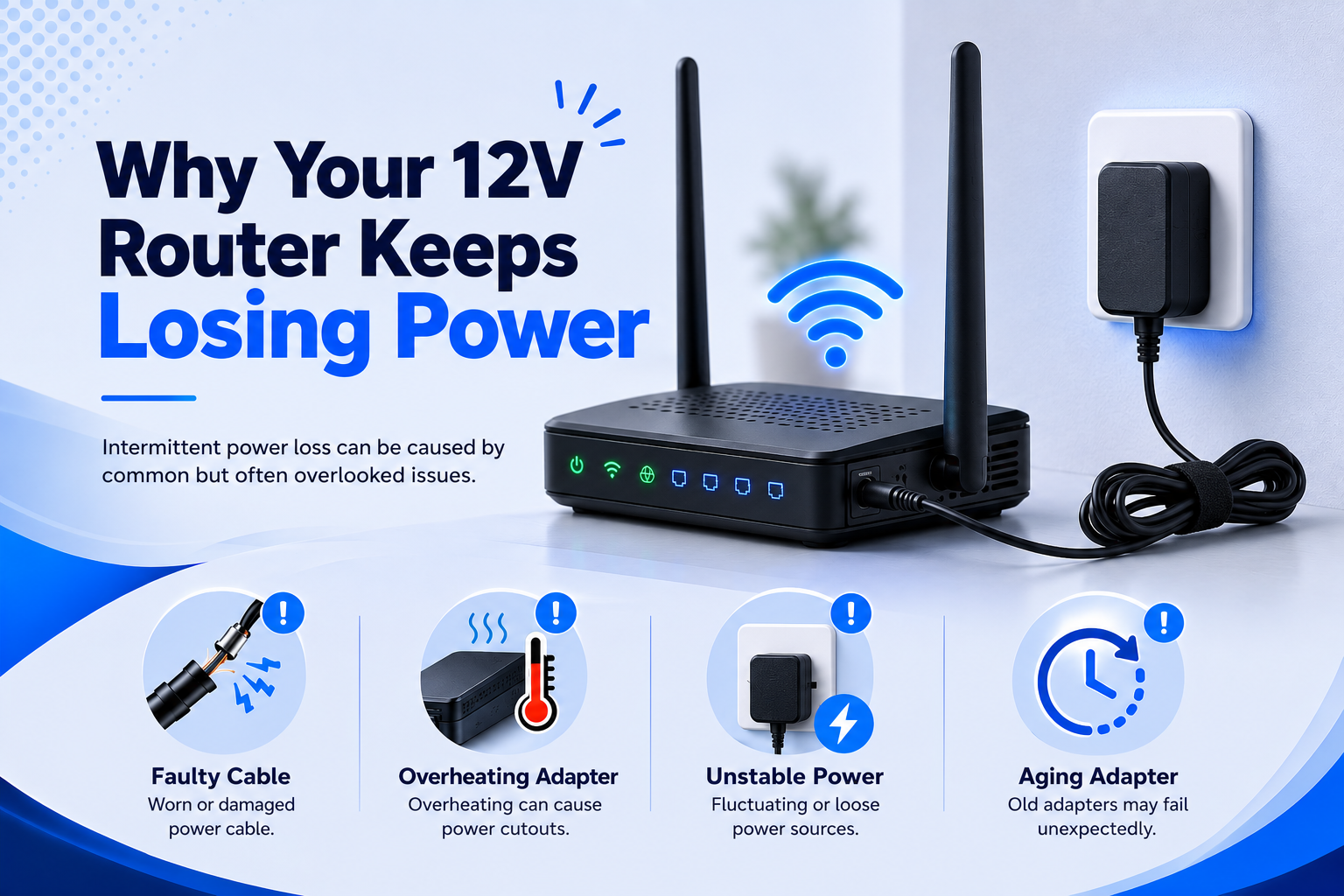
Why does a 12V router suddenly keep losing power? It can be frustrating, especially when it happens several times a day. You may notice the lights abruptly go off, the router restarts by itself or your internet connection disappears for a few minutes.

The problem is not always your internet provider. If the router is actually losing electrical power, the cause could be the power adapter, cable, connector, mains socket or the router itself.

A Wi-Fi router needs a suitable power supply to operate reliably. If the adapter is damaged, underpowered or making an unreliable connection, the router may repeatedly shut down and restart.

The good news is that you can check several things before replacing the router.

Read More »
Higher-Amp 12V Adapter With a Router?
Is It Safe to Use a Higher-Amp 12V Adapter With a Router?

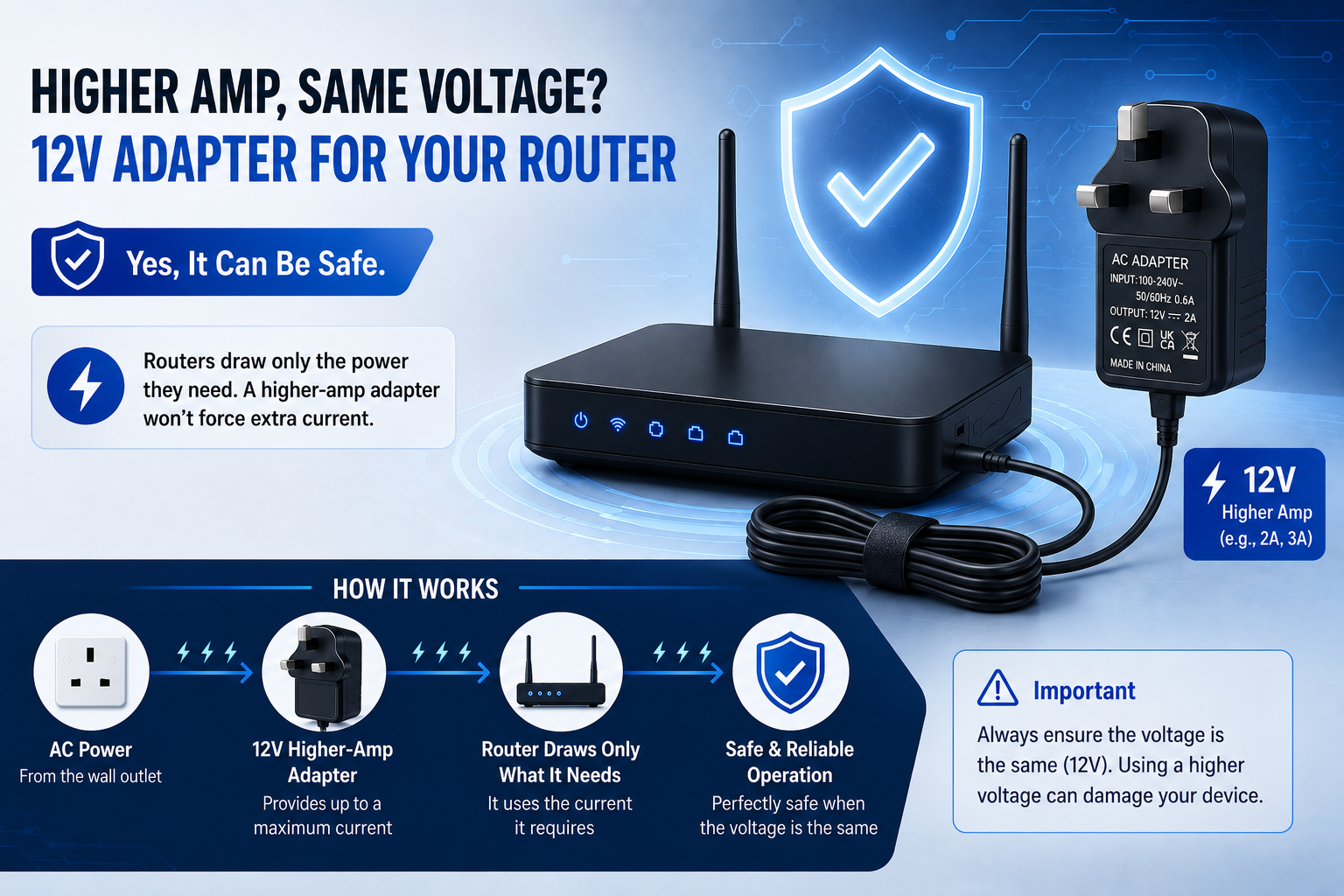
Before you plug in a higher-amp 12V adapter with a router, it helps to understand how power ratings work. You may have found a replacement adapter marked 12V 2A, while your router’s original adapter says 12V 1A. The obvious question is whether those extra amps could damage the router.

In most cases, a higher-amp 12V adapter can be suitable. The important part is that the voltage remains correct and the replacement also matches the router’s connector, polarity and other requirements.

A higher amp rating does not mean the adapter forces all of those amps into the router. It means the adapter has more current capacity available when the router needs it.

So, if your router requires 12V 1A, a compatible 12V 2A or 3A adapter can generally work. However, there are several checks you should make before connecting it.

Read More »
12V power adapter does a Wi-Fi router
What 12V Power Adapter Does a Wi-Fi Router Need for Perfect Performance?

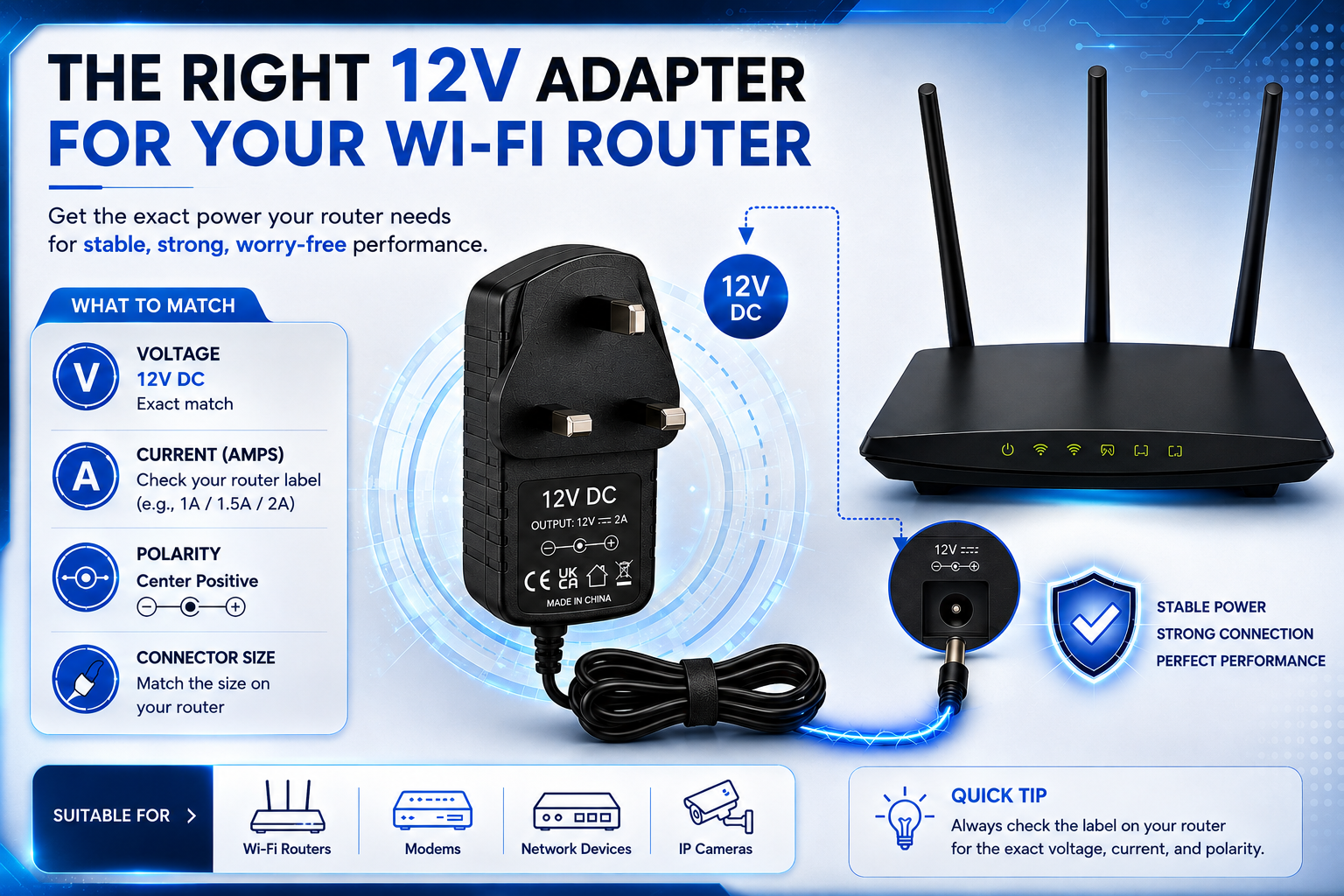
When figuring out what 12V power adapter does a Wi-Fi router need, you might think replacing it is easy. Just find a charger that says 12V and plug it in.

It is not that simple.

The 12V figure is important, but it is only one part of what you need to check. Your Wi-Fi router may also need a specific current rating, connector size and polarity. The exact router model matters too.

This is worth checking because a Wi-Fi router is usually switched on all day and night. Its power adapter is working for long periods too, so you want one that is properly matched to your router.

Read More »
12V router power adapter
12V Router Power Adapters: How to Choose the Perfect Replacement

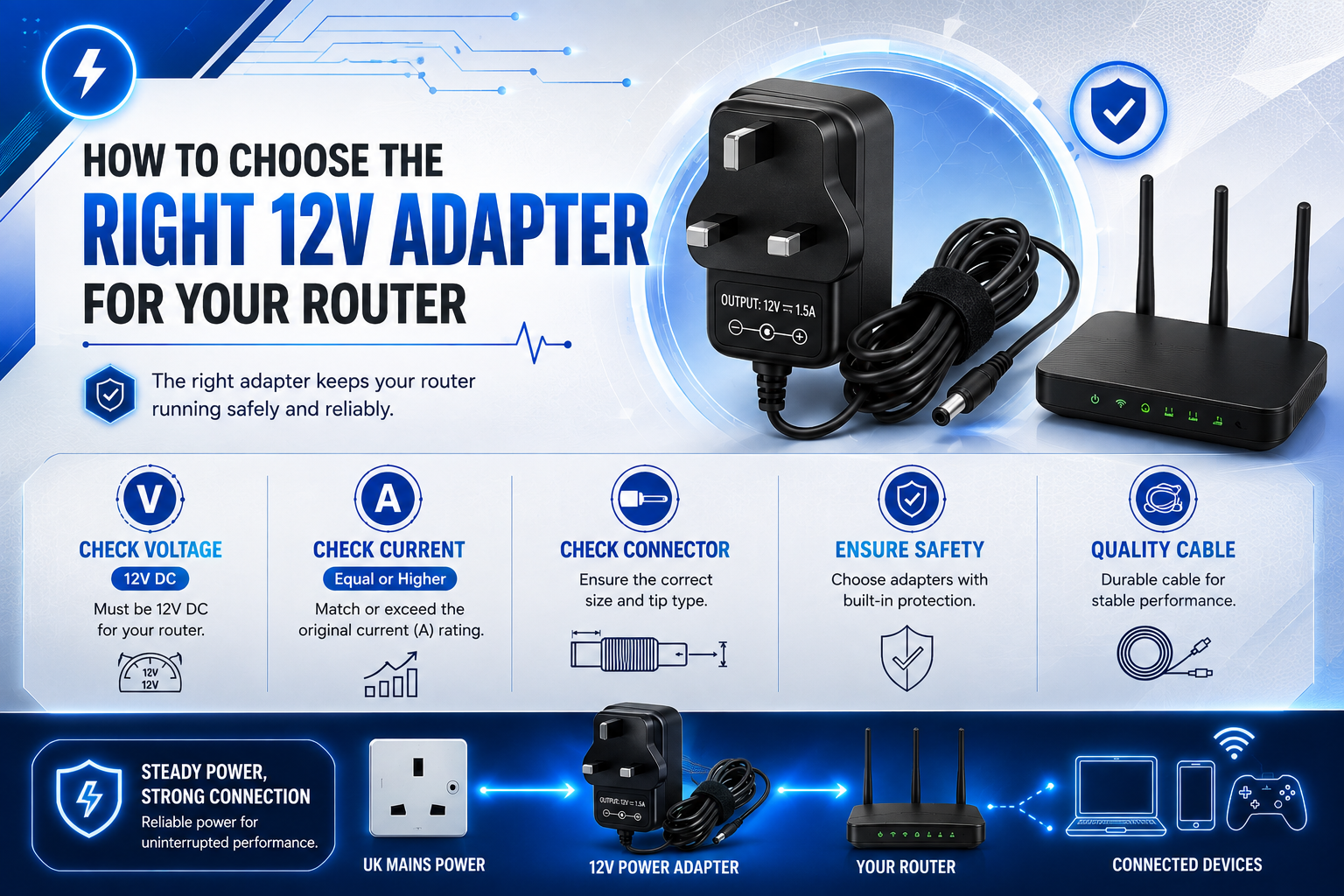
When you need a replacement 12V router power adapter, the voltage label is only the starting point. Different routers can require different current ratings, connector sizes and polarity configurations.

The safest approach is to start with the router model or original adapter. Then confirm the required voltage, connector and polarity. Wattage can help you compare adapters, but it should not replace those checks.

If your original adapter is missing or damaged, do not guess based on the plug alone. A replacement should be selected for the router’s electrical requirements.

Read More »