

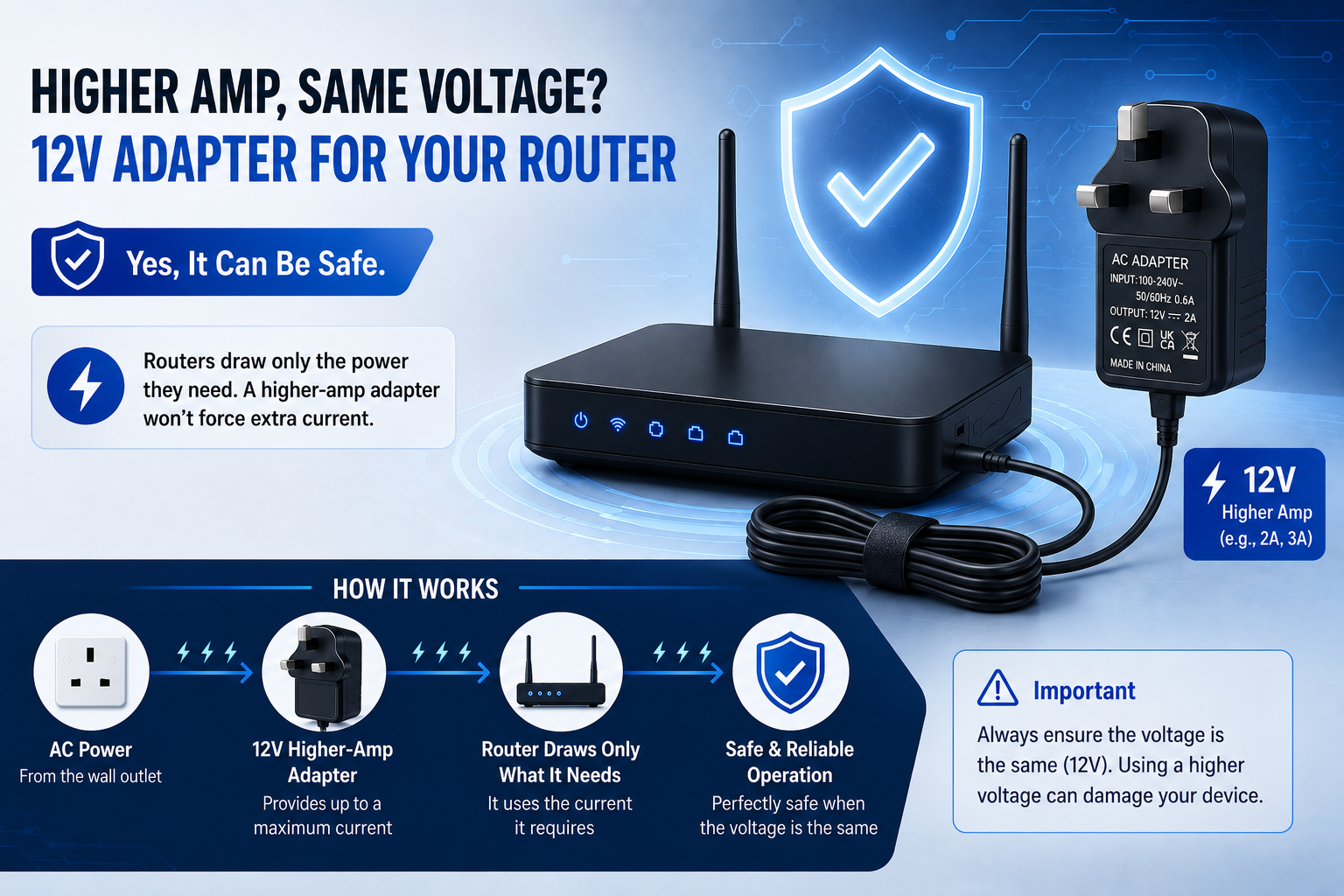
Before you plug in a higher-amp 12V adapter with a router, it helps to understand how power ratings work. You may have found a replacement adapter marked 12V 2A, while your router’s original adapter says 12V 1A. The obvious question is whether those extra amps could damage the router.
In most cases, a higher-amp 12V adapter can be suitable. The important part is that the voltage remains correct and the replacement also matches the router’s connector, polarity and other requirements.
A higher amp rating does not mean the adapter forces all of those amps into the router. It means the adapter has more current capacity available when the router needs it.
So, if your router requires 12V 1A, a compatible 12V 2A or 3A adapter can generally work. However, there are several checks you should make before connecting it.
What Does the Amp Rating Mean?
The amp rating tells you how much current an adapter can supply under its rated conditions.
For example:
- 12V 1A – up to 1 amp of current capacity
- 12V 2A – up to 2 amps
- 12V 3A – up to 3 amps
If your router needs 1A, a 2A adapter has enough capacity to supply that requirement. The router draws the current it needs rather than automatically receiving the full 2A.
This is why a higher current rating is different from a higher voltage rating. The voltage needs to match the router, while the adapter’s current capacity can generally be equal to or greater than the router’s stated requirement.
Can You Use a 12V 2A Adapter Instead of 12V 1A?
In many cases, yes.
For example, if your router requires 12V 1A and the replacement adapter provides 12V 2A, the replacement has greater current capacity while keeping the voltage at 12V.
That can generally be suitable, provided the connector, polarity and router compatibility are also correct.
However, you should not assume that every 12V 2A adapter will work. Two adapters can have the same voltage and current rating but use different connectors or polarity configurations.
What About a 12V 3A Adapter?
A 12V 3A adapter follows the same principle.
If your router requires 12V 1A, a suitable 12V 3A adapter has more than enough current capacity for that requirement.
For example, a 15V 3A adapter should not be treated as an alternative to a 12V 1A adapter simply because it has enough current capacity. The voltage is no longer correct.
This is why you should not choose a replacement based on the largest amp number you can find.
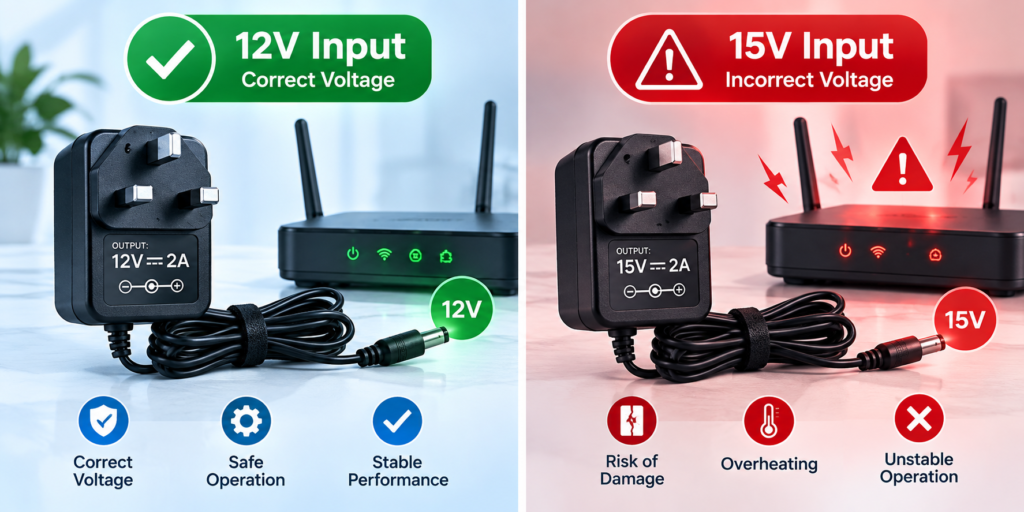
Why Does the Voltage Still Need to Be 12V?
The voltage is one of the most important specifications on a router power adapter.
If your router is designed for a 12V DC input, the replacement should provide the required 12V DC output.
A higher amp rating does not make an incorrect voltage safe. Changing from 12V 1A to 15V 3A is not simply an increase in current capacity. It changes the voltage supplied to the device.
What Happens If the Adapter Has Too Few Amps?
Using an adapter with a lower current rating can be more concerning.
Imagine your router requires 12V 2A, but the replacement adapter provides 12V 1A. The adapter has less current capacity than the router’s stated requirement.
Depending on the router and the circumstances, this can result in unstable operation. You could experience unexpected restarts, intermittent power loss or other problems.
For this reason, it is generally better to choose an adapter with sufficient current capacity rather than one that falls below the router’s requirement.
Does the Connector Still Matter?
Yes. Even when the voltage and amp ratings look correct, the adapter still needs the correct DC connector.
Many routers use round barrel connectors, but these are available in different sizes. Two plugs can look almost identical while having different inner or outer diameters.
A connector that does not fit correctly can result in an unreliable connection. A loose plug can cause the router to lose power.
Do not force a connector into the router.
If you still have the original adapter, use its connector as a reference when checking a replacement listing.
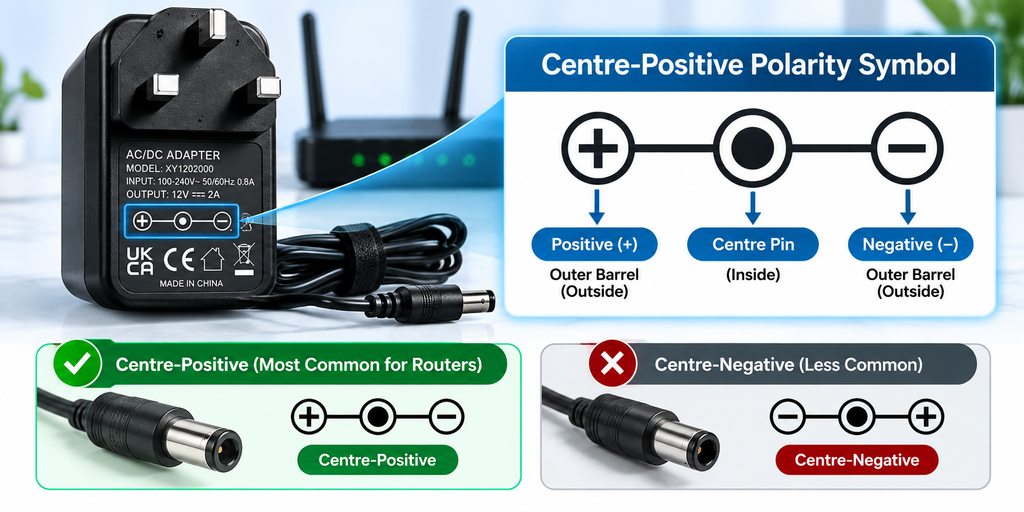
What About Polarity?
Polarity is another specification that needs to match.
The polarity symbol shows how the positive and negative connections are arranged at the DC connector.
Many consumer routers use centre-positive barrel connectors, but you should still confirm the requirement for your particular router rather than assuming.
A connector can physically fit while having the wrong polarity. That means a 12V 2A adapter is not automatically suitable simply because it has the correct voltage and a higher amp rating.
Before connecting a replacement, check the 12V output, current capacity, connector, polarity and router model together.
Why the Router Model Is Still Important
The exact router model can help you avoid choosing a generic adapter that happens to have similar electrical ratings.
Different routers can use different connectors, power requirements and adapter specifications. Instead of searching only for “12V 2A router adapter”, include the exact model number when looking for a replacement.
A model-specific listing gives you another way to check whether the adapter is actually intended for your device.
For example, a 12V DrayTek Vigor 2700G/2710 router adapter is aimed at specific router models. A 12V Virgin Media SuperHub router power adapter provides another example of why matching the model can make replacement shopping easier.
Is Using a Higher-Amp 12V Adapter With a Router Better?
Not necessarily.
A higher amp rating does not make the router faster, improve its Wi-Fi range or automatically make the adapter better.
If your router requires 12V 1A, there is usually no need to choose an unnecessarily large adapter just because it has a 5A rating.
Instead, look for a replacement with the correct voltage, sufficient current capacity and the correct physical and electrical connection.
What Should You Check Before Buying?
Use this quick comparison before ordering:
| Specification | What to Check |
| Voltage | Must match the router |
| Current | Equal to or greater than required |
| Connector | Correct type and size |
| Polarity | Must match |
| Router model | Confirm compatibility |
If you are also replacing an old adapter, official UKCA marking guidance can provide useful information about the UK product-marking framework.
If your old adapter is no longer usable, GOV.UK WEEE guidance provides information about electrical waste responsibilities.
Frequently Asked Questions
Can I use a 12V 2A adapter instead of a 12V 1A adapter?
Yes, a compatible 12V 2A adapter can generally be suitable for a router requiring 12V 1A, provided the connector, polarity and other requirements match.
Can I use a 12V 3A adapter with a 12V 1A router?
A compatible 12V 3A adapter can generally provide enough current capacity for a 12V 1A router. The voltage, connector and polarity must still match.
Will a higher amp adapter damage my router?
A higher current rating does not normally damage the router when the voltage and other compatibility requirements are correct.
Can I use a lower-amp adapter?
A lower-current adapter may not have enough capacity to supply the router reliably.
Does a higher amp adapter make Wi-Fi faster?
No. A higher amp rating does not increase Wi-Fi speed or range.
Conclusion
So, can you use a higher-amp 12V adapter with a router?
Generally, yes. If your router requires 12V 1A, a compatible 12V 2A or 3A adapter can generally be suitable because the higher amp rating provides additional current capacity.
The key is not to focus on amps alone. Check the voltage, current capacity, connector, polarity and exact router model before buying a replacement.
If you still have the original adapter, use its label and connector as a reference. If you are unsure, check the router manufacturer’s specifications rather than guessing.
A higher-current adapter can be perfectly suitable, but only when the complete power specification matches the router.