

How to Find the Perfect Replacement Speaker Power Adapter

Lost the power adapter for your speaker, or has the original stopped working? Finding a replacement speaker power adapter does not have to leave you staring at a page full of almost identical black power bricks. Getting the right match is much simpler than it looks.
The key is to look beyond the plug and check the complete electrical specification. You need to confirm the speaker model, voltage, current, connector and polarity. Once these details match, choosing a compatible replacement becomes much easier.
Start With the Speaker Model Number
The easiest way to find the correct adapter is to check your speaker’s exact model number. Look for a label on the rear, underside or side, or check the original adapter’s label.
Searching by model is more reliable than using a broad term like ‘speaker charger’, as similar-looking speakers often require different power supplies. For example, Power Adapter Warehouse has a power adapter compatible with the Pyle PPHP1044B Bluetooth PA speaker.
Key point: Your speaker model is the best starting point because it reduces guesswork.
Match the Speaker’s Voltage Exactly
Voltage is a key specification when choosing a replacement. Check the speaker label for its required input voltage, such as 9V, 12V, 15V, 18V, 19V or 20V DC.
The replacement adapter should match the exact voltage specified. Never assume a higher voltage is better. For example, if your speaker requires 12V, using a 19V adapter because the connector fits is unsafe. Current capacity works differently, so voltage and amperage should not be treated the same.
Common mistake: Choosing an adapter because it says ‘power supply’ and has a similar-looking plug without checking the voltage.
Check the Amperage and Wattage
Once you know the voltage, check the speaker’s required current, such as 12V 2A or 19V 3A. The replacement adapter should provide at least that amount. A higher current rating is generally acceptable when the voltage and other specifications match. For example, a speaker requiring 12V 2A can use a compatible 12V 3A adapter. The adapter does not force 3A into the speaker; the speaker only draws the current it needs.
Wattage is calculated using Voltage × Amps = Watts, meaning a 12V 2A adapter has a 24W capacity. For example, the 12V adapter compatible with the QTX QR10PA 100W portable PA speaker shows why actual power requirements matter when selecting a replacement.
Key point: Match the voltage and make sure the adapter has sufficient current capacity.
Check the DC Connector Size
Getting the electrical specifications right is only half the job; the connector must also fit correctly. Many speakers use DC barrel connectors in different sizes, and two plugs can look almost identical despite having different outer or inner diameters.
A loose connector can cause intermittent power, while an oversized or undersized plug may not connect properly. Compare the replacement with your original adapter or check the listed dimensions against your speaker’s requirements. Never force a plug into the speaker.
Common mistake: Assuming every round DC connector is the same size.
Confirm the Polarity
Polarity is another specification that is easy to overlook. A DC barrel connector can usually be centre-positive or centre-negative, and the polarity symbol on the speaker or original adapter shows how the positive and negative connections are arranged.
A plug can physically fit the socket and still have the wrong polarity, so checking only the voltage and connector is not enough. Look for the polarity symbol on the original adapter or speaker label. If the information is unclear, use the exact speaker model to verify the correct replacement rather than guessing.
Key point: Correct polarity is essential. Physical compatibility does not guarantee electrical compatibility.
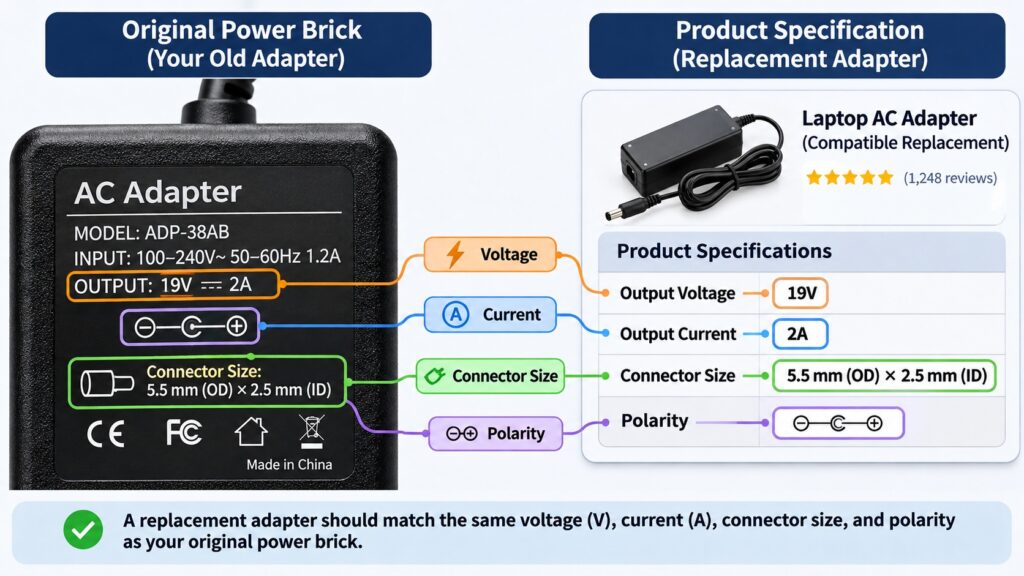
Compare the Original Adapter With the Replacement
If you still have the old adapter, compare it with the replacement listing.
Check:
- Input and output voltage
- Current rating
- Connector type and size
- Polarity
- Compatible speaker models
For example, if the original adapter says Output: 19V 2A, look for a replacement that matches those requirements rather than simply searching for a generic 19V charger. Power Adapter Warehouse also lists a 19V replacement adapter compatible with the Positive Grid Spark 40.
Key point: Comparing the complete specification is safer than comparing appearance.
Can You Use a Different Brand’s Power Adapter?
Sometimes, yes. The replacement does not need the same brand name as the speaker. What matters is electrical and physical compatibility. The voltage, current, connector and polarity must match the speaker’s requirements.
A compatible replacement helps when the original is expensive, unavailable or discontinued. For example, the 20V adapter compatible with JBL Control 2.4G active speakers is matched to a specific system rather than being a one-size-fits-all solution.
Key point: Brand matching is less important than complete electrical and physical compatibility.
What If the Original Speaker Adapter Is Missing?
You can still find the correct replacement even without the original unit. Start with the speaker’s model number and check its documented power requirements by looking for an input label on the speaker or using the exact model to identify its required voltage, current, connector and polarity.
Do not guess based on the speaker’s size or the appearance of another adapter. Different speakers can require completely different power specifications even when they are made by the same manufacturer.
Key point: When the original adapter is gone, use the speaker model and documented input specifications.
How Do You Know a Replacement Speaker Power Adapter Is Safe to Use?
Once compatibility is confirmed, consider the adapter’s quality and suitability. Avoid choosing one just because it is cheap or fits. Instead, buy a clearly specified product from a reputable supplier with clear output and compatibility details.
For UK consumers, the Health and Safety Executive’s electrical safety guidance covers electrical risks and safe practices, while Electrical Safety First’s plugs and fuses guidance offers consumer safety advice. You can also check the UKCA marking guidance for product conformity.
Key point: Check both compatibility and the quality of the replacement adapter.
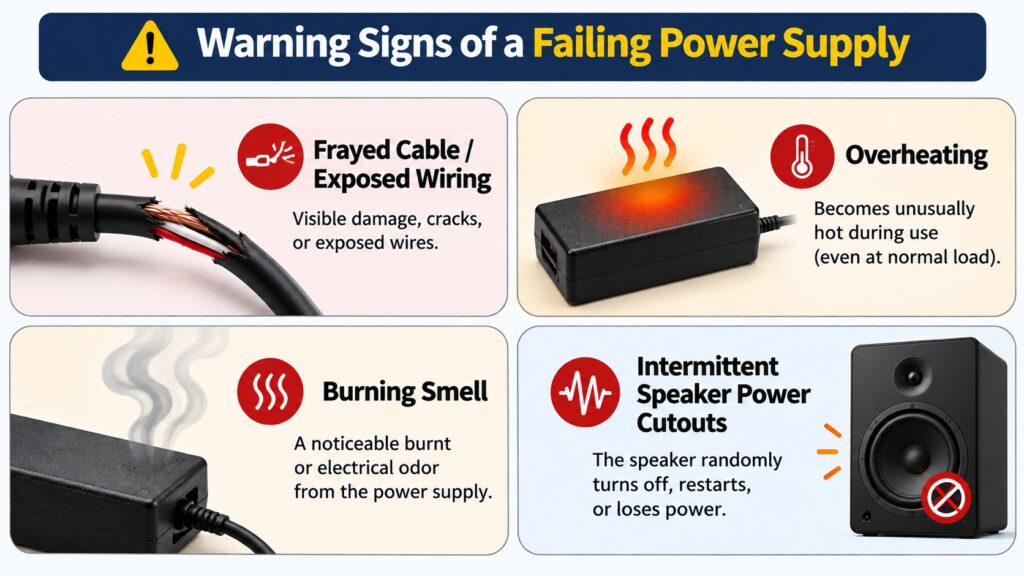
When Should You Replace the Speaker Adapter?
Replace the original adapter if it has a damaged cable, exposed wiring, a burning smell, unusual heat or other physical damage. Never keep using a damaged power supply just because the speaker still works.
If your speaker cuts out, restarts or turns off unexpectedly, check the adapter, though the speaker itself can also have faults. A model-specific Philips DS3100-05 docking speaker power adapter shows the value of matching the supply to the equipment rather than using a random alternative.
Quick Replacement Adapter Check
Before buying, compare these five details:
| Specification | What to Check |
| Voltage | Must match the speaker requirement |
| Current | Equal to or greater than the requirement |
| Connector | Correct type and size |
| Polarity | Must match |
| Speaker model | Should be compatible |
If all five agree, you have a much stronger basis for choosing a replacement.
Frequently Asked Questions
How do I know what power adapter my speaker needs?
Check the speaker’s model number and input label. Look for voltage, current, connector and polarity information. If the original adapter is available, compare its output specifications as well.
Can I use any power adapter that fits my speaker?
No. A plug that fits does not prove electrical compatibility. The voltage, current capacity and polarity must also be correct.
Can I use a higher-amp adapter for my speaker?
Generally, yes, when the voltage, connector and polarity are correct. A higher current rating provides additional capacity rather than forcing that amount of current into the speaker.
What happens if I use the wrong voltage?
An incorrect voltage can cause malfunction and may damage the speaker’s internal electronics. Do not use a higher-voltage adapter simply because the connector fits.
Is a replacement speaker adapter better than a universal adapter?
A model-specific or clearly compatible replacement can make compatibility easier to verify. Universal adapters can work in some situations, but only when their settings and connector configuration are correctly matched.
Final Thoughts
Finding a replacement speaker power adapter is about matching the complete specification, not just a plug that fits. Start with the speaker model, check the required voltage and current, then confirm the connector and polarity using the original adapter label if available.
Checking these details before ordering helps you avoid an incompatible adapter and ensures your speaker gets a suitable replacement power supply.