

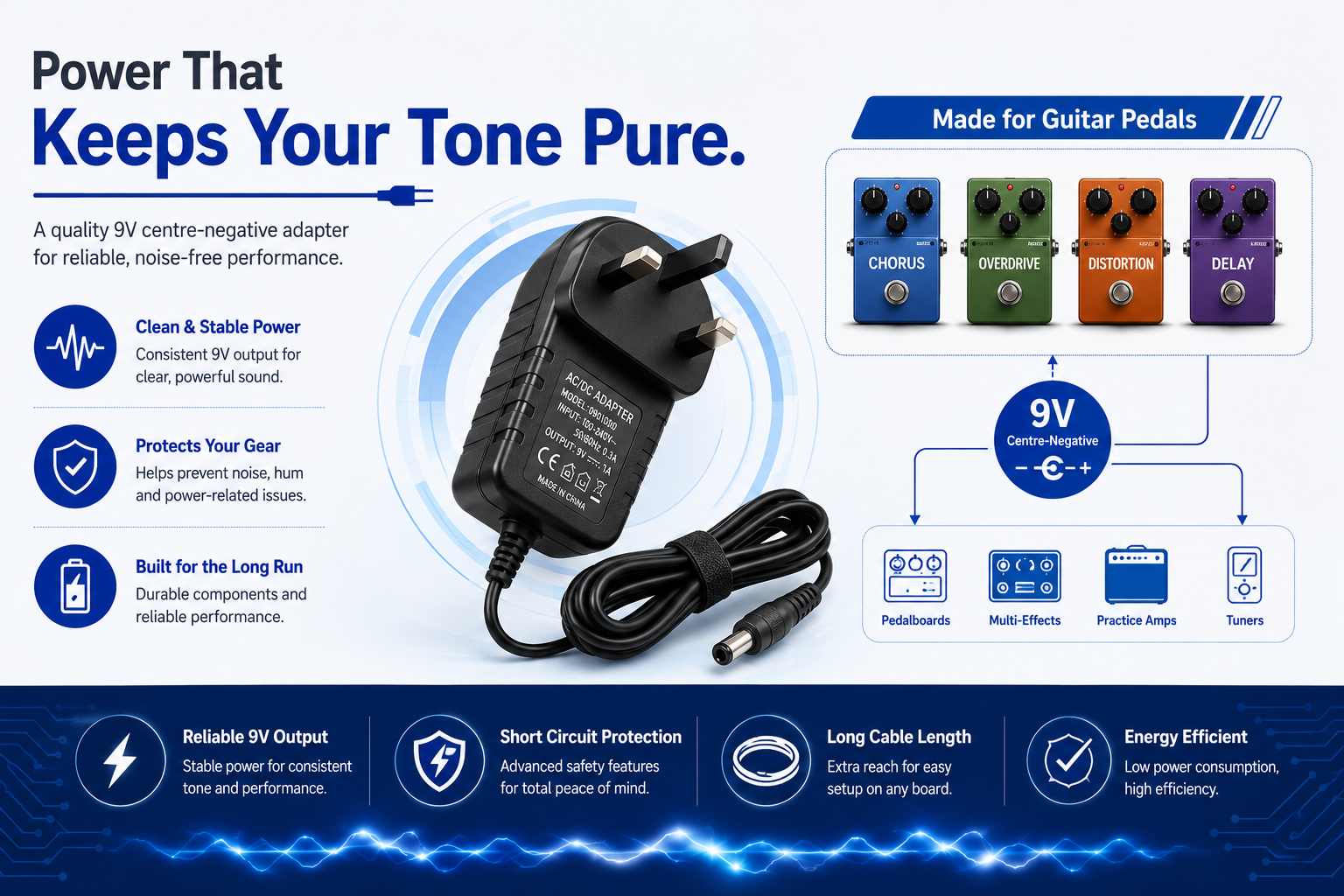
If you have searched for a 9V centre-negative guitar pedal power adapter, you have probably noticed how common this specification is. Many guitar effects pedals use 9V DC power with centre-negative polarity, making it one of the most familiar power configurations for musicians.
However, 9V centre-negative is not a universal rule. Some pedals require a different polarity, connector or current rating. Checking the complete power specification before connecting an adapter is essential.
Why Do Guitar Pedals Use 9V Power?
Many guitar effects pedals use 9V DC because it is a practical voltage for compact electronic circuits. It can power a wide range of analogue and digital effects while allowing manufacturers to keep pedals relatively small and portable.
The popularity of 9V also developed alongside established pedal designs. As musicians became familiar with powering effects using 9V supplies, manufacturers continued using the specification because it was easy to integrate into existing pedalboards.
That does not mean every pedal operates at 9V. Some effects use different voltages, so always check the number printed on the pedal, its manual or the original power adapter.
A 9V rating is only one part of the specification. It does not confirm the polarity, connector size or current requirement.
What Does Centre-Negative Mean?
Centre-negative describes the polarity of a DC barrel connector.
A typical barrel connector has a centre contact and an outer sleeve. With centre-negative polarity, the centre contact is negative (-), while the outer sleeve is positive (+). Centre-positive uses the opposite arrangement.
This matters because a plug can physically fit a pedal while still having the wrong electrical polarity. A matching connector does not automatically mean the adapter is compatible.
Most pedals show a polarity symbol near the DC input. Check this symbol before connecting a replacement supply.
For example, a model-specific power adapter for the Strymon Flint effects pedal can make it easier to identify the correct product for a particular pedal.
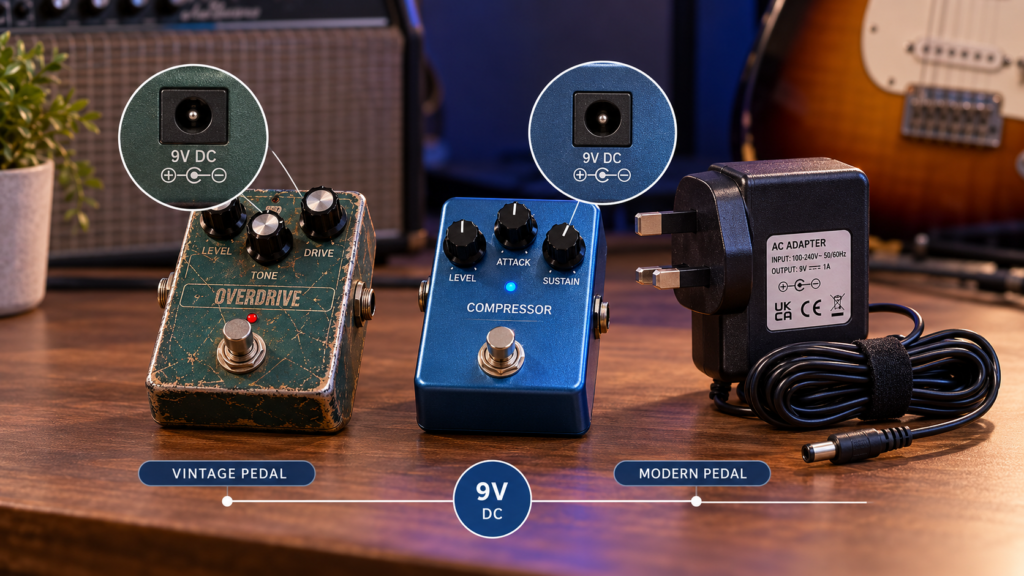
Why Is Centre-Negative Common on Guitar Pedals?
Centre-negative became common through the development of the guitar-effects industry and the power systems used with those effects.
As more pedal designs adopted the same arrangement, compatible power supplies became easier to produce and use. Manufacturers could create pedalboard power systems around familiar requirements, while musicians could add compatible effects without needing a different power connection for every pedal.
Over time, this created a practical ecosystem. Centre-negative became a configuration that guitarists expected to see when buying effects pedals and their power supplies.
It is common because manufacturers and musicians have used the arrangement extensively over many years. However, the individual product specification always takes priority.
How Can You Tell If You Have a 9V Centre-Negative Guitar Pedal?
Start with the polarity symbol near the pedal’s DC power socket. You may also find the information on the bottom of the pedal, in its manual or on the original power adapter.
If you still have the original adapter, compare its output information with the pedal’s requirements. Check the voltage, current, polarity and connector information.
If the original supply is missing, identify the exact pedal model before searching for a replacement. A model-specific power adapter for the BBE Opto Stomp effects pedal is an example of why exact model identification can be more useful than choosing a generic 9V adapter.
What Happens If the Polarity Is Wrong?
Using the wrong polarity can cause a pedal to stop working correctly. Depending on the pedal’s circuit design and protection features, reverse polarity can also cause electrical damage.
Some modern pedals include protection against incorrect connections, but this should not be treated as a reason to test an unsuitable adapter.
If the pedal requires centre-negative, use a centre-negative supply. If it requires centre-positive, use the specified arrangement instead.
Never assume a connector is safe simply because it fits into the socket. Electrical polarity must also match.
Do All 9V Guitar Pedals Use Centre-Negative?
No. Centre-negative is common, but it is not universal.
Some pedals use centre-positive polarity. Others may require different operating voltages, current levels or connector dimensions. Even pedals that look similar can have different power requirements.
This is why searching for a generic “9V guitar pedal adapter” can produce an unsuitable result.
A model-specific example is a 9V replacement adapter for the TC Electronic Vortex Flanger guitar pedal. Matching the replacement to the exact pedal model helps reduce the risk of choosing the wrong supply.
Why Isn’t 9V Enough to Confirm Compatibility?
The voltage rating is only one part of the specification.
Two guitar pedals can both require 9V DC while having different polarity, connector or current requirements. A replacement adapter therefore needs to match the complete electrical specification.
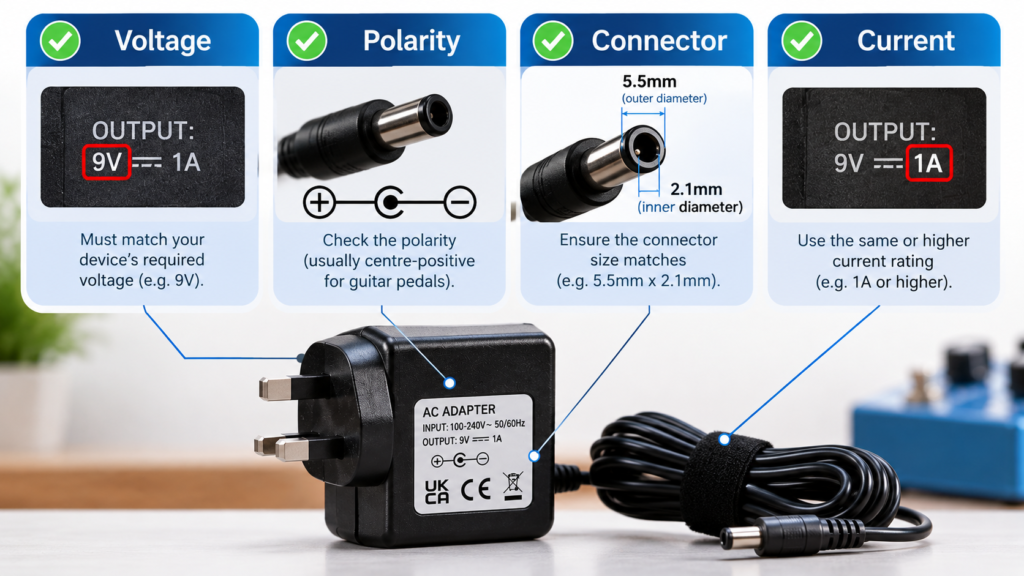
Before connecting an adapter, check these four points:
- Voltage: Does the adapter provide the required voltage?
- Polarity: Is it centre-negative or centre-positive as required?
- Connector: Does the plug match the pedal?
- Current: Can the adapter provide enough current?
Checking all four is safer than choosing a supply simply because it says 9V.
Can You Use a Higher-Amp 9V Adapter?
In many cases, a higher current-rated adapter can be used when the voltage, polarity, connector and other requirements match.
The current rating represents the adapter’s available capacity. It does not mean the pedal is forced to draw the entire amount.
For example, a pedal requiring 9V DC and 100mA can generally use a compatible 9V supply capable of providing more than 100mA.
However, a higher current rating cannot compensate for the wrong voltage or polarity.
What Should You Check Before Connecting an Adapter?
Before connecting a replacement power supply, confirm:
- Pedal model: Identify the exact effects pedal.
- Voltage: Confirm the required DC voltage.
- Polarity: Check whether it requires centre-negative or centre-positive.
- Connector: Confirm the correct barrel plug size and type.
- Current: Make sure the adapter can provide enough current.
- Mains compatibility: For UK users, make sure the adapter is suitable for UK mains power.
If any specification is unclear, verify it before connecting the supply.
FAQs
Does 9V automatically mean centre-negative?
No. The 9V rating describes voltage only. Polarity, connector and current requirements must also be checked.
Can you use a higher-amp 9V adapter?
Generally, yes, when the voltage, polarity, connector and other requirements match. A higher current rating does not force the pedal to draw more current.
Do all guitar pedals use the same 9V connector?
No. Connector sizes and electrical requirements can vary between pedal models.
What happens if you use the wrong polarity?
Using the wrong polarity can stop the pedal from working and potentially cause electrical damage to the circuit.
Why do most guitar pedals use 9V power?
It is a practical voltage for compact circuits, allowing manufacturers to keep effects pedals relatively small and highly portable.
Conclusion
Guitar pedals commonly use 9V centre-negative power because the arrangement became a familiar convention through years of effects-pedal development and pedalboard use.
The key point is that common does not mean universal. A 9V label alone does not confirm centre-negative polarity or guarantee that an adapter is compatible.
Before connecting a replacement, check the exact pedal model, voltage, polarity, connector and current requirement. Taking a few moments to verify these details can help prevent compatibility problems and protect your equipment.