

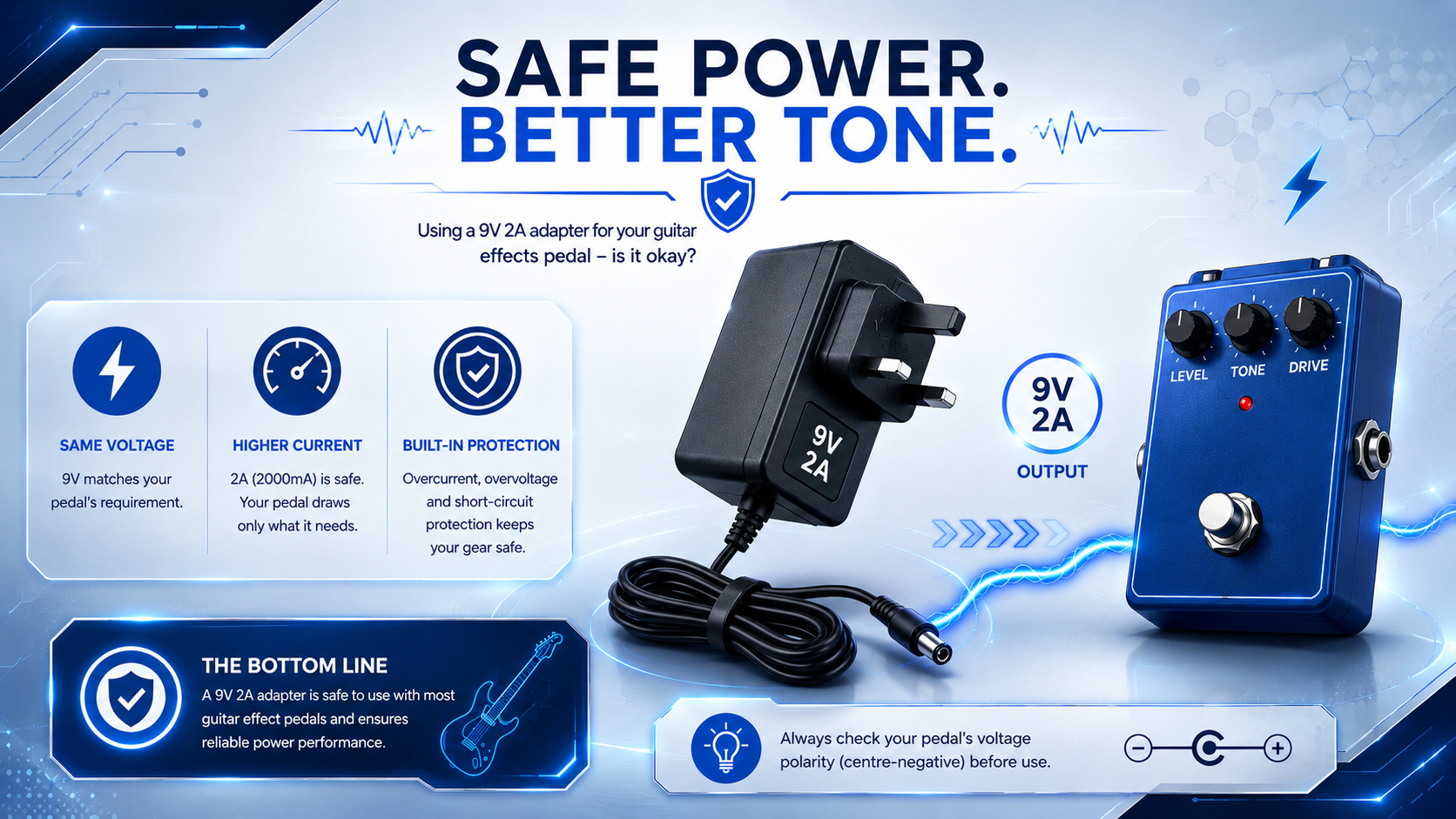
Using a 9V 2A adapter for guitar effect pedals is often perfectly safe if the pedal requires 9V DC, but the number “2A” is not enough to determine compatibility. The pedal and adapter must agree on voltage, polarity, connector type and current requirements. Understanding how these ratings work can prevent a simple replacement purchase from turning into a power problem.
A 2A adapter does not automatically push 2A into a pedal. The pedal normally draws the current its circuit requires.
What Does 9V 2A Actually Mean?
The 9V figure identifies the adapter’s output voltage, while 2A describes its maximum available current capacity. In simple terms, the adapter can supply up to 2 amps when the connected equipment demands it.
That does not mean every device connected to it consumes 2A. A pedal rated at 100mA may only draw around 100mA during operation.
The theoretical maximum output is 18 watts because 9V multiplied by 2A equals 18W.
Is 2A Too Much for a Guitar Pedal?
For most compatible 9V pedals, having an adapter capable of supplying more current than the pedal requires is not inherently a problem.
Consider a pedal that needs 9V DC and 150mA. A compatible 9V 2A adapter has substantially more current capacity than necessary. The pedal does not become a 2A device just because the supply can provide that amount.
This is different from using a higher voltage. Current capacity represents what the supply can provide, whereas voltage determines the electrical potential supplied to the pedal. Voltage must match the pedal’s specification.
If you are replacing a supply for a particular effects unit, a power adapter for the Strymon Flint effects pedal shows why checking the exact model is more useful than relying on a generic description.
When Is a Higher Current Rating Useful?
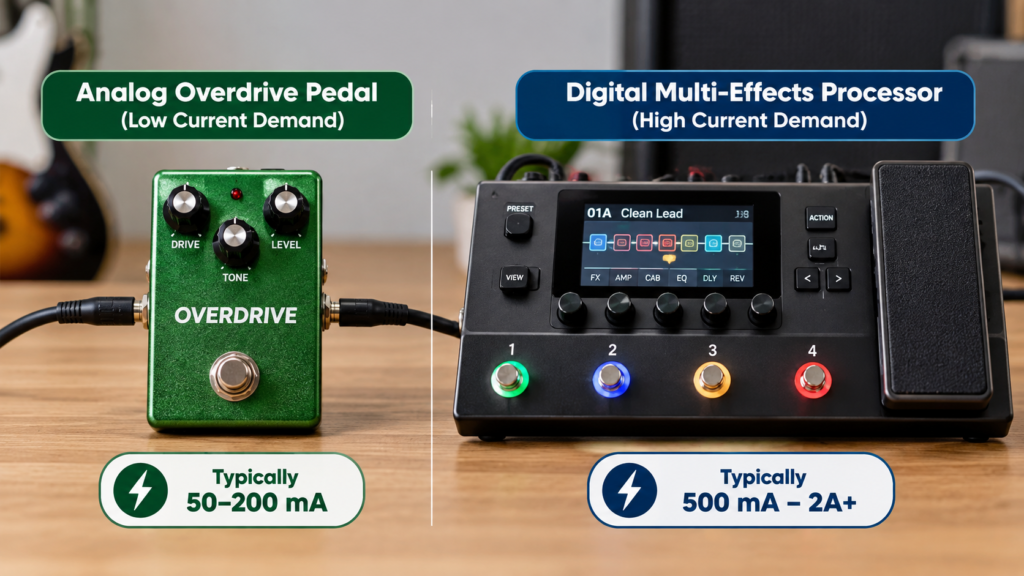
A higher current rating can be useful when a pedal has a relatively demanding circuit. Digital delays, reverbs, multi-effects processors, loopers and pedals with displays can require considerably more current than simple analogue effects.
Using an adapter that cannot provide enough current can lead to unreliable operation, unexpected shutdowns or an overloaded power supply. Choosing an adapter with adequate capacity gives the equipment enough available current to operate without continually pushing the supply beyond its intended rating.
For this reason, a 2A supply may provide useful headroom for equipment that requires less than 2A.
Does the Polarity Still Need to Match?
Absolutely. The adapter’s current rating does not make incorrect polarity safe.
Many guitar effects pedals use 9V DC centre-negative polarity. With a centre-negative connector, the centre contact is negative and the outer sleeve is positive.
A pedal with centre-negative requirements needs an adapter with the corresponding polarity. Connecting a centre-positive supply simply because its voltage and current ratings look suitable can cause the pedal to malfunction and, depending on its circuit protection, potentially cause damage.
A power adapter for the BBE Opto Stomp effects pedal illustrates why the exact pedal specification should be identified before choosing a replacement.
Can a 9V 2A Adapter Power a Pedalboard?
A 9V 2A adapter may be useful for a pedalboard setup, but the way the power is distributed matters.
Some pedalboards use dedicated multi-output power supplies, while others use individual adapters or distribution systems. Each output must be suitable for the connected pedal, including its voltage, polarity and available current.
A 9V replacement adapter for the TC Electronic Vortex Flanger guitar pedal is an example of why a specific pedal should be checked rather than assuming every effect has identical power requirements.
A 2A rating on one supply does not mean every output or connected pedal can automatically use 2A. Always follow the specifications of the actual power system.
What Happens If the Adapter Cannot Provide Enough Current?
A supply with insufficient current capacity can struggle when the pedal demands more than it is designed to deliver.
Depending on the adapter and pedal, symptoms may include unstable operation, noise, unexpected resets or the pedal failing to power up properly. A supply that operates close to or beyond its rated capacity may also run hotter than intended.
This is why the current requirement printed on the pedal or specified by its manufacturer matters. If a pedal needs 300mA, an adapter rated at 100mA is not an appropriate choice simply because both are labelled 9V.
The safer approach is to select a compatible supply with enough current capacity for the pedal’s requirement.
What Should You Check Before Buying a 9V 2A adapter for guitar effect pedals?
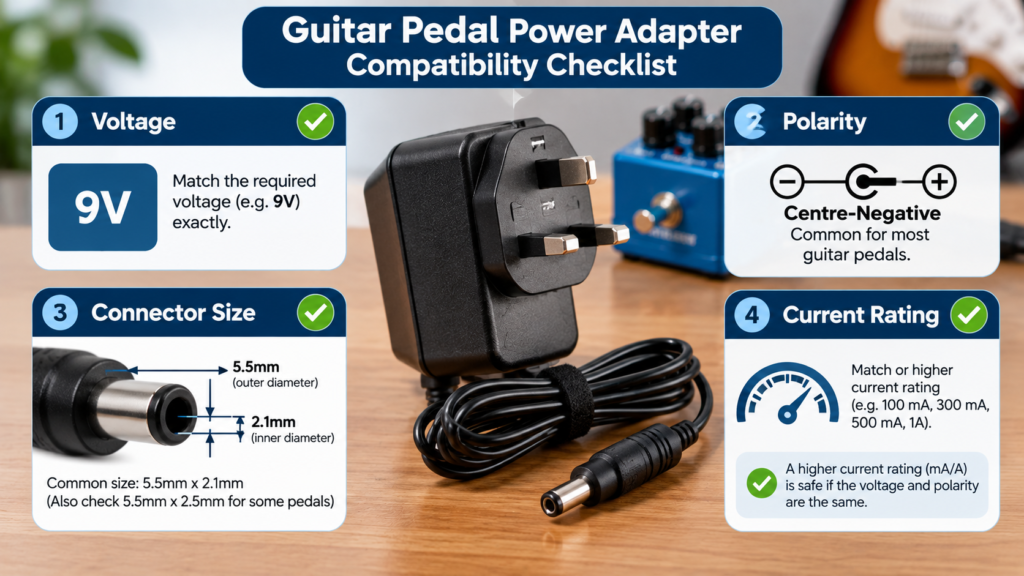
Before connecting a 9V 2A adapter to a guitar effects pedal, verify the complete power specification.
First, confirm that the pedal requires 9V DC. Next, check the polarity, especially whether it is centre-negative or centre-positive. Then verify the DC connector dimensions and make sure the adapter can provide at least the current the pedal requires.
Finally, check that the adapter is appropriate for the mains supply where it will be used. UK users should also consider relevant product information and markings; GOV.UK’s UKCA marking guidance provides an official reference.
If any specification is uncertain, verify it before connecting the adapter.
A Higher Current Rating Does Not Change the Pedal’s Demand
A higher current rating is extra supply capacity. It gives the pedal access to enough current when required, without changing the pedal’s current demand. This is why current capacity and voltage should never be treated as interchangeable specifications.
Why Is a Model-Specific Replacement a Better Choice?
A model-specific replacement can make compatibility much easier to verify.
Instead of starting with a generic 9V 2A search, identify the exact pedal first. You can then compare the required voltage, polarity, connector and current with the replacement adapter.
This approach is useful for older pedals and equipment whose original documentation is no longer available.
A 9V power supply for the VSN Vibrock guitar effects pedal is another example of model-specific matching.
A 9V power adapter for the Amuzik Odrive II guitar effects pedal demonstrates the value of matching a replacement to a specific pedal rather than treating every 9V effect as identical.
FAQs
Can I use a 9V 2A adapter with a guitar pedal?
Generally, yes, if the pedal requires 9V DC and the polarity, connector and other specifications match.
Does a 2A adapter force 2A into the pedal?
No. The 2A rating represents available current capacity. The pedal normally draws the current its circuit requires.
Can a higher-amp adapter damage a guitar pedal?
A higher current rating alone is generally not the issue. Incorrect voltage, polarity or connector compatibility can create serious problems.
Is a 9V 2A adapter suitable for every 9V pedal?
No. Two 9V pedals can have different polarity, connectors or current requirements.
Should I choose a model-specific adapter?
A model-specific replacement can reduce compatibility guesswork, particularly when replacing an adapter for an older or less common pedal.
Conclusion
A 9V 2A adapter can often power a guitar effects pedal that requires 9V DC. The 2A rating does not mean the adapter forces 2A into the pedal; it indicates the amount of current the supply can make available when required.
The real compatibility check is broader. Voltage must match, polarity must be correct, the connector must fit properly and the adapter must provide sufficient current for the pedal.
For that reason, do not choose a replacement simply because it says “9V 2A”. Start with the pedal’s exact requirements and compare every specification before connecting it.
When replacing an old adapter, correct identification is also a better way to protect your equipment and avoid unreliable operation. For information about disposing of unwanted electrical equipment, GOV.UK WEEE guidance provides relevant information for electrical waste responsibilities.