

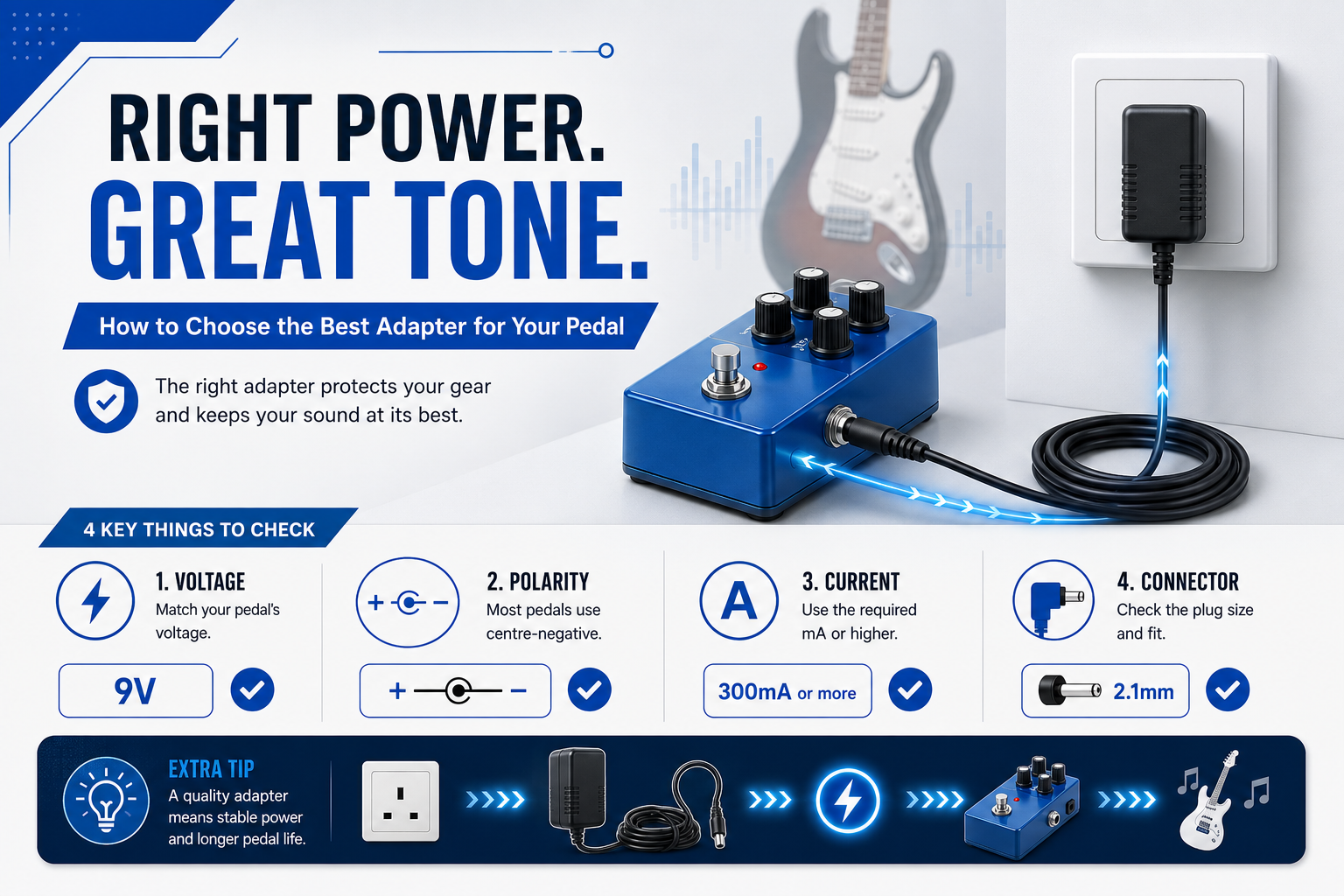
Losing, damaging, or misplacing a guitar pedal power adapter is a rite of passage for almost every guitarist, but grabbing a random household mains adapter and hoping for the best is a fast track to a fried circuit board and a silent rehearsal. Because guitar effects pedals possess unique electrical specifications and sensitivity profiles compared to standard household electronics, you can never judge compatibility by barrel plug size alone.
Understanding how your stompbox draws power protects your vintage investments, prevents frustrating mid-gig audio dropouts, and eliminates ground hum. This comprehensive step-by-step guide will teach you how to decode your pedal’s power requirements and source a safe, reliable, and noise-free UK replacement.
Where to Look: Decoding the Pedal Label First
Before you start searching online stores or sorting through a tangled mess of spare cables in your studio, you need to inspect the physical hardware. Reputable manufacturers print the exact factory power requirements directly onto the pedal casing.
When searching for specifications, check these three common locations:
- The Backplate: Many manufacturers print operational specifications, voltage warnings, and polarity symbols on the paper sticker or metal plate covering the bottom of the pedal.
- Near the DC Input Jack: Look closely at the metal or plastic chassis right next to where the power barrel plug connects; technical ratings are frequently embossed, engraved, or printed in high-contrast ink right on the housing.
- The User Manual or Manufacturer Website: If the text has completely rubbed off the back of a vintage or heavily used pedal, a quick online search for the exact model manual or specification sheet will reveal its required factory parameters.
As you inspect these details, you are looking to record three critical metrics: Voltage (V), Polarity, and Current draw (mA). For further troubleshooting advice, you can also consult external resources like Andertons Ultimate Guide to Pedal Power Supplies.
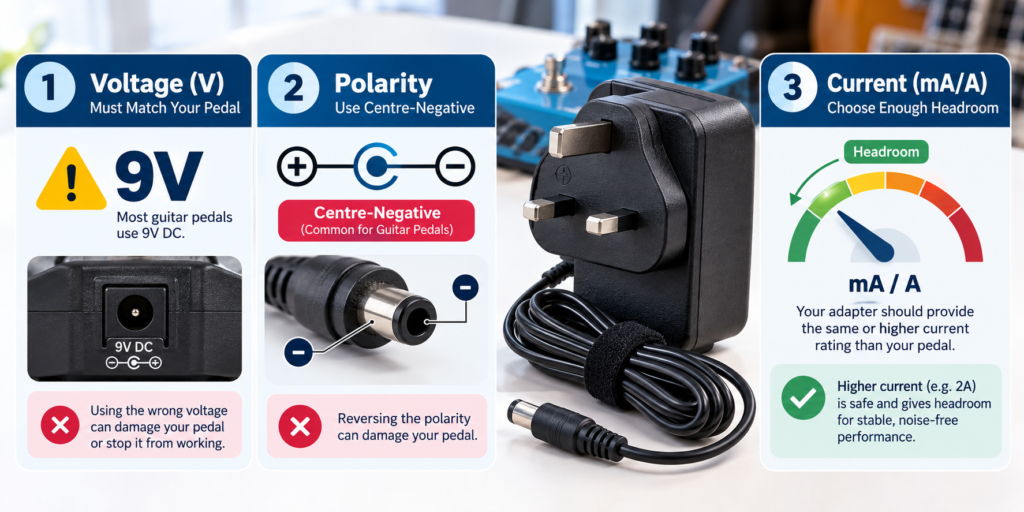
Decoding the ‘Big Three’ Technical Specs
Voltage (V) – The “Must Match” Rule
Voltage measures the electrical pressure delivered from the power supply to the internal circuit components. If your pedal calls for 9 Volts, you must supply 9 Volts. Never guess this metric.
- Too High: Plugging a 12V or 18V adapter into a standard 9V pedal will cause immediate thermal overload, swell electrolytic capacitors, and permanently fry integrated circuits (ICs) or digital microprocessors.
- Too Low: Undervolting a pedal (such as supplying 9V to a pedal designed for 12V or running a digital unit on weak current) will cause unpredictable audio distortion, a dim LED indicator light, or complete failure to boot.
Note: Almost all standard guitar pedals run on 9V DC (Direct Current). Never plug an AC (Alternating Current) adapter into a DC pedal unless explicitly specified by heavy-duty multi-effects units.
Polarity – The “Centre-Negative” Standard
Polarity determines the direction of electrical current flow through the barrel connector. More than 90% of guitar pedals use centre-negative polarity, which is represented by this universally recognised graphic symbol:
CENTRE-NEGATIVE (Guitar Standard): (-)—(o—(+)
General consumer electronics—such as wireless internet routers, digital keyboards, and phone chargers—almost always use centre-positive adapters. Plugging a centre-positive adapter into a centre-negative guitar pedal causes an immediate short circuit, potentially blowing internal protection diodes or fusing components. Always confirm that your replacement adapter features the negative sign pointing directly to the centre pin (- C +).
For standard stompboxes, you can ensure total safety and seamless compatibility by choosing a trusted Power Adapter Compatible for Boss Guitar Pedals.
Current (mA) – The “Headroom” Rule
Current is measured in milliamperes (mA) and indicates how much electrical current the pedal requires to operate effectively. This metric is where musicians experience the most confusion:
- Can you use an adapter with more mA? Yes, absolutely. If your analogue overdrive pedal requires 100mA, using a 500mA or 1000mA power supply is 100% safe. Pedals only draw the exact current they demand; the extra milliamps act as clean, noise-free electrical headroom.
- Can you use an adapter with less mA? No. If your digital delay requires 300mA and you plug in a weak 100mA adapter, it will cause severe current starvation, resulting in audio dropouts, digital processor reboots, constant stuttering, and dangerous overheating of the power supply unit.
If you are powering power-hungry digital delays, loopers, or multi-effects pedalboards, grab a robust, high-headroom option like a 9V 1A 1000mA Switching Power Adapter.
Checking Barrel Plug Dimensions & Tip Sizes
Even if your voltage, polarity, and amperage match your pedal’s specifications perfectly, the physical plug might still fail to work if the barrel dimensions are wrong.
- The Industry Standard (2.1mm x 5.5mm): The vast majority of stompboxes manufactured by brands like Boss, Electro-Harmonix, MXR, and Ibanez utilise a standard barrel plug featuring a 2.1mm internal pin diameter and a 5.5mm outer sleeve diameter.
- The 2.5mm Exception: Some boutique pedals, high-current multi-effects units, or specialised keyboard pedals utilise a slightly wider 2.5mm centre pin. Plugging a standard 2.1mm cable into a wider 2.5mm jack results in a loose physical connection and frustrating intermittent power cutouts whenever you step on the switch. If you own a specialised processor, check out a Replacement Power Adapter Compatible for Vox Stomplab to guarantee a secure physical fit.
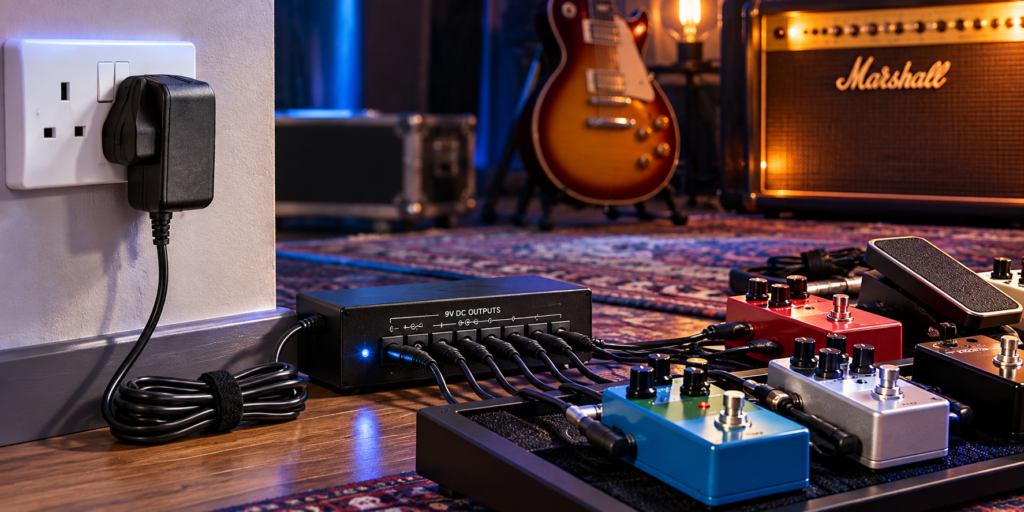
Why You Should Always Choose a Regulated Switching Power Adapter for a Guitar Pedal?
When shopping online for a replacement adapter, look specifically for a modern regulated switching power supply.
- Unregulated Adapters: Older or cheap universal wall plugs are often “unregulated,” meaning they output a much higher voltage than rated (sometimes climbing up to 14V) when the connected pedal is pulling low current. This excess voltage slowly degrades sensitive analogue components over time.
- Regulated Switching Adapters: Modern regulated supplies maintain a rock-solid, constant 9V DC regardless of minor grid or load fluctuations, protecting your gear from harmful power surges and eliminating background 50Hz/60Hz mains hum.
To protect your gear with clean, reliable power during live performances and recording sessions, explore our range of Low-Noise Isolated Power Supply Units built specifically for stage and studio safety.
Browse our entire UK 9V Effects Pedal Power Supply Collection to find the exact match for your rig today.
Frequently Asked Questions
How do I know if my guitar pedal power adapter is the right one?
Check the label on your pedal for Voltage (must match, usually 9V DC), Polarity (must be centre-negative – C +), and Amperage (adapter mA must be equal to or greater than the pedal’s requirement).
Can a higher mA rating damage my guitar pedal?
No. Current (mA) is drawn by the pedal, not forced by the adapter. Having extra milliamps gives your power supply healthy electrical headroom and keeps it running cool.
What is the difference between centre-positive and centre-negative?
Centre-negative means the inner pin of the barrel plug carries the negative charge (standard for guitar pedals). Centre-positive puts the positive charge on the inner pin (standard for household electronics). Mixing them up will short-circuit your pedal.
What barrel plug size do most guitar pedals use?
The standard size for 9V guitar pedals is a 2.1mm x 5.5mm DC barrel plug with a negative centre pin.
Can I power multiple guitar pedals with a single adapter?
Yes, using a daisy-chain cable, provided all pedals share the same voltage and polarity. Ensure the adapter’s total mA rating exceeds the combined current draw of all connected pedals.
Conclusion
Finding the correct replacement power adapter for your guitar pedal doesn’t have to be a stressful guessing game. By taking a few moments to verify your pedal’s specific voltage requirements, ensuring a centre-negative polarity, and matching or exceeding the required current draw (mA), you can safeguard your equipment against permanent electrical damage. Always double-check the physical barrel dimensions for a secure fit, and invest in a high-quality, regulated switching adapter to guarantee a clean, noise-free signal. When you power your rig correctly, you protect your tone and your gear, leaving you free to focus entirely on your performance.