

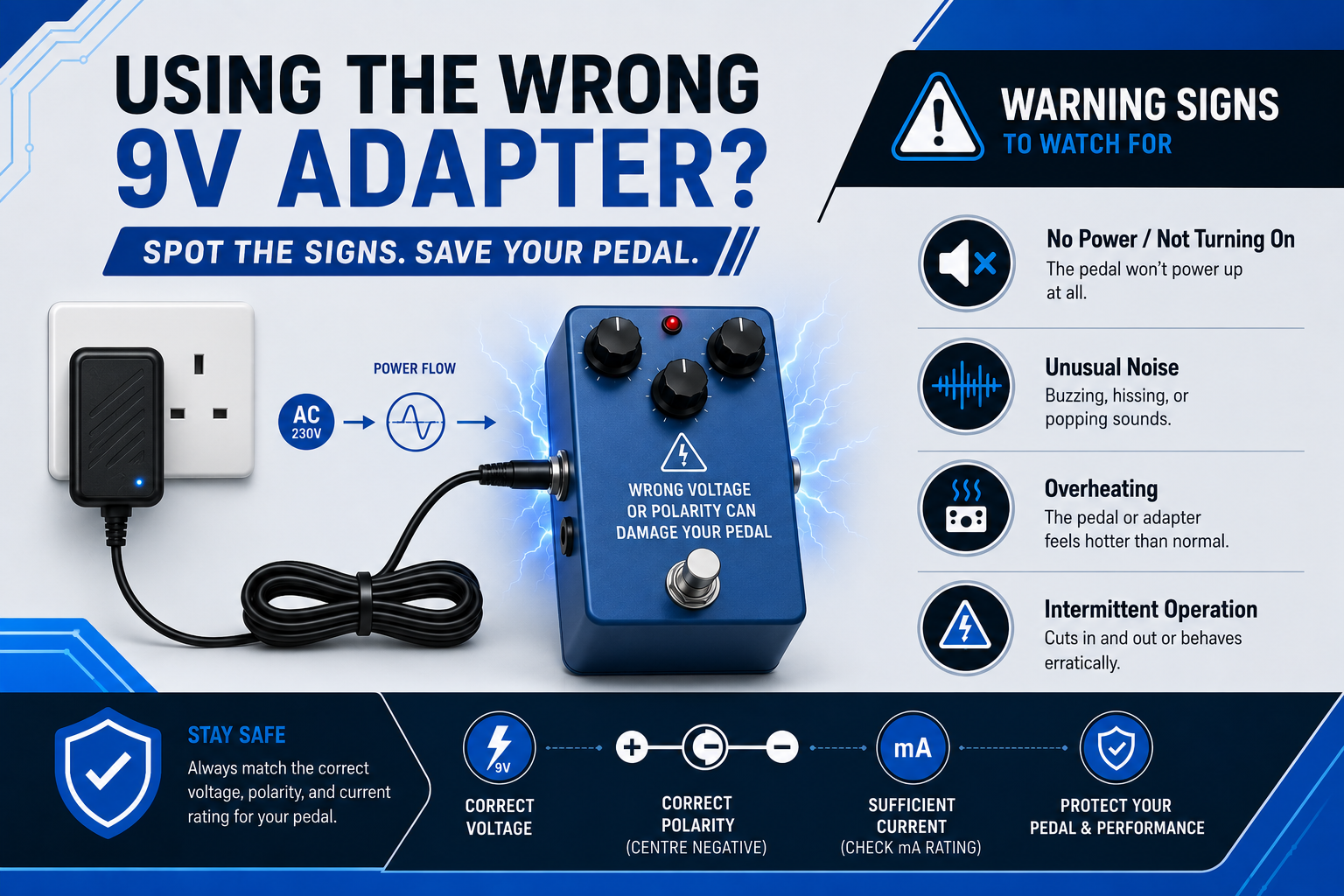
Every guitarist has experienced the panic of setting up for a gig or practice session, only to realise their dedicated power supply is missing. In a rush, it is tempting to grab the nearest household plug from a broadband router or electronic keyboard and hope for the best. However, using the wrong 9v adapter on a guitar pedal is one of the fastest ways to permanently destroy your favourite stompbox.
While some power mismatches might only cause a temporary loss of sound or an unbearable background hum, others will instantly fry sensitive internal processors and leave you with a costly repair bill. In this guide, we will break down exactly what happens when you mismatch voltage, polarity, or current, and how to safely power your rig without risking your hardware.
What Happens When You Use the Wrong 9V Adapter on a Guitar Pedal?
Plugging a higher voltage adapter into a 9V pedal forces excessive electrical energy into components, causing rapid thermal overload, capacitor rupture, and permanent circuit destruction. Underpowering a pedal causes audio distortion or boot failure but rarely causes physical hardware damage.
Overvoltage Damage vs Undervoltage Performance
Introducing excessive voltage into a standard 9V pedal creates rapid heat accumulation and causes internal capacitor seals to rupture and leak conductive fluid. Supplying 6V to a 9V analogue overdrive causes voltage sag, creating a thin fuzz tone, while supplying insufficient voltage to digital pedals simply causes them to crash or continuously reboot.
Buying Tips & Voltage Verification
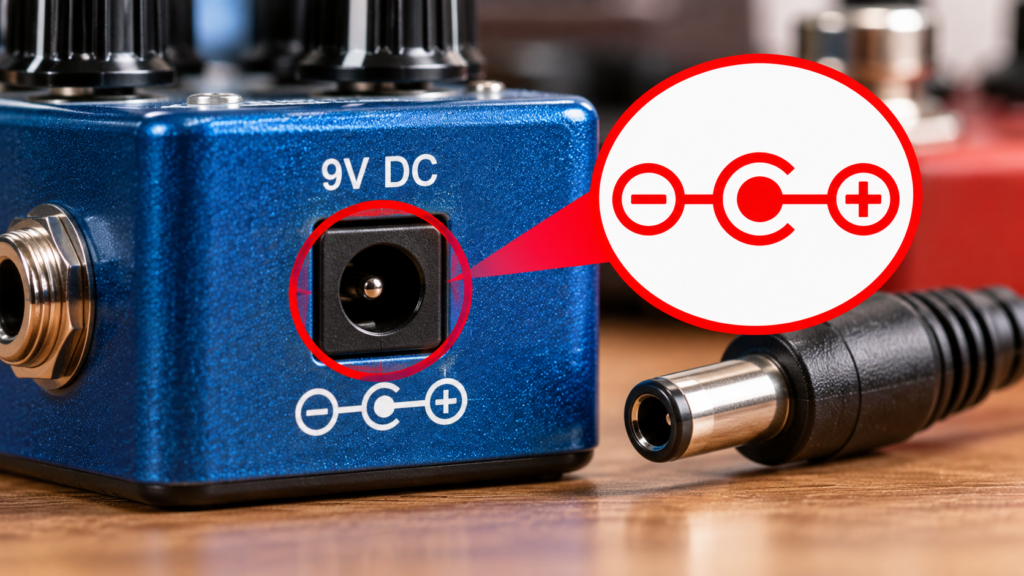
- Check the DC Jack Graphic: Always verify the printed label near the power input jack (e.g., 9V DC).
- Avoid Unregulated Adapters: Cheap unregulated wall plugs can output up to 14V when no electrical load is connected. Always use a regulated switching power supply.
To keep your drive pedals operating safely, pair them with a clean output Power Adapter Compatible for Boss Blues Driver BD2. For further technical details on device safety limits, consult the Institution of Engineering and Technology (IET).
Why Polarity Reversal Is the #1 Pedal Killer
Reversing power polarity sends positive voltage straight into the ground path, causing an immediate short circuit. Most modern guitar pedals use centre-negative polarity, whereas general consumer electronics use centre-positive adapters. Plugging a centre-positive adapter into a centre-negative pedal instantly blows protection diodes or burns circuit board traces.
Centre Negative vs Centre Positive Standards
In a standard centre-negative DC jack, the centre pin carries negative potential, whilst the outer sleeve carries positive 9V. If a centre-positive adapter is plugged in, positive current hits the metal chassis and internal ground. Without a protective diode, this reversed current destroys active transistors and sensitive audio chips in milliseconds.
Polarity Safety Checklist
- Ensure exact polarity alignment with a dedicated supply like the Power Adapter Compatible for Vox Stomplab Effects Pedal.
- Look for the polarity symbol (- C +) printed directly next to the DC input socket on the enclosure.
- Never use centre-positive keyboard, router, or household appliance plugs without a dedicated polarity-reversing adapter cable.
Circuit-Level Breakdown: Which Components Suffer Damage First?
Connecting an incorrect adapter forces specific internal components to act as electrical sacrifices. Reverse polarity diodes short out first, followed by popping filter capacitors, destroyed voltage regulators, and digital microprocessors.
| Component | Function | Failure Mode | Repairability |
| Protection Diode (1N4001) | Clamps reverse voltage to protect circuit | Shorts out completely; cuts all power | Easy (Diode replacement) |
| Filter Capacitors | Smooths power ripple and removes hum | Swells, leaks electrolyte, or pops | Moderate (Basic soldering) |
| Voltage Regulator (78L05) | Converts 9V DC down to 5V DC for digital ICs | Thermal burnout; outputs 0V or full 12V | Moderate (Component swap) |
| DSP Chip / Op-Amps | Handles primary audio signal processing | Internal semiconductor junction melts | Hard (Board replacement) |
Digital DSP Vulnerability vs. Analogue Durability
Analogue pedals with discrete components can occasionally survive overvoltage spikes. However, digital delay, pitch-shift, and reverb pedals rely on sensitive microprocessors on strict power rails. A brief 12V spike will permanently ruin digital DSP microprocessors. Protect complex digital delays using a Power Adapter Compatible for Strymon Flint Effects Pedal.
Understanding Milliampere (mA) Current: Headroom vs. Starvation
A 9V power supply with a higher mA rating will never cause damage because pedals only draw the exact current they need. However, using an adapter with a lower mA rating causes current starvation, leading to audio dropouts, processor reboots, and overheating adapters.
Analogue vs. Digital Amperage Requirements
Analogue pedals require minimal current, drawing 5mA to 20mA, whilst digital multi-effects, loopers, and reverbs draw 150mA to over 500mA. Plugging a 100mA supply into a 300mA digital delay causes starvation, resulting in boot loops and muffled audio.
Why a 1000mA Adapter Is the Best Choice
A 1000mA adapter safely powers low-draw pedals, leaving ample clean electrical headroom. This allows the transformer to run cool, efficiently, and noise-free. Supply sufficient headroom across your board using a universal 9V 1A 1000mA Switching Power Adapter.
Ground Loops & Daisy-Chain Buzz: Signal Noise vs. Physical Damage
Using a shared daisy chain cable will not damage internal circuits but frequently creates ground loops and loud background hum. Sharing a ground wire between digital and high-gain analogue pedals allows digital noise to bleed directly into your audio signal.
Isolating Digital & Analogue Signals
Power digital pedals with dedicated, isolated supplies instead of daisy chains to stop noise from corrupting high-gain distortion circuits. Eliminate signal hum using a Replacement Power Adapter Compatible for TC Electronic Vortex Flanger and review safety guidelines via the UK Government Product Safety Standards.
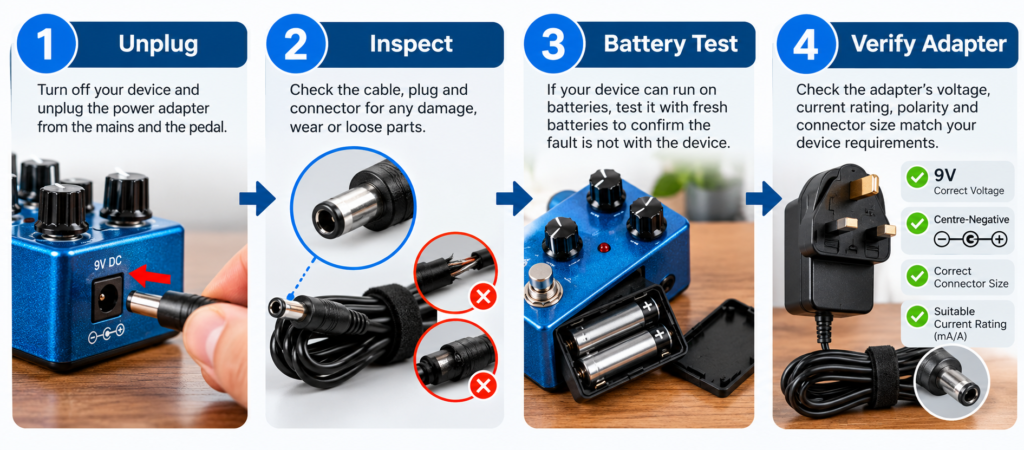
Diagnostic Flowchart: What to Do If You Plugged in the Wrong Adapter
If you accidentally plug an incorrect power supply into your pedal, follow these steps immediately to assess the damage:
- Step 1: Unplug Immediately — Remove the DC power connector the instant you smell burning plastic, hear a pop, or notice a dead LED light.
- Step 2: Inspect for Visual or Smell Damage — Remove the backplate screws and check for burnt copper traces, bulging capacitors, or a black shorted protection diode.
- Step 3: Test with a 9V Battery — Insert a fresh 9V battery. If the pedal turns on and processes audio normally on battery power, only the DC input jack or protection diode circuit was damaged.
- Step 4: Verify Regulated 9V DC Adapter — Connect a verified 9V DC centre-negative adapter with ample mA capacity to confirm full recovery.
Frequently Asked Questions
Will a 12V power supply ruin a 9V Boss guitar pedal?
Yes. Boss pedals are rated for strict 9V DC regulated supplies. Supplying 12V overheats internal components, exceeds capacitor voltage limits, and fries voltage-sensitive IC chips.
Can I use a 9V 1000mA (1A) adapter on a pedal that only requires 100mA?
Yes, absolutely. Current (mA) is drawn by the pedal, not forced by the adapter. The pedal safely takes 100mA, leaving 900mA as clean headroom in the power supply.
How do I know if my guitar pedal power adapter is centre-negative?
Check the label on the plug or pedal jack for the polarity symbol: a line leading from the negative (-) symbol to the inner circle (- C +) indicates centre-negative polarity.
Why does my pedal make a high-pitched squeal on a daisy chain?
High-pitched squealing occurs when digital processing noise bleeds into a shared ground cable on a daisy chain. Powering digital pedals with isolated adapters fixes this issue instantly.
What happens if I use an AC power supply on a DC guitar pedal?
Connecting an Alternating Current (AC) supply to a Direct Current (DC) pedal will instantly destroy semiconductor chips, melt protection diodes, and ruin the pedal beyond repair. Always verify 9V DC output.
Conclusion
Powering your pedalboard correctly protects your tone and hardware investment. Always confirm strict 9V DC output, verify centre-negative polarity (- C +), ensure ample mA capacity headroom, and isolate digital units from analogue signal paths.
Find high-quality, noise-free 9V Guitar Effects Pedal Power Supplies at Power Adapter Warehouse UK today.