

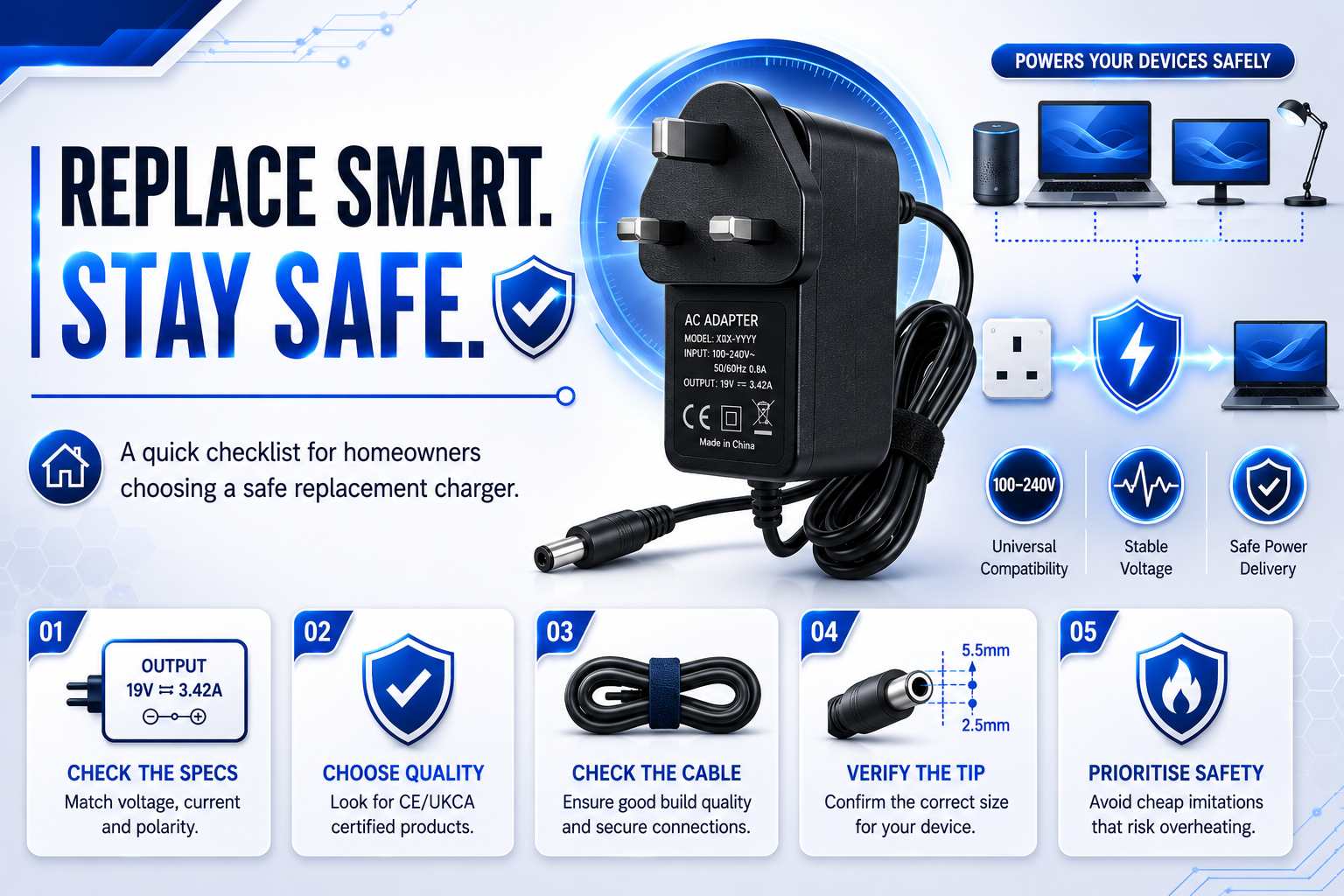
Every modern household relies on external power bricks hidden behind TV stands, tucked under desks, and running constantly. These unassuming plastic blocks perform a critical, high-stakes job: transforming raw, high-voltage alternating current (AC) from your plug sockets into a smooth, regulated stream of direct current (DC) for your electronics.
When a cable breaks, online marketplaces make it easy to find ultra-cheap replacements. While saving a few pounds feels like a win, low-grade chargers frequently omit crucial safety layers. Understanding how to find a safe adapter is essential to shield your home from electrical hazards and protect electronics from terminal damage.
Is Your Replacement Charger Safe? Markings, Fuses, and Internal Circuitry
A safe, legally compliant replacement adapter must feature genuine, non-counterfeit UKCA and CE conformity markings, precise input/output electrical calibrations, and an internal circuit design that includes over-voltage, over-current, short-circuit, and thermal cut-off protections.
Evaluating a new adapter’s safety level starts with an inspection of its technical specification label. Legitimate manufacturers display their unique model identifiers, precise input/output tolerances, and required consumer safety marks clearly. If an adapter’s label lacks detailed manufacturer info, contains spelling mistakes, or feels like a flimsy, peeling sticker, it is a strong indicator of an uncertified product that has bypassed mandatory laboratory testing.
The Role of Internal Isolation Barriers
Inside a premium supply, the high-voltage mains side is completely separated from the low-voltage output. This galvanic isolation uses an internal transformer wrapped in fire-retardant insulation tape. Cheap chargers skimp on this separation, placing circuits dangerously close together. If a component fails or moisture enters, 240 Volts of electricity can jump the gap, destroying your device and causing a severe electrical shock.
The Stages of active Multi-Layered Protection Networks
To act as a reliable barrier between the erratic domestic mains grid and your delicate home electronics, a high-quality switching power supply relies on a systematic protective framework:
- Over-Voltage Clamping: Instantly intercepts and dampens massive electrical power surges (like lightning strikes) before they enter your device’s motherboard.
- Over-Current Protection Fuse: Monitors the flow of electricity. If the connected peripheral draws an unsafely high volume of current, the fuse immediately breaks the path cleanly.
- Thermal Sensor Switch: Constantly gauges running temperatures. If internal heat levels spike beyond safe operational thresholds, it cuts off current entirely.
- Regulated Safe Output Control: Final-stage smoothing capacitors refine the dropping voltage, delivering perfectly stable direct current into your equipment.
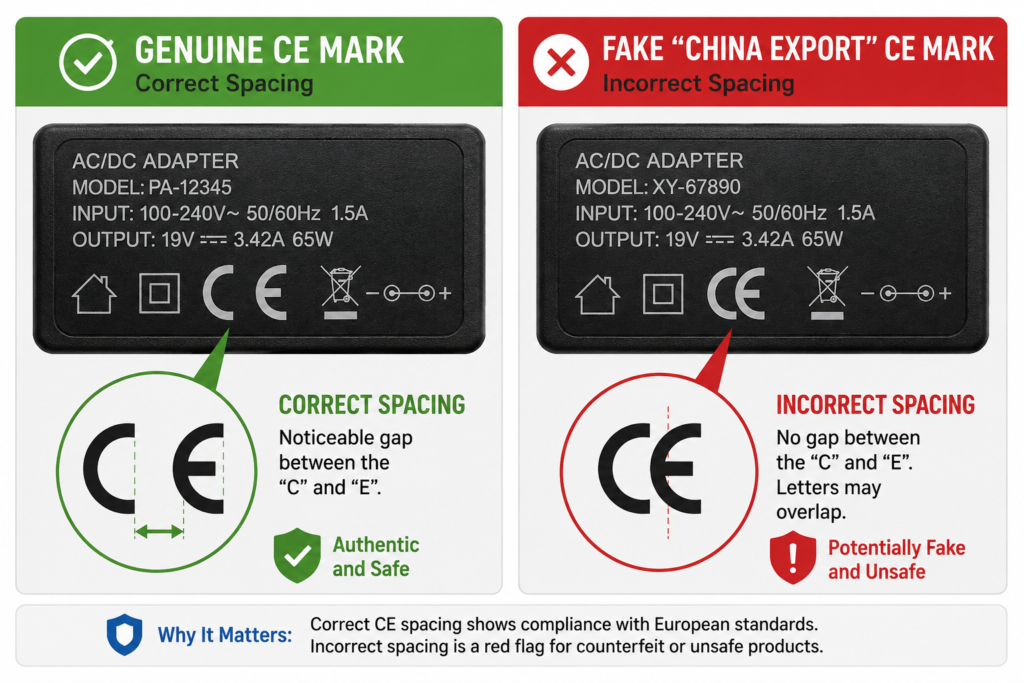
Checking Safety Mark Spacing
How do I spot a fake CE or UKCA mark?
Counterfeiters often print a fake “CE” logo standing for “China Export.” On a genuine European CE mark, the inner curve of the “E” sits far enough away that a full circle drawn from the “C” would perfectly touch its outer edge. If letters overlap, the marking is fraudulent, and the adapter has skipped official evaluations.
Securing Everyday Home Devices: Audio, Entertainment, and Tech Hubs
Home electronics such as digital television hubs, high output party speakers, and sensitive electronic music gear require a certified, steady mains line to prevent hardware degradation. Using premium, safety compliant replacement adapters removes the risk of sudden voltage surges, keeping your household electronics running safely for years to come.
An unshielded, low grade block allows heavy electrical ripples to bleed straight into your device’s motherboard, triggering component overheating and sudden hardware failure. Conversely, a certified alternative provides a clean, stable current flow, ensuring your gear runs efficiently and safely.
Mitigating Workplace and Residential Fire Risks
Uncertified adapters present a constant hazard because they use low-grade plastics that melt or catch fire easily during a short circuit. Certified, high-quality power bricks are housed in thick, impact-resistant polycarbonate casings engineered with self-extinguishing capabilities to ensure any localised component failure remains safely contained.
Restoring Home Entertainment Safety
If a digital streaming hub or portable entertainment device restarts unexpectedly, a degrading, uninsulated power cable is often the root cause. Upgrading to a certified TalkTalk Android TV hub adapter instantly restores stable power delivery and stops system drops. For larger home audio setups, using a robust, fuse-protected Acoustic Solutions party speaker supply prevents dangerous overheating during extended playback sessions. Similarly, protecting specialised performance gear with an exact Tourtech electronic drum kit power adapter guards sensitive audio chips. A dedicated Alba LED TV-DVD combo power supply protects sensitive display panels from unexpected grid surges.
The Danger of Generic Voltage Swapping
Avoid using unverified multi-pack replacement bricks that feature interchangeable tips and manual voltage selectors. These variable sliders are easily knocked out of position, which can accidentally send a high-voltage surge straight into lower-rated consumer gear. Choosing a fixed-voltage replacement designed specifically for your hardware class is the best way to keep your home safe.
Counterfeit Clones vs. Certified Safe Adapters
| Build Feature | Dangerous Counterfeit Charger | Certified Power Adapter Warehouse Supply |
| Internal Isolation | Missing or Sub-Standard Tape Barrier | Heavy Galvanic Transformer Isolation |
| Safety Circuitry | Omitted to Minimise Factory Costs | Active Over-Current, Thermal, & Surge Fuses |
| Casing Material | Thin, Flammable Recycled Plastics | Fire-Retardant Polycarbonate Housing |
| UK Legal Compliance | Fake or Misprinted Safety Marks | Fully Verified, Genuine CE & UKCA Marks |
| Voltage Performance | Spikes and Drifts Under Thermal Stress | Delivers a Flat, Regulated Power Line |
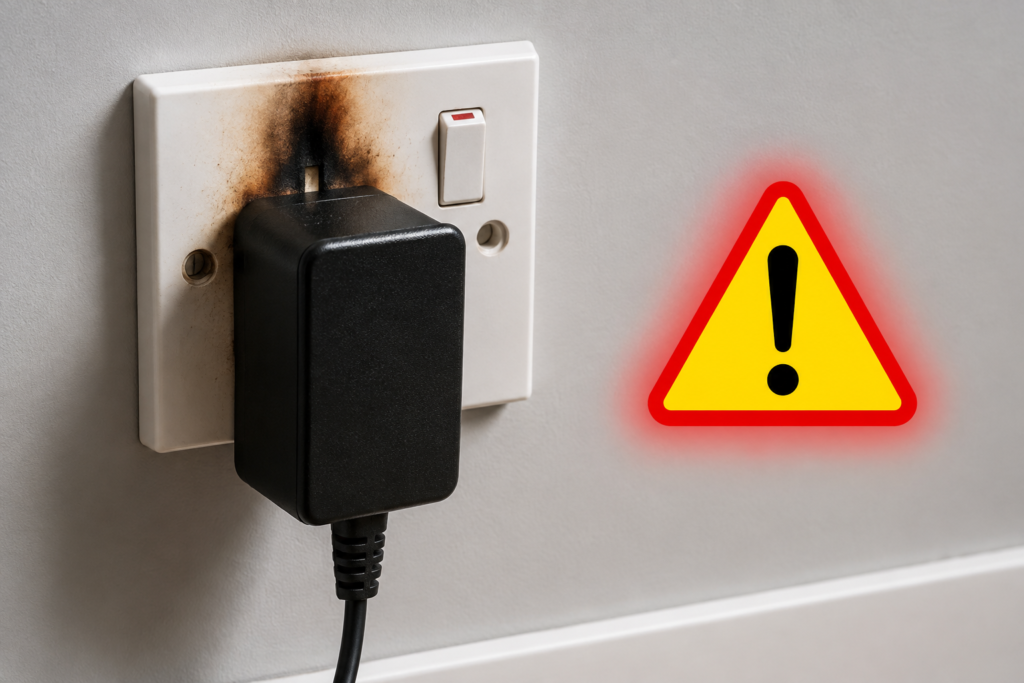
Spotting a Defective or Dangerous Power Supply
Disconnect your plug immediately if you notice any of the following symptoms:
- Excessive Heat: The casing feels hot to the touch or smells like warm plastic, indicating overloaded circuits.
- Audible Noise: A crackling or buzzing sound, pointing to internal arcing and a severe fire risk.
- Erratic Devices: Connected touchscreens behave erratically or glitch while charging due to high-frequency electrical noise leaking through.
- Visible Sparks: Sparks emerge from the socket when plugging the brick in, showing a lack of proper inrush current suppression.
Myth vs. Fact Analysis
- Myth: If a replacement power adapter has a CE or UKCA logo printed on the label, it is guaranteed to be completely safe.
- Fact: Counterfeiters easily print fake logos. Always inspect the text spacing and look for the manufacturer’s name to confirm real compliance.
- Myth: Heavy power adapters are outdated, and lighter, ultra-compact chargers are always built better.
- Fact: While modern tech allows for smaller designs, counterfeit blocks are often suspiciously light because they completely omit essential filtering coils, safety fuses, and copper heat sinks.
Household Electrical Safety Checklist
- The adapter’s outer shell shows no signs of hairline cracks, splitting seams, or warping.
- The wall pins are sturdy, properly aligned, and tightly secured to the main body.
- The plug label displays genuine, correctly spaced UKCA or CE safety marks.
- The electrical output voltage matches your device’s input requirements exactly.
- The manufacturer’s brand name and clear contact information are visible on the casing.
FAQs
What exactly makes a cheap replacement power block an electrical fire hazard?
Sub-standard blocks use thin wiring and omit internal thermal shut-offs. When left plugged in under constant load, internal components can experience thermal runaway, creating intense heat that melts the plastic casing and can ignite nearby soft furnishings.
How can I confirm my adapter has genuine overcurrent protection power supply logic?
Legitimate, safety-tested power supplies include dedicated fuses that automatically cut power if current levels spike. This protection is verified by independent labs and confirmed by the presence of valid UKCA and CE marks on the product.
Is it safe to leave a certified compatible adapter plugged in when not in use?
Yes. High-quality replacement adapters feature minimal standby power draw and active protection loops that monitor internal temperatures and grid surges, ensuring safe operation even when devices are turned off.
Why do some uncertified chargers cause touchscreens to stutter or glitch?
Uncertified units lack output smoothing capacitors, allowing raw electrical noise to travel down the charging cord. This noise interferes with the capacitive sensors on your smartphone or tablet screen.
What steps should I take if a power brick sparks inside a wall socket?
Carefully turn off the main power at your fuse box or isolation switch before removing the charger from the socket. Inspect both the plug pins and the wall socket for burn marks, and replace the adapter immediately.
Conclusion
Your household electronics represent a significant financial investment, and your family’s safety is irreplaceable. Protecting both requires moving away from unverified, budget charging options that compromise on essential build quality. Sourcing a fully certified, precisely calibrated replacement block ensures your devices receive clean, regulated power without risking dangerous electrical faults. Ready to upgrade your home’s electrical safety? Explore our full range of certified safe replacement adapters today.