

Finding the perfect replacement power adapters for home electronics can be highly frustrating. A missing adapter renders gadgets completely useless. Many consumers search online for quick fixes, only to face an overwhelming wall of technical terms like polarity, milliamps, and barrel connectors. Using an incorrect replacement can permanently destroy your sensitive devices or create a safety hazard. This comprehensive guide simplifies the selection process, explaining exactly how to identify correct voltage, match amperage, and select the right connector tip size so you can restore power safely.

Understanding the Basics of an AC DC Power Adapter
Every electronic device in your household relies on specific electrical current. The mains wall sockets in the UK deliver roughly 230 volts of Alternating Current (AC). However, almost all home electronics—from smart speakers to television sets—run internally on Direct Current (DC) at a much lower voltage.
The primary job of an AC DC power adapter is to safely convert that high-voltage alternating household current into a steady, lower-voltage direct current that your specific device requires. This is why these components are often called external power supplies or transformers.
If you look closely at any adapter brick, you will find a technical specification label. This small sticker outlines the electrical boundaries of the unit. It details the input ratings (the voltage and frequency the adapter can accept from the wall) and the output ratings (the exact current the adapter sends downstream to your device). When source equipment fails, understanding this little sticker becomes your primary tool for securing a perfectly compatible electronics charger.
The Three Golden Rules for Finding a Perfect Replacement
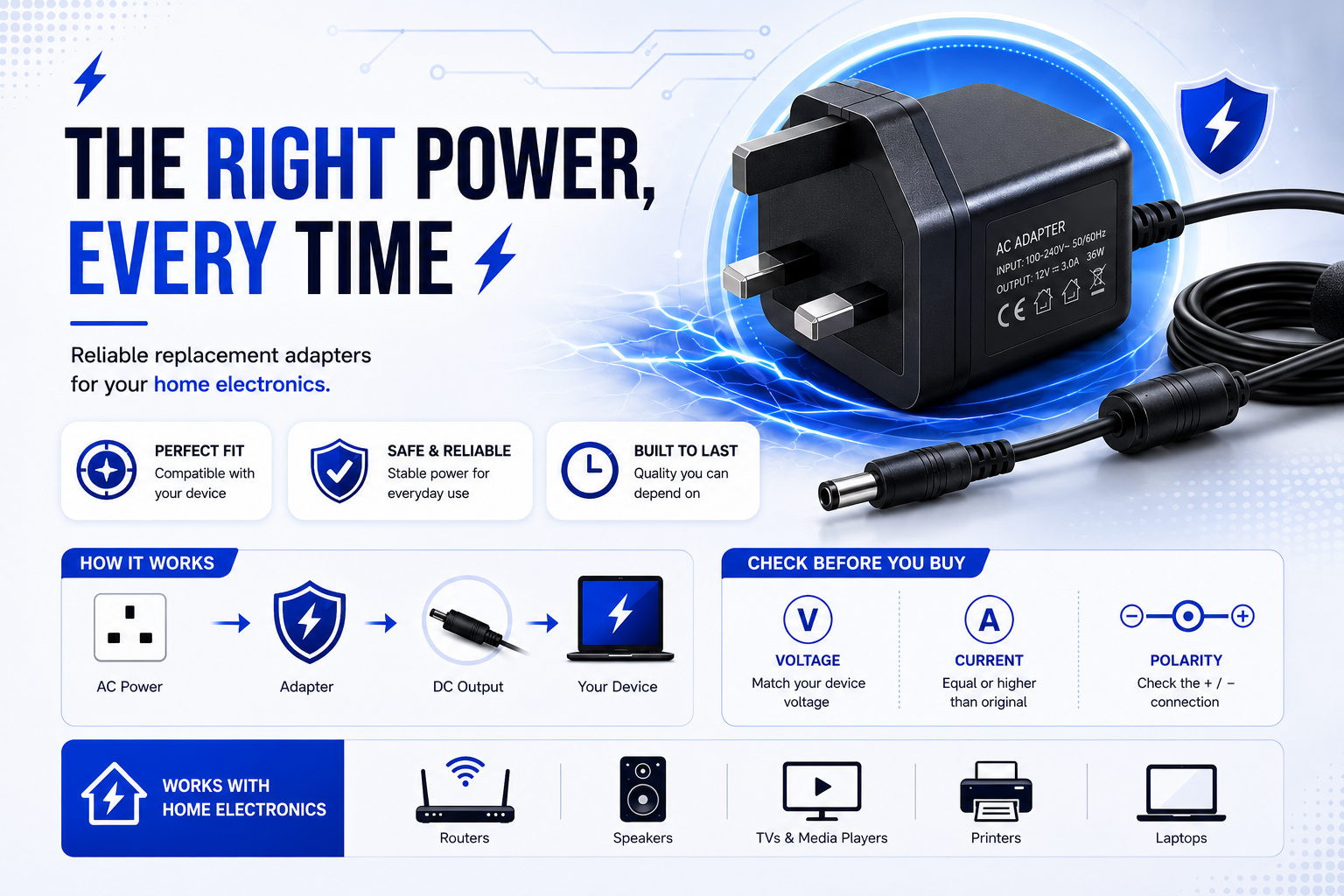
To ensure complete safety and peak performance, finding replacement power adapters requires strict adherence to three rigid electrical rules. Making an error on any parameter can result in electronic failure, component overheating, or a completely fried motherboard.
1. Voltage Must Match Exactly
The electrical voltage of your replacement power supply must match the input requirement of your device exactly. Voltage represents electrical pressure pushed into the circuit. Using a 12V adapter on a device designed for 5V pushes too much pressure into the system, causing components to overheat, melt, or short circuit instantly. Conversely, connecting a 5V adapter to a 12V system leaves the device underpowered, preventing correct performance. Always look for the “V” symbol on your old power brick or device input port.
2. Amperage Must Be Equal or Higher
While voltage must match exactly, electrical current or amperage behaves differently. Amperage represents total electrical volume drawn by the device. Equipment only pulls the specific current it needs to operate. Therefore, your replacement adapter must possess an amperage rating equal to or higher than the original requirement. If your router demands a 12V 1.5A supply, utilising a 12V 2.0A replacement is perfectly safe and highly efficient. The router will only draw 1.5A. Attempting to use a 12V 1.0A adapter causes the power supply to overheat, drop voltage, or fail prematurely.
3. Connector Tip Size and Polarity Must Align
Even if electrical values are correct, the physical connection must be flawless. Most electronics utilise a cylindrical barrel connector, defined by outer diameter (OD) and inner diameter (ID). Common sizes include 5.5mm x 2.1mm or 5.5mm x 2.5mm. A half-millimetre mismatch prevents fitting or creates a loose, sparking connection. You must also verify electrical polarity. The device label indicates which part of the barrel connector is positive and negative. The vast majority of modern electronics use a centre positive configuration, meaning the inner pin carries the positive charge. Connecting a centre-negative adapter to a centre-positive device causes instantaneous electrical destruction.

Finding an Accurate Compatible Electronics Charger for Common Devices
Different categories of household electronics feature distinct power profiles. Knowing what to look for simplifies your search.
Wireless Routers and Network Hubs
Most household routers operate continuously every hour of the day. Because they run constantly, their power units experience significant thermal stress over time, making them a frequent point of hardware failure. Routers typically demand a reliable 12V AC DC power adapter with a centre-positive barrel connector. When your home internet drops offline unexpectedly and the router status lights remain dark, the problem is almost always a failed power brick rather than an ISP signal outage.
Televisions and Smart Displays
Modern flat screen LED televisions and standalone display monitors frequently leverage external power bricks to keep the display housing remarkably thin and lightweight. These devices possess a much higher energy draw compared to standard networking equipment, typically requiring 19V or 24V inputs with an amperage output ranging anywhere from 3A to over 6A. When searching for a television power supply replacement, ensure the housing features robust internal heat management and strict UK electrical compliance certifications to safely handle the continuous load.
Audio Equipment and Bluetooth Speakers
Portable party speakers, amplifiers, and digital radio systems present distinct power challenges. These devices consume wildly variable levels of electricity depending on the output volume and bass thumps. Audio systems require exceptionally clean electrical filtering to prevent background buzzing, humming, or ground loop noise from contaminating the audio path. Standard multi-voltage universal adapters often lack the sophisticated filtering circuitry needed, making a dedicated, high-quality compatible replacement essential for pristine acoustic performance.
Frequently Asked Questions (FAQ)
Can I use a laptop charger on my internet router if the plug fits?
Only if electrical parameters line up perfectly. Most laptop chargers deliver 19V, whereas most network routers require exactly 12V. Plugging a 19V laptop charger into a 12V router destroys internal routing circuitry instantly.
My old adapter says 12V 1A, but the replacement is 12V 2A. Will this burn out my device?
No, it will not. The amperage rating on an adapter represents maximum delivery capacity, not forced flow. Your device draws only the 1A required, leaving the replacement adapter with operating headroom. This ensures the unit runs cooler and lasts much longer.
What happens if I accidentally use an adapter with reversed polarity?
Using an adapter with reversed polarity permanently destroys your device within a fraction of a second unless the equipment features built in reverse polarity protection. Components on the circuit board will burn out immediately, often accompanied by smoke.
Why does my new universal adapter make my home speakers buzz?
Generic universal adapters often utilise cheap, poorly insulated switching components that leak electromagnetic interference. When attached to audio gear, this electrical noise translates directly into an audible background hum. Dedicated replacement power adapters utilise clean filtering capacitors to prevent this.
Is a loose power plug dangerous?
Yes, highly dangerous. If connector diameters do not match tightly, electricity sparks across the gap. This intermittent connection causes localized heat buildup, melting the plastic housing or starting an electrical fire.
Conclusion
Replacing a missing or failed power supply does not have to be a guessing game. By ensuring your replacement power adapters match the required voltage exactly, provide an equal or greater amperage capacity, and feature the correct tip size and polarity, you can restore life to your home electronics safely. Avoid the risks of unbranded, low quality universal adapters that skip vital safety testing.
Protect your valuable home infrastructure by selecting fully certified, model specific replacement power supplies tailored precisely to your device needs. Visit our full store catalogue today to find the exact, premium compatible power solution for your routers, screens, and audio gear with fast UK delivery.