

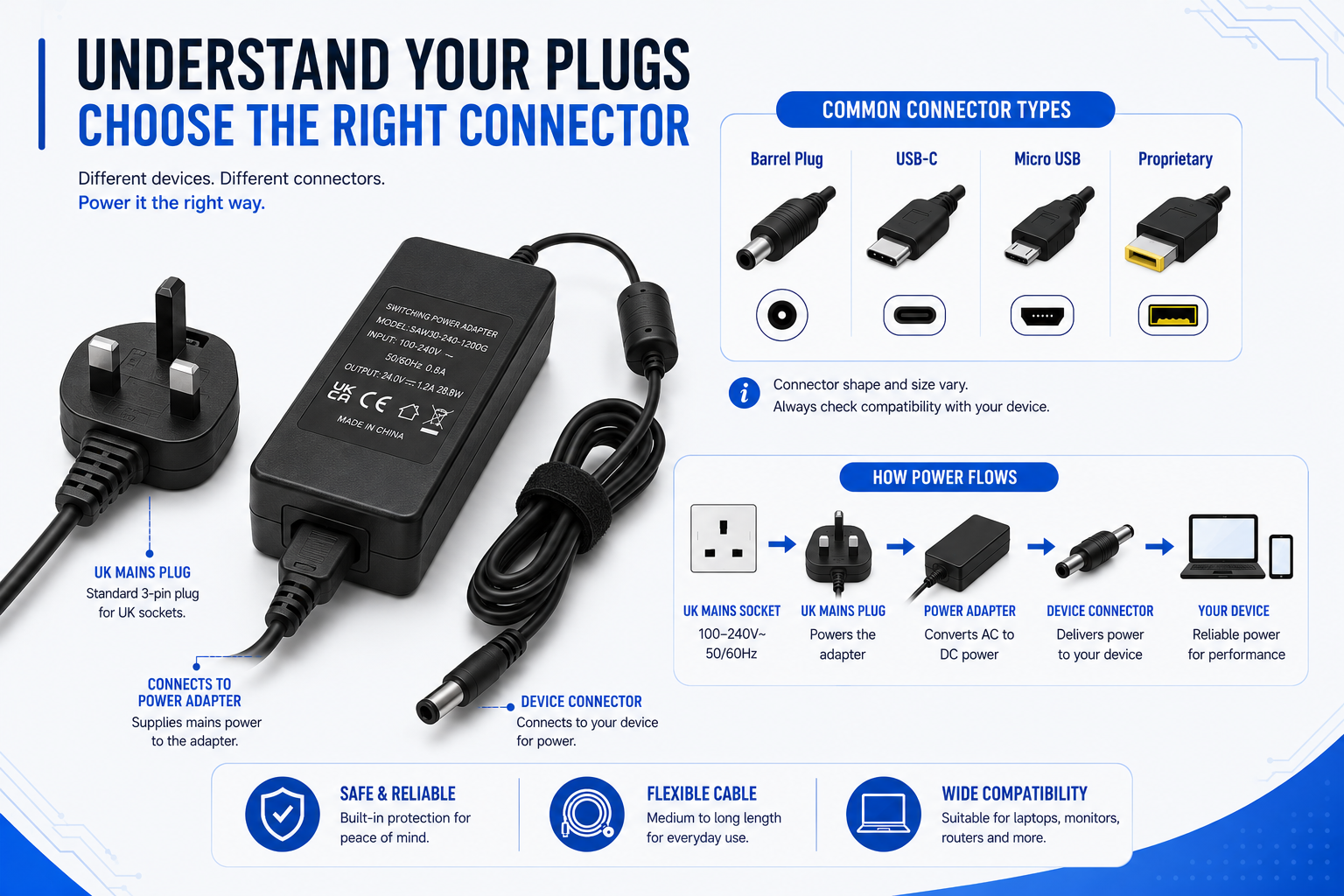
Finding the exact replacement charger for an electronic device can be incredibly frustrating. With hundreds of charger connector types circulating across the UK market, ordering the wrong size plug online is one of the most common consumer purchasing errors. Whether you are looking to breathe life back into a flashing broadband internet router, a primary workspace laptop, or an LED television set, identifying the precise layout of your power plug is essential to getting back up and running safely.
This guide breaks down the most common charger connector types, outlines simple ways to measure them accurately down to the millimetre, and ensures you can select an affordable, reliable, and perfectly compatible replacement power supply with confidence.
1. DC Barrel Jacks: The Cylindrical Standard
DC barrel jacks are cylindrical power connectors featuring an outer metallic sleeve and an insulated hollow centre core. They are identified by measuring their Outer Diameter (OD) and Inner Diameter (ID) in millimetres. These plugs serve as the primary power connection across thousands of consumer devices, including network hubs, smart TV boxes, and home electronics.
Understanding the Barrel Blueprint
The classic cylindrical “barrel plug” remains the absolute workhorse of household electronics. This connector relies on a dual-contact structure where the exposed outer metal wall represents the Outer Diameter (OD), acting as one electrical contact point. Meanwhile, the insulated inner ring space represents the Inner Diameter (ID), which is designed to slide over a solid pin embedded deep inside the device’s receiving port.
Because many barrel jacks look virtually identical to the naked eye, buyers frequently mistake their sizes. For instance, a plug measuring $5.5\text{mm} \times 2.1\text{mm}$ looks exactly like a $5.5\text{mm} \times 2.5\text{mm}$ plug on a screen, yet they are not interchangeable.
Examples & Common Matches
- $5.5\text{mm} \times 2.1\text{mm}$: Widely deployed on mainstream network boxes and peripheral electronics. If your router goes offline, you can quickly find a high-quality compatible 12V power adapter for router systems featuring these exact specifications.
- $5.5\text{mm} \times 2.5\text{mm}$: Designed to handle higher current loads safely. This size is commonly used on home screens, such as compatible Alba 22-inch LED TV power supplies.
Common Mistakes
The most frequent mistake is guessing the size purely by sight. If you attempt to plug a $5.5\text{mm} \times 2.1\text{mm}$ cable into a $2.5\text{mm}$ device pin, the internal dimensions will not clear the pin, making it impossible to insert. Conversely, using a $2.5\text{mm}$ plug on a $2.1\text{mm}$ pin leaves a loose gap, causing intermittent power connections or dangerous electrical arcing.
Buying Advice
Always locate the small silver sticker or moulded plastic text on your original power brick to find the millimetre specs. When buying an affordable third-party alternative, select an expert UK provider that guarantees precise structural dimensions so your equipment stays fully powered.
Definition Box: DC Barrel Jack
A concentric cylindrical power adapter tip characterized by an external metallic cylinder sleeve (Outer Diameter) and an insulated centre hollow core (Inner Diameter) built to transfer low-voltage Direct Current safely to a standalone electronic appliance.

2. USB Type-C: The Modern Universal Standard
USB Type-C is a compact, 24-pin reversible connector that utilises the advanced USB Power Delivery (USB-PD) protocol to stream high-capacity power. It has rapidly become the universal charging standard for modern smartphones, premium tablets, and lightweight contemporary laptops.
Intelligent Power Delivery Negotiation
Unlike traditional barrel plugs that push a single fixed voltage down a cable, USB Type-C connectors are highly intelligent. When you plug a high-quality USB-C adapter into a device, internal configuration chips execute a digital handshake. This conversation allows the power supply to adjust its output to exactly what the device needs—whether that is 5V for a small handheld accessory or 20V for a high-performance laptop. You can read up on these technical staging layers on the official USB-IF Charger and Power Delivery Hub.
Common Mistakes
A widespread error is assuming all USB-C cables and bricks offer identical charging speeds. Using a basic phone charger cord to power a demanding laptop often fails. While the plug will physically fit perfectly, the internal wires of a standard phone cord lack the required thickness or smart e-marker microchips to transmit higher currents safely, resulting in slow charging or no power delivery at all.
Buying Advice
Always verify that your replacement brick supports the specific wattage and voltage configurations required by your machine. When dealing with modern compact devices, choosing a properly rated option like a premium Lenovo Ideapad Miix 320 laptop charger ensures your battery charges efficiently without overheating or straining its internal components.
3. Proprietary & Multi-Pin Laptop Connectors
Proprietary multi-pin connectors are custom-engineered charging tips—such as square shapes or pins surrounded by thick metal rings—designed by individual brands exclusively for their own hardware lines. These unique shapes prevent users from accidentally connecting a charger with an incompatible voltage profile.
The Manufacturer Ecosystem
For years, major computing brands created unique connector profiles to lock consumers into their respective ecosystems. Lenovo developed a distinctive rectangular “slim tip” coated in yellow plastic that mimics a USB port but routes high-amperage DC lines. Other manufacturers utilise smart centre pins that transmit data signals back to the machine, confirming that an authorised safety-compliant adapter is attached.
Comparing Common Charger Connector Types
| Connector Profile Shape | Core Technical Dimensions | Typical Appliance Placement | Common Voltage Baselines |
| Cylindrical Barrel | $5.5\text{mm} \times 2.5\text{mm}$ | Larger LED TVs / Soundbars | 12V – 19V |
| Cylindrical Barrel | $5.5\text{mm} \times 2.1\text{mm}$ | Home Wi-Fi Routers & Modems | 9V – 12V |
| Oval / Flat Reversible | USB Type-C (Universal PD) | Modern Laptops & Mobile Tech | 5V / 9V / 15V / 20V |
| Rectangular Plug | Lenovo “Slim Tip” Layout | ThinkPad Business Notebooks | 20V |
| Micro Cylinder Barrel | $3.5\text{mm} \times 1.35\text{mm}$ | Budget Netbooks & HD Tablets | 5V – 12V |
Troubleshooting: How to Measure Your Connector Accurately
If your old power brick is missing its sizing text and you do not own a digital caliper, you can easily verify your plug dimensions at home using this method:
- Line Up with a Metric Ruler: Lay the round metal tip flat against a standard ruler with clear millimetre markings.
- Determine the Outer Diameter (OD): Measure the total distance across the widest external edges of the circular metal tip. A standard large barrel tip will measure exactly $5.5\text{mm}$.
- Inspect the Inner Hole (ID): Look straight down into the centre opening. Compare it visually to a standard fine pin or needle to determine if it is a narrow $2.1\text{mm}$ path or a wider $2.5\text{mm}$ opening.
- Confirm the Device Label: Check the underside of your device for a small stamped logo or text panel specifying the required DC input voltage and current values.

Myth vs Fact
- Myth: If a replacement charger tip physically slides into your device’s charging port, it is completely safe to plug it into the wall.
- Fact: Many barrel tips look identical on the outside but feature inverted polarity configurations. Plugging a centre-negative power supply into a device that requires a centre-positive connection can instantly short-circuit and ruin your equipment’s internal circuit board. You can explore consumer compliance and insulation standards regarding UK hardware assembly directly on the British Standards Institution Electronic Products Portal.
Buying Checklist for Replacement Adapters
- Verify Tip Polarity: Look at the technical label on your device to confirm the polarity diagram matches your replacement power brick ($\oplus$ Centre Positive).
- Confirm the Plug Shape: Is your device’s port a round barrel jack, a flat USB-C connection, or a specialized square block?
- Check the Exact Dimensions: Measure carefully to verify the outer and inner diameters match your original plug down to the millimetre.
- Match the Voltage Output: Ensure the replacement power supply provides the exact voltage your device requires (e.g., a 12V device needs an adapter with an exact 12V output).
- Verify Amperage Capability: The replacement charger’s current rating (Amps) must be equal to or higher than your device’s original requirement. For example, a 3A adapter can safely replace a 2A adapter, as the device will only pull the current it needs.
FAQs
What is the standard DC barrel plug size used for internet routers in the UK?
The most common plug size for residential UK broadband boxes and routers features a $5.5\text{mm}$ Outer Diameter combined with either a $2.1\text{mm}$ or $2.5\text{mm}$ Inner Diameter. Always cross-check your specific network device model before purchasing a replacement.
Is it safe to use a power supply with a higher amperage rating than my original one?
Yes, it is completely safe. Your electronic device will only draw the specific amount of current (Amps) it needs to operate. Using an adapter with a higher amp ceiling simply means the power supply runs cooler and under less strain.
What happens if I connect an adapter with the wrong voltage to my device?
Using a voltage rating that is too low can cause your device to behave erratically or fail to power on. Using a voltage that is too high will overload internal components, causing permanent board damage and presenting a serious electrical hazard. Always match voltage requirements exactly.
How can I tell if a device requires a centre-positive connection?
Look for a small three-ring diagram printed on the product label. If the centre line connects directly to a plus sign ($\oplus$), the device utilises a centre-positive configuration, meaning the inside pin carries the positive charge.
Can I use an old ASUS laptop charger on a newer Lenovo laptop?
Generally no. Even if the cylindrical shapes look similar, various brands use slightly different outer diameters, distinct pin layouts, or internal smart verification chips that block cross-brand power delivery.
Conclusion
Navigating the wide world of charger connector types does not have to be a guessing game. By identifying your plug’s shape, measuring its physical dimensions accurately, and confirming vital electrical specifications, you can easily choose a safe and efficient power solution.
Avoid the hassle of incorrect online orders and protect your devices from dangerous power mismatches. Explore our comprehensive collection of fully tested, safety-certified compatible replacement power adapters at Power Adapter Warehouse to find your perfect match today!