

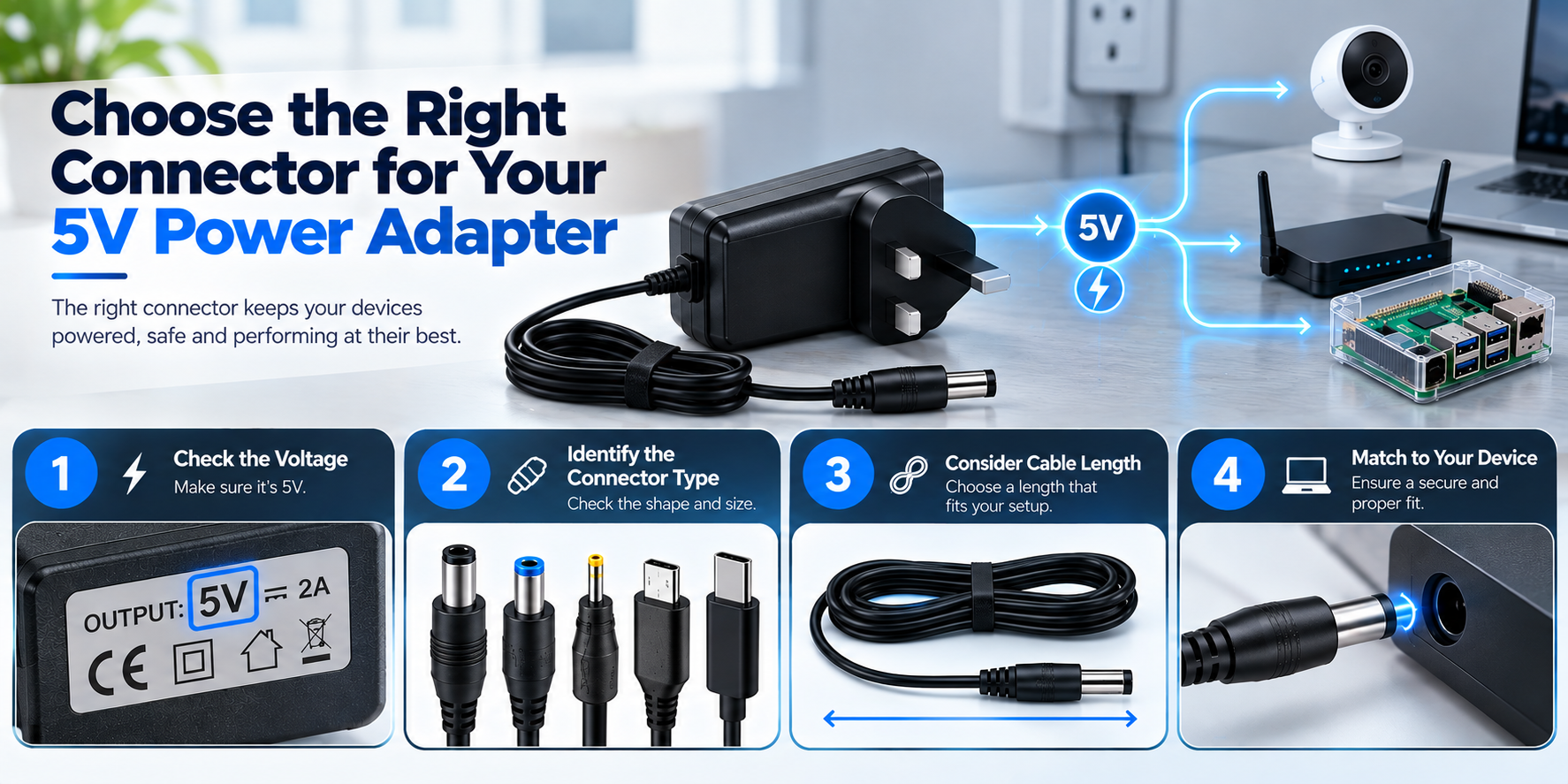
Finding the correct 5V power adapter connector can seem simple until you discover that the plug does not fit your device. A matching 5V rating is important, but it is only one part of compatibility.
The connector must also be the correct type and size, and the polarity must match where applicable. For barrel plugs, both the outer and inner diameter matter. USB-powered devices require you to identify the correct USB connector and confirm the device’s power requirements.
This guide explains how to identify the right fit before buying a replacement.
How Do You Find the Correct 5V Power Adapter Connector?
Identify the connector type used by your device, then confirm its size, polarity and electrical requirements. For a barrel connector, check both the outer and inner diameter. For USB, identify the connector type and make sure the adapter’s output is suitable for the device.
The easiest place to start is the original adapter, device label or manufacturer’s documentation.

What Information Should You Check First?
Before buying a connector or replacement adapter, check the original adapter, device label, manual and model number. These can reveal the required voltage, current, connector type and polarity.
Do not choose a connector simply because it looks similar to the original. Small differences can make an adapter incompatible.
Check the Original Adapter Label
The adapter label may show information such as 5V, 1A, 2A, connector specifications and a polarity symbol.
If the original adapter is missing, check the device’s input label or manual. You need to identify the complete power requirement rather than matching only the voltage.
A replacement adapter can have the correct 5V output but still have the wrong connector or polarity.
How Do You Identify a 5V Barrel Connector?
A DC barrel connector is normally identified using two measurements: outer diameter and inner diameter.
For example, 5.5mm x 2.1mm means the barrel has a 5.5mm outer diameter and a 2.1mm inner diameter.
Common sizes can look almost identical, so checking both measurements is essential.
A useful example is this 5V 1A power adapter with a 5.5mm x 2.1mm connector, which shows why the complete connector specification matters.
Measure Both Connector Diameters
A digital calliper is useful when measuring a barrel plug.
Measure the outside of the metal barrel for the outer diameter and the internal opening for the inner diameter.
If you do not have suitable measuring equipment, use the original adapter’s specifications or the device manufacturer’s documentation.
Avoid estimating the size from appearance. A small difference in the inner diameter can affect how securely the plug connects to the device.
How Do You Check Polarity on a 5V Adapter?
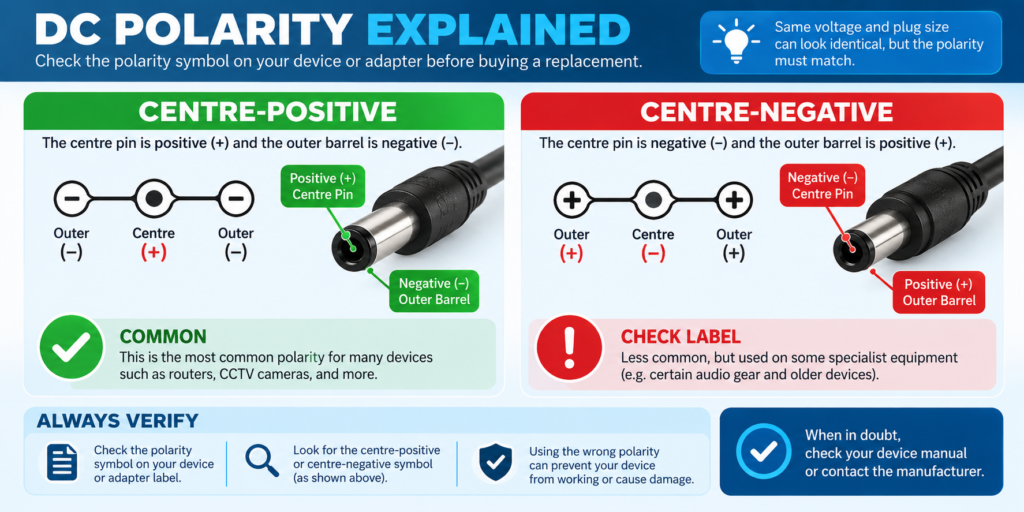
Polarity identifies which part of a DC connector carries positive and negative voltage.
Many barrel adapters use centre-positive polarity, but you should not assume this applies to every device.
Check the polarity symbol on the original adapter, device or product specification. The replacement adapter should have the polarity required by the equipment.
Correct physical dimensions alone do not make a power connector electrically compatible.
Compare the Polarity Symbol
A typical DC polarity symbol shows a centre point and an outer ring with positive and negative indicators.
Compare this symbol with the replacement adapter’s specification.
If the polarity information is missing or unclear, check the device documentation before connecting an adapter. This is particularly important when working with older electronics or equipment using less common power arrangements.
What If Your 5V Device Uses USB?
USB-powered devices can use connectors such as USB-A, Micro-USB and USB-C.
These connectors have different physical designs, so identifying the connector is the first step. However, physical compatibility is not enough. You should also check the device’s required power specification.
For USB-C products, the official USB Type-C specification is a useful technical reference when checking connector information.
Identify the Exact USB Connector
USB-C is reversible and has a small oval-shaped connector, while Micro-USB has a different, non-reversible design.
If your device requires USB-C, confirm that the replacement adapter is intended for that device and provides an appropriate output.
Do not assume every USB-C adapter is interchangeable simply because the plug physically fits. The device’s specifications should always be the final compatibility reference.
Can a Higher-Current 5V Adapter Use the Same Connector?
A higher-current adapter can be suitable when the voltage, connector, polarity and other compatibility requirements match.
The current rating describes the adapter’s available capacity rather than forcing that amount of current into the device.
For example, a compatible 5V 2A adapter may be suitable for equipment requiring 5V 1A. However, current capacity does not compensate for an incorrect connector.
Compare Every Specification
Think of adapter selection as a complete compatibility check.
Confirm:
- Voltage
- Current capacity
- Connector type
- Connector dimensions
- Polarity
- Device compatibility
For example, a device requiring 5V 1A with a 5.5mm x 2.1mm centre-positive connector should not automatically be paired with a 5V 2A adapter using a 5.5mm x 2.5mm plug.
The current rating may be adequate, but the connector is different.
Frequently Asked Questions
How do I know what size connector my 5V adapter needs?
Start with the original adapter’s specifications or the device manual. For a barrel connector, identify both the outer and inner diameter, such as 5.5mm x 2.1mm.
If documentation is unavailable, a digital calliper can help measure the plug. Do not rely only on visual appearance because connectors with similar dimensions can have different internal openings.
Are all 5V power adapters interchangeable?
No. A 5V rating only identifies the output voltage.
Adapters can have different current ratings, connector dimensions, polarity and connector types.
A 5V barrel adapter is not automatically interchangeable with a USB-C adapter, even though both can provide 5V.
The replacement should match the device’s complete electrical and physical requirements before use.
Is a 5V 2A adapter safe for a 5V 1A device?
It can be suitable when the device accepts 5V and the connector, polarity and other specifications match.
The 2A rating indicates the adapter’s maximum available current capacity, not that it will automatically force 2A into the device.
Always compare the complete adapter specification with the device requirement.
What is the difference between 5.5mm x 2.1mm and 5.5mm x 2.5mm?
Both barrel connectors have a 5.5mm outer diameter, but their inner diameters differ.
This difference affects how the plug contacts the device’s socket. A connector may therefore look correct while being too loose or otherwise incompatible.
Always check both measurements in the product specification before ordering a replacement adapter.
What should I do if I cannot identify the connector?
Do not guess.
Record the device brand and model, check the original adapter label and look for specifications in the device manual.
If the connector is a barrel plug, measure its dimensions where possible. You should also confirm polarity and current requirements.
If important specifications remain unknown, seek reliable technical advice before connecting a replacement adapter.
Conclusion
Finding the correct connector for a 5V power adapter requires more than matching the number “5V”.
Check the device’s voltage and current requirements, identify the connector type, confirm barrel plug dimensions where applicable and verify polarity.
For USB-powered equipment, identify the correct USB connector and check the device’s power requirements.
Once these details are confirmed, you can compare compatible replacement adapters with much greater confidence.
For additional information about electrical equipment and product safety in Great Britain, readers can refer to the relevant GOV.UK guidance.