

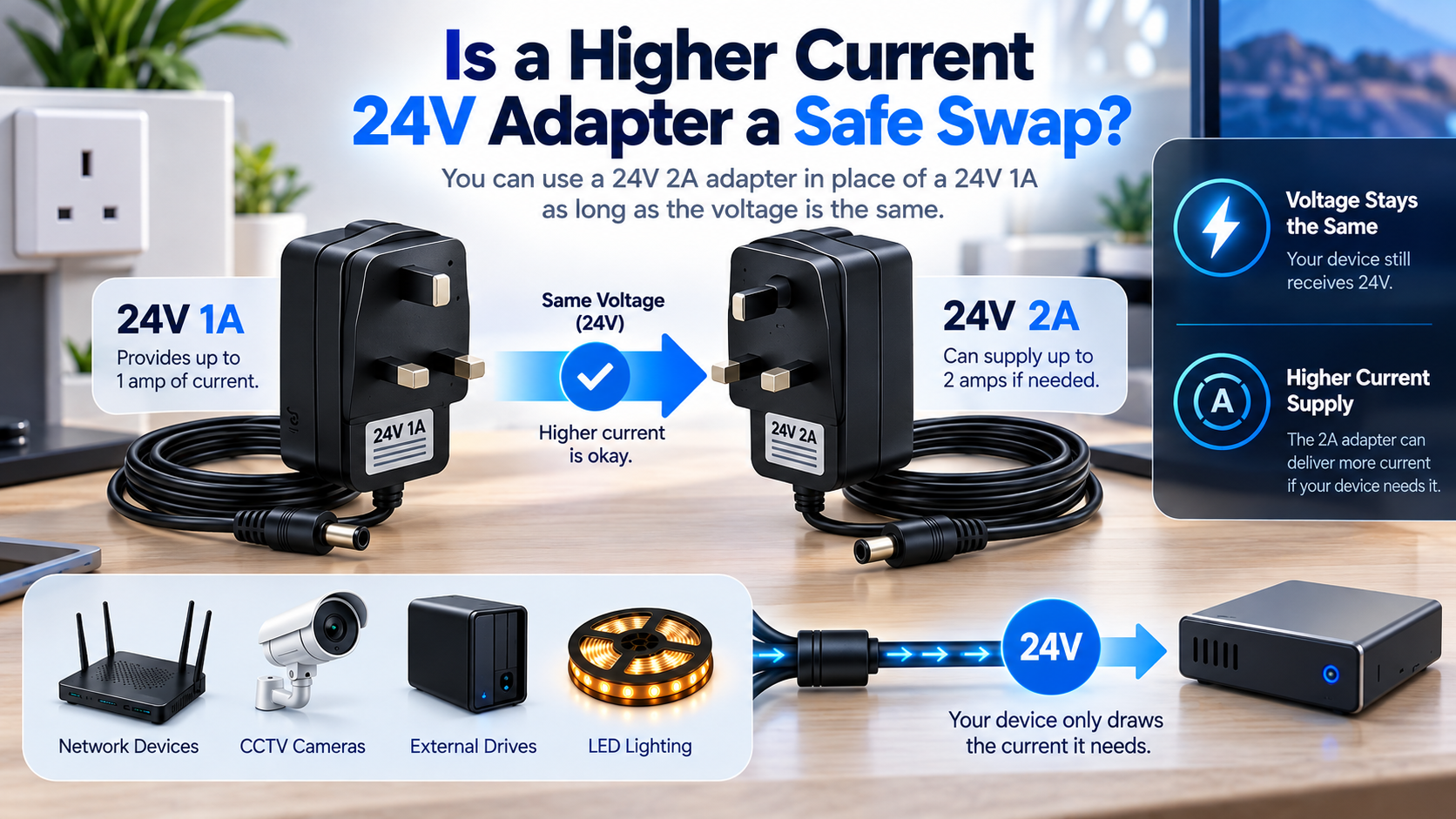
Before you use a 24V 2A adapter instead of 24V 1A, it helps to know that finding a replacement power supply for your electronics can feel like navigating a minefield of technical jargon. Whether you need a charger for a home router, a musical keyboard, or specialised audio gear, stumbling across a replacement with a higher amperage rating is common. A frequent dilemma for UK consumers is whether swapping out the original adapter for a more robust version will fry your equipment or offer a safer, cooler alternative. Understanding how electrical current flows between a power source and your appliance removes guesswork, ensuring you can restore power safely, affordably, and sustainably without generating e-waste.
Understanding Voltage and Amperage Basics
Electrical adapters act as miniature conversion stations, turning mains electricity into usable Direct Current (DC) for your electronics. Voltage (measured in volts) is the electrical pressure pushing power through the circuit. Supplying higher voltage will damage sensitive internal components, while lower voltage causes operational failure. Amperage (measured in amperes or amps), however, measures the maximum current capacity the adapter can safely deliver. Think of voltage as water pressure in a pipe and amperage as the maximum volume of water the pipe can handle.
Practical Example / Use Case
Consider an electric keyboard or LED driver designed for a 24V 1A specification. If you plug in a high-quality replacement, the device only draws the 1 amp it needs. The extra capacity remains in reserve. Because the adapter operates well below its maximum threshold, it runs cooler and experiences less internal wear over extended periods of daily use. Explore matching options in the 24V Power Adapter Collection.
Will Using a 24V 2A Adapter Instead of 24V 1A Damage Your Device?
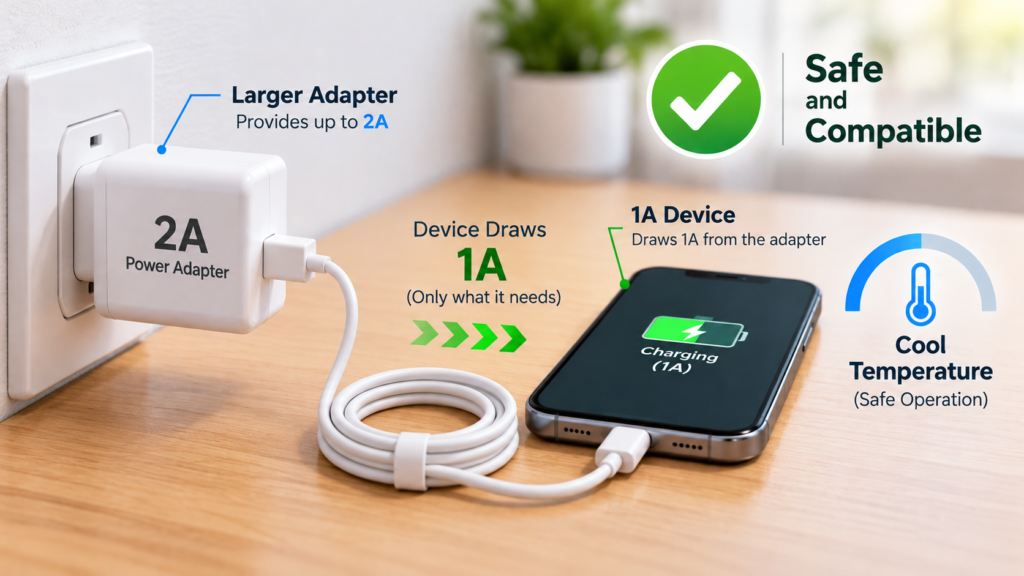
A common misconception is that a power supply forces its full current rating into a connected appliance. In reality, electrical current is drawn by the load, not pushed by the source. Ohm’s law dictates that given a fixed voltage and a fixed device resistance, current draw remains constant regardless of how many amps the supply can provide. As long as the voltage output matches the requirement of 24 volts precisely, stepping up from 1A to 2A introduces zero risk of electrical overloads or thermal runaway.
Practical Example / Use Case
Imagine replacing the original power brick on equipment calling for 24V 1A using a higher-rated compatible adapter. When connected, the hardware regulates its own power intake, drawing precisely what it needs while ignoring extra capacity. For hardware requiring robust current delivery, consider upgrading to a 24V 2A AC/DC Adapter.
What Must Match When Replacing Power Adapters?
Although current flexibility is a helpful rule of thumb, other electrical and physical parameters allow zero room for error. First, the voltage must be identical; a 24V device requires a 24V adapter. Second, you must verify barrel connector polarity, usually indicated by a diagram showing whether the centre pin is positive or negative. Reversing polarity can instantly short circuit sensitive microchips. Finally, physical barrel plug dimensions (such as 5.5mm x 2.1mm) must form a snug, secure physical connection to maintain stable electrical contact.
Practical Example / Use Case
You are ordering a replacement power supply for specialised studio equipment. You verify that both old and new adapters output 24V and that the replacement offers 2A or higher. Before plugging it in, you double-check the barrel tip diagram to ensure centre-positive polarity matches your hardware socket. Taking two minutes to check these compatibility markers prevents blown fuses when using a standard 24V 2A switching adapter.
Benefits of Upgrading to a Higher Amperage Power Supply
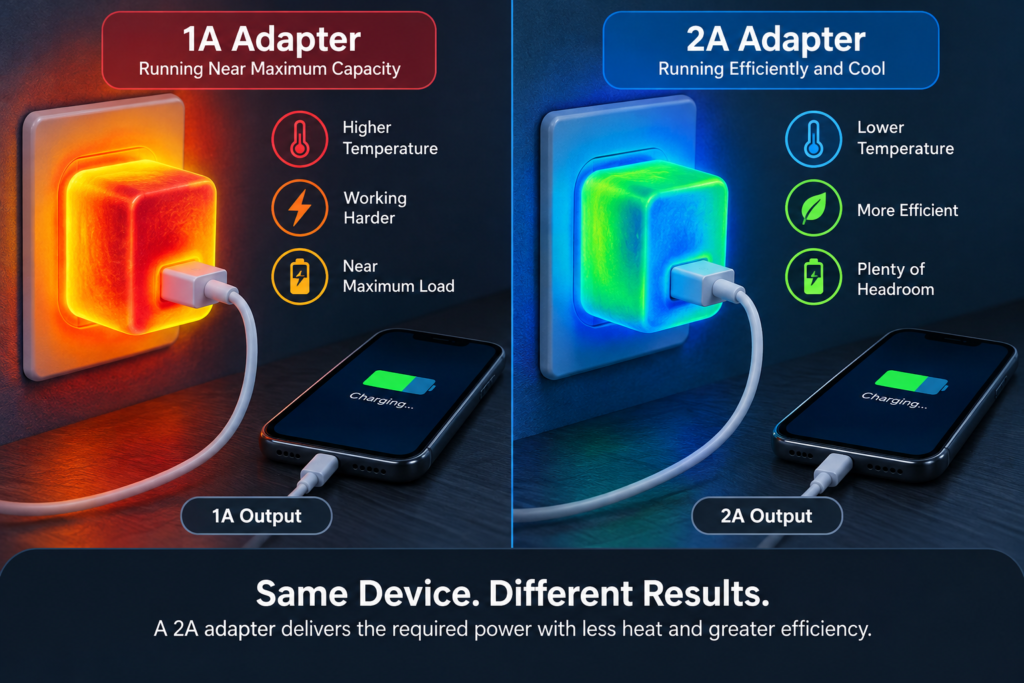
Power adapters operating at maximum capacity generate substantial internal heat, which degrades capacitors and electronic components over time. When you use a 2A adapter to power a device demanding only 1A, the power supply runs at roughly 50% capacity instead of running near 100%. This reduced operational stress lowers operating temperatures, increases energy efficiency, and prevents premature thermal degradation, making it a smart upgrade for devices left powered on continuously.
Practical Example / Use Case
A small business owner running network hardware or continuous equipment 24/7 experiences frequent power supply failures due to cheap 1A adapters overheating in enclosed spaces. Upgrading to robust adapters like the 24V Power Adapter for Electric Curtains and Equipment reduces thermal strain across the hardware array.
Frequently Asked Questions (FAQs)
Can I use a 24V 1A adapter if my device requires 24V 2A?
No, you should never use a lower amperage adapter than what your device specifies. If an appliance demands 2 amperes and you supply only 1 ampere, the power adapter will become severely overloaded, overheat rapidly, and potentially fail or pose a fire hazard. Always match or exceed the original amperage requirement.
Does voltage have to match exactly on a replacement charger?
Yes, the voltage must match your device requirements with absolute precision. While amperage can be higher, voltage cannot vary. Plugging a device into a higher voltage adapter floods internal circuits with excessive electrical pressure, frying microprocessors and destroying equipment instantly.
How do I check my device’s power requirements?
You can find your device’s power requirements printed on a small label or specification plate located on the bottom or back of the appliance, or near the power input jack. Look for input specifications, which typically read like “Input: 24V DC 1A”.
What does the polarity symbol mean on a power adapter?
Polarity symbols indicate the configuration of positive and negative connections inside the barrel plug tip. Most modern electronics use a centre-positive configuration, denoted by a symbol showing lines connecting a positive sign to the inner dot and a negative sign to the outer ring.
Where can I buy safe replacement power adapters in the UK?
You can purchase safe, high-quality, and fully tested replacement power adapters directly from specialised UK suppliers like Power Adapter Warehouse. Buying locally ensures compliance with rigorous UK safety standards.
Conclusion
Replacing a lost or broken charger does not have to be stressful. You can safely use a 24V 2A power adapter in place of a 24V 1A adapter because devices draw only the current they need. As long as your voltage matches precisely, your polarity is correct, and the physical plug fits snugly, a higher amp adapter provides a cooler, more reliable power source. Explore our range of compliant, reliable power solutions at Power Adapter Warehouse today.