

Can You Safely Use a Higher-Amp Powered Speaker Adapter?

Yes, you can generally use a higher-amp powered speaker adapter, provided the voltage is correct and the connector size and polarity match. A higher current rating does not normally force extra current into the speaker. It means the adapter has more available capacity.
For example, if your powered speaker requires 12V 2A, a compatible 12V 3A adapter may be suitable. However, a 15V or 24V adapter should not be used simply because it has enough current capacity.
Understanding the difference between voltage and amperage is essential when choosing a replacement.
What Does the Amp Rating on a Power Adapter Mean?
The amp rating tells you the maximum current the adapter is designed to provide. You might see specifications such as 12V 1A, 12V 2A, 12V 3A, 15V 2A or 19V 3.42A.
If a powered speaker requires 12V 2A, a 12V 3A adapter has greater current capacity. This does not mean the speaker automatically receives 3A. The speaker draws the current it needs from a suitable power source.
That is why a higher-amp replacement can often be acceptable when the other specifications match.
Why Voltage Must Match
Voltage is different from amperage. For a powered speaker requiring a specific DC voltage, the replacement adapter should normally provide the same voltage specified by the manufacturer.
For example:
Speaker requirement: 12V 2A
Replacement: 12V 3A
This can potentially be compatible because the voltage remains 12V and the replacement has greater current capacity.
Compare that with:
Speaker requirement: 12V 2A
Replacement: 15V 3A
The second replacement has more current capacity, but its voltage is also higher. It is unsuitable simply because it has a higher amp rating. Incorrect voltage can cause malfunction or potentially damage internal electronics.
Is a Higher-Amp Adapter Safer Than a Lower-Amp Adapter?
A higher current rating is generally preferable to an adapter with insufficient current capacity, assuming the voltage, connector and polarity are correct.
Suppose a powered speaker requires 12V 2A. A suitable replacement might be 12V 2A, 12V 2.5A, 12V 3A or 12V 4A.
A 12V 1A adapter may not provide enough current for a speaker requiring 2A. This can result in unstable operation, voltage drop, overheating or the adapter shutting down under load.
For portable PA equipment, where power demand can increase during louder operation, sufficient current capacity is particularly important.
A 12V replacement adapter for QTX QR10PA is an example of choosing a replacement around the equipment’s specified requirements.
What Else Must Match Besides Amperage?
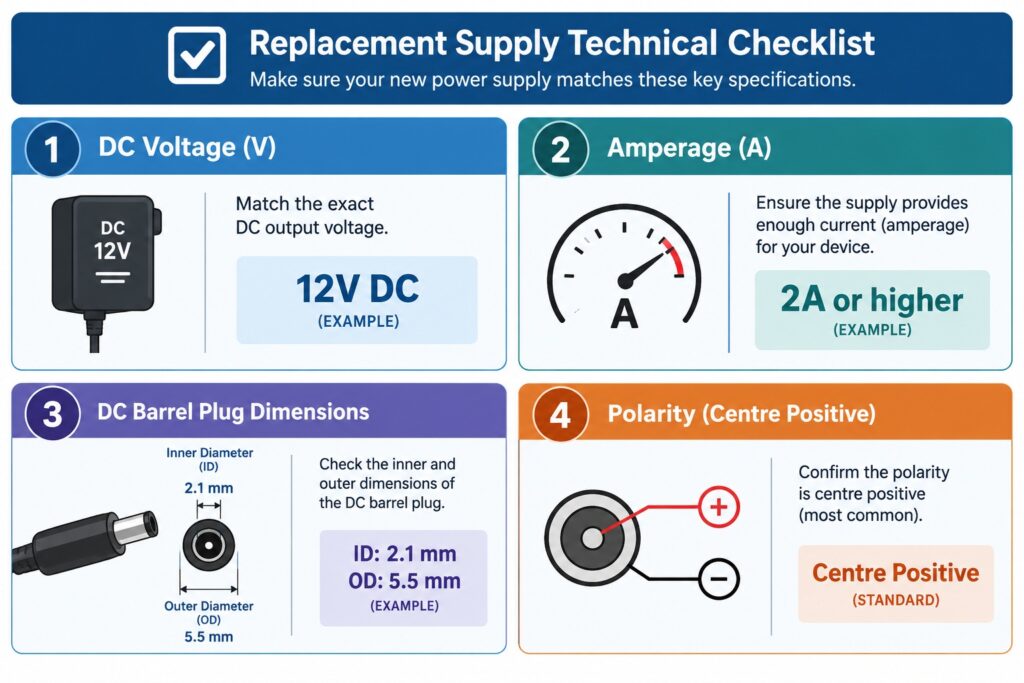
A higher amp rating is only one part of compatibility. Before connecting a replacement powered speaker adapter, check these four specifications:
1. Voltage
The adapter should provide the voltage required by the speaker.
2. Current
The adapter should normally provide at least the current required by the speaker.
3. Connector Size
The DC connector must physically and electrically match the speaker’s input. Similar-looking barrel connectors can have different dimensions.
4. Polarity
The polarity must also match. Many DC barrel connectors are centre-positive, but this should always be confirmed rather than assumed.
A replacement with the wrong polarity may still be unsuitable even when its voltage and connector appear correct.
Can a Higher-Amp Powered Speaker Adapter Cause Damage?
A higher current rating by itself is not normally what causes damage. The bigger concerns are incorrect voltage, polarity or connector configuration.
Replacing a 15V 2A adapter with a correctly matched 15V 3A adapter is different from replacing it with a 19V 3A adapter. The first has higher current capacity while keeping the required voltage. The second increases voltage as well.
For general UK electrical safety information, the Health and Safety Executive (HSE) provides official guidance on electrical risks.
How Do You Check Your Powered Speaker’s Requirements?
Start with the label on the speaker or original power adapter. Look for:
- Input voltage
- Required current
- DC symbol
- Polarity symbol
- Model number
- Connector information
If the label says Input: 12V DC 2A, the replacement needs to provide 12V DC and sufficient current capacity.
If the original adapter has been lost, use the speaker’s model number to find its documented power requirements. Different products can require different adapters. For example, the replacement adapter for Pyle PPHP1044B is intended for that specific speaker, while the JBL Control 2.4G active speaker adapter uses a different 20V supply.
This is why you should not assume that one powered speaker adapter works with another.
Can You Use a Higher-Amp Adapter for Any Powered Speaker?
Not automatically. A higher current rating can be acceptable only when the adapter is otherwise electrically compatible.
Confirm the manufacturer’s requirements, including voltage, connector and polarity. Some equipment may have specific power supply requirements beyond basic voltage and current figures. If the manufacturer specifies a particular adapter type, follow those requirements.
Matching the exact speaker model can provide additional confidence. A Positive Grid Spark 40 compatible 19V adapter is one example of model-specific power equipment.

What Is the Best Replacement for a Powered Speaker?
The best replacement is not simply the adapter with the highest amp rating.
Choose an adapter that:
- Matches the speaker’s required voltage.
- Meets or exceeds the required current.
- Has the correct connector size.
- Has the correct polarity.
- Is compatible with the specific speaker model.
- Is suitable for a UK mains supply.
A 15V replacement adapter for QTX QR10PA (for models rated at 15V rather than the 12V version) is an example of selecting a replacement based on a specific voltage and model rather than choosing a higher-rated supply at random.
For products sold in the UK, relevant product conformity requirements should also be considered. The UK Government provides UKCA marking guidance. When disposing of an unwanted or damaged adapter, follow applicable UK electrical waste responsibilities and recycling guidance.
Frequently Asked Questions
Can I use a 12V 3A adapter instead of 12V 2A?
Generally, yes, provided the connector size and polarity are correct and the adapter is suitable for the speaker.
Is higher amperage bad for a powered speaker?
Not necessarily. A higher current rating can be suitable because the speaker normally draws only the current it requires. The voltage must still match.
Can I use a higher-voltage adapter if it has the correct amps?
No. A higher current rating does not make a higher-voltage adapter safe. The speaker should receive the voltage specified for its input.
Does a higher-amp adapter make a speaker louder?
No. A higher amp rating provides additional current capacity. It does not automatically increase the speaker’s volume.
What should I check before buying a higher-amp replacement?
Check the speaker’s voltage, current requirement, connector size, polarity and model compatibility.
Final Thoughts
A higher-amp adapter can be a suitable replacement for a powered speaker when the voltage remains correct and the connector and polarity match.
Think of amperage as the adapter’s available current capacity. If the speaker needs 2.5A and the compatible adapter can provide 3.42A, the extra capacity does not automatically get pushed into the speaker.
Before connecting any replacement, check the speaker’s label or model information and compare the complete electrical specifications. This can help you avoid buying an adapter that fits physically but is electrically unsuitable.