


Finding a replacement 24V power adapter can look easy until you compare different products and realise that “24V” is only one part of the specification. Two adapters can provide the same voltage while having different current ratings, connectors or polarity.
If your original adapter has failed, been lost or become damaged, start with the information printed on its label or the input specification on the device. This gives you the electrical requirements you need to compare before purchasing a replacement.
Before buying, check five key specifications: voltage, current, output type, connector and polarity. The device model or original adapter can provide additional confirmation. Matching only the 24V rating is not enough because different 24V adapters can have very different electrical and physical specifications.
24V Adapter Compatibility Checklist
- Voltage: Match the device requirement.
- Current: Meet or exceed the required amperage.
- Output: Confirm the required DC or AC output.
- Connector: Check the size and physical fit.
- Polarity: Confirm centre-positive or centre-negative.
A 24V power adapter provides an output voltage of 24 volts, commonly as DC power for compatible electronic equipment. The voltage tells you the electrical level the device is designed to receive, making it one of the first specifications to check when selecting a replacement.
If your device specifies 24V DC, look for a replacement providing the required 24V output. Do not assume that every 24V adapter can be substituted for another. The current rating, connector, polarity and output type can still make two otherwise similar products incompatible.
For example, if an original adapter states “Output: 24V DC 3A”, a replacement should provide the required 24V DC output and sufficient current capacity. You can also compare suitable options such as this 24V 1A UK power adapter, but only if its electrical requirements match your equipment.
How Many Amps Should a 24V Adapter Have?
The amp or current rating tells you how much current the adapter is designed to supply. For a replacement, the current capacity should normally meet or exceed the device requirement, assuming the voltage and other specifications also match.
For example, equipment requiring 24V 2A may potentially use a compatible 24V 3A or 5A adapter. A higher current rating describes available capacity; it does not automatically force the maximum current into the equipment.
This is different from voltage. Increasing current capacity is not the same as increasing voltage. If equipment requires 24V, replacing it with a higher-voltage adapter is not made acceptable simply because the replacement has a higher amp rating.
You can calculate an adapter’s rated power with Voltage × Current = Wattage. A 24V 1A adapter is rated at 24W, a 24V 2A adapter at 48W, a 24V 3A adapter at 72W and a 24V 5A adapter at 120W.
A lower-current replacement can be unsuitable when the equipment requires more current. For example, replacing a 24V 3A supply with a 24V 1A model gives the device a lower-capacity power source. It may result in unreliable operation depending on the equipment and load. A 24V 2.5A 60W adapter illustrates how current and wattage are related.
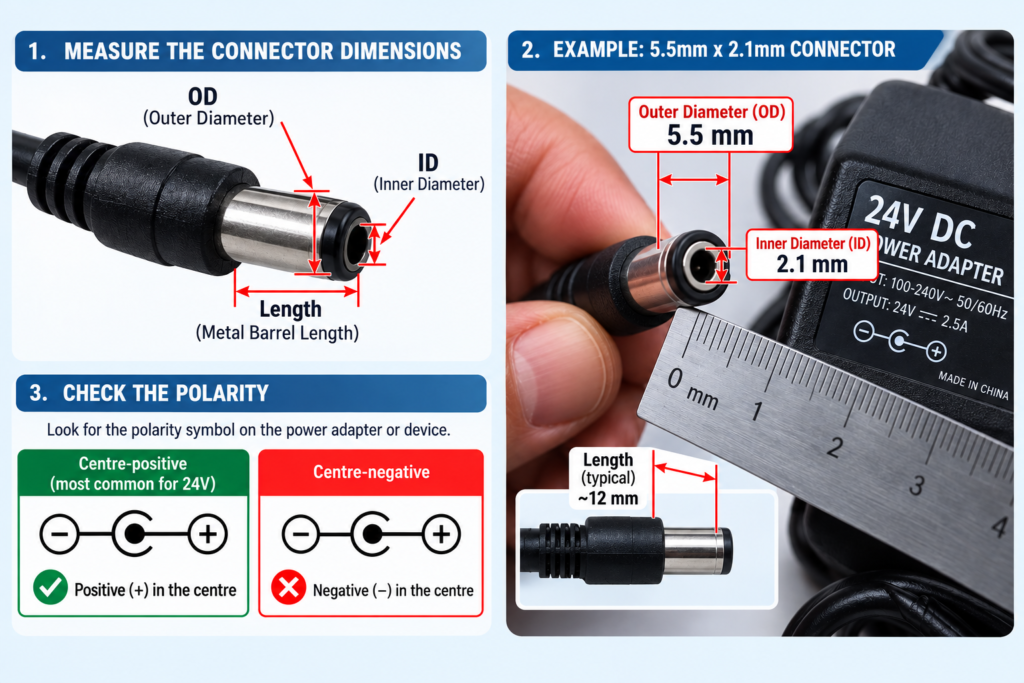
How Do You Check the Connector and Polarity?
The DC connector is another important part of compatibility. Barrel plugs are available in different outer diameters, inner diameters and lengths, so a plug that looks similar to the original may still be the wrong size.
If you still have the original adapter, use its connector as a reference. Check the listed dimensions where available, or use the device documentation to identify the required connector. A plug should fit naturally and should never need to be forced.
Polarity must also match. The polarity symbol shows how positive and negative connections are arranged at the DC connector. Many consumer electronics use centre-positive connections, but you should always verify the actual requirement rather than assuming.
For example, a 24V 3A adapter with 5.5mm connector options still needs to match your equipment’s exact connector and polarity. Connector size and polarity should therefore be treated as two separate checks.
How Do You Choose the Right 24V Replacement?
The best starting point is the original adapter label. Look for the output voltage, output current, output type, polarity, connector information and model or part number. If the original adapter is missing, check the device label, manual or manufacturer’s documentation.
Searching for the exact device model together with “24V replacement power adapter” can narrow the options compared with searching for “24V power supply” alone.
A product listing should provide enough information for you to compare its specifications with your equipment. If a listing only states “24V adapter” without clearly identifying the output, current, connector or polarity, there may not be enough information to confirm compatibility.
For devices using a compatible barrel connection, this 24V 2.5A replacement adapter is an example of why connector dimensions should be checked alongside the electrical ratings.
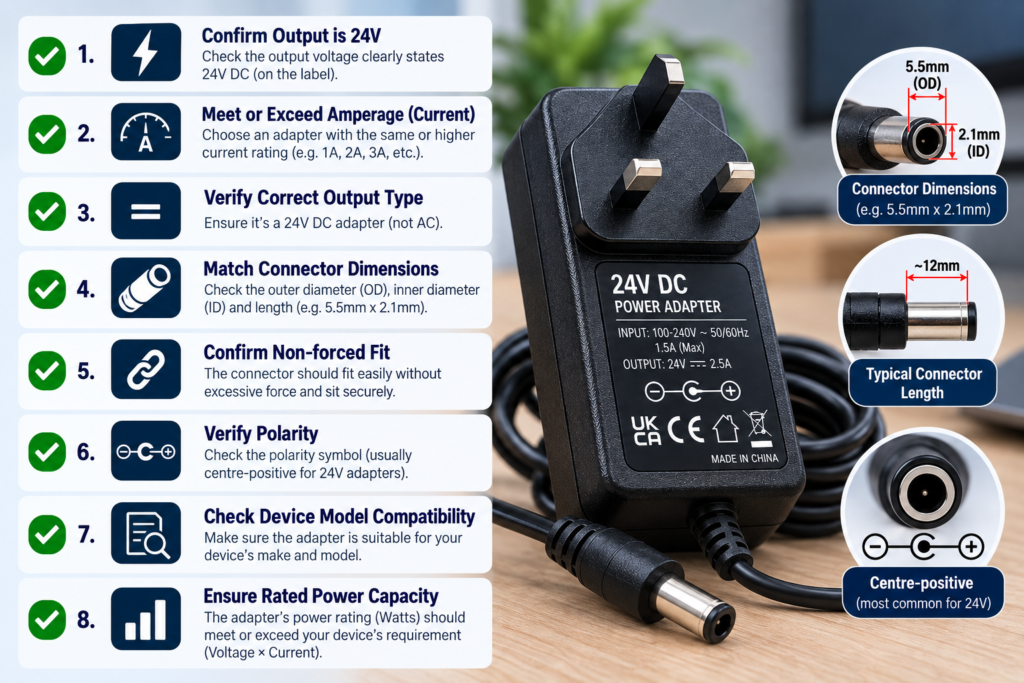
24V Adapter Buying Checklist
Before purchasing, confirm:
- The required output voltage is 24V.
- The current rating meets or exceeds the device requirement.
- The output type is correct.
- The connector dimensions match.
- The connector fits without force.
- The polarity matches.
- The device model or application is compatible.
- The rated power provides sufficient capacity.
If any important specification is unknown, avoid guessing. Find the information from the original adapter, equipment documentation or another reliable specification source before ordering.
A 24V 2.5A replacement power adapter with UK plug may be worth considering when its complete specifications match your equipment. Always compare the product specifications before purchasing rather than selecting an adapter based only on the 24V label.
FAQ
Can I use a higher-amp 24V adapter?
A higher-current 24V adapter can potentially be suitable when the device requires 24V and the connector, polarity and output type also match. For example, equipment requiring 24V 2A may potentially use a compatible 24V 3A adapter. The higher rating represents available current capacity rather than automatically forcing 3A into the equipment.
Can I use a 24V 5A adapter instead of a 24V 3A adapter?
A 24V 5A adapter can potentially replace a 24V 3A adapter when the voltage, connector, polarity and output type are compatible. A 24V 5A adapter is rated at 120W, while a 24V 3A adapter is rated at 72W. The higher current capacity alone does not establish compatibility.
What happens if I use the wrong voltage?
Using the wrong voltage can cause equipment to malfunction and may damage internal electronics, depending on the device and the difference in voltage. A higher current rating does not compensate for an incorrect voltage. If the equipment specifies 24V, choose a replacement designed to provide the required 24V output.
How do I know which 24V connector I need?
Check the original adapter, device documentation or manufacturer’s specifications for the connector dimensions. DC barrel connectors can have different outer and inner diameters and different lengths. A connector that looks similar may not fit correctly. Never force a plug into the device.
How do I calculate the wattage of a 24V adapter?
Multiply voltage by current using V × A = W. A 24V 1A adapter is rated at 24W, while a 24V 3A adapter is rated at 72W. This describes the adapter’s rated power capacity and does not necessarily mean the connected device continuously consumes that exact amount.
Conclusion
Choosing a 24V replacement power adapter is easier when you look beyond the voltage printed on the label. Start with the required 24V output, then check current capacity, output type, connector dimensions and polarity. The original adapter and device model can provide useful confirmation before you buy.
A compatible replacement should match the complete electrical and physical specification rather than simply having the same voltage or a similar-looking plug. Once you have confirmed your requirements, explore Power Adapter Warehouse for suitable replacement power solutions and choose an adapter that matches your equipment.