

Can You Safely Use a 5V 2A Adapter Instead of a 5V 1A?
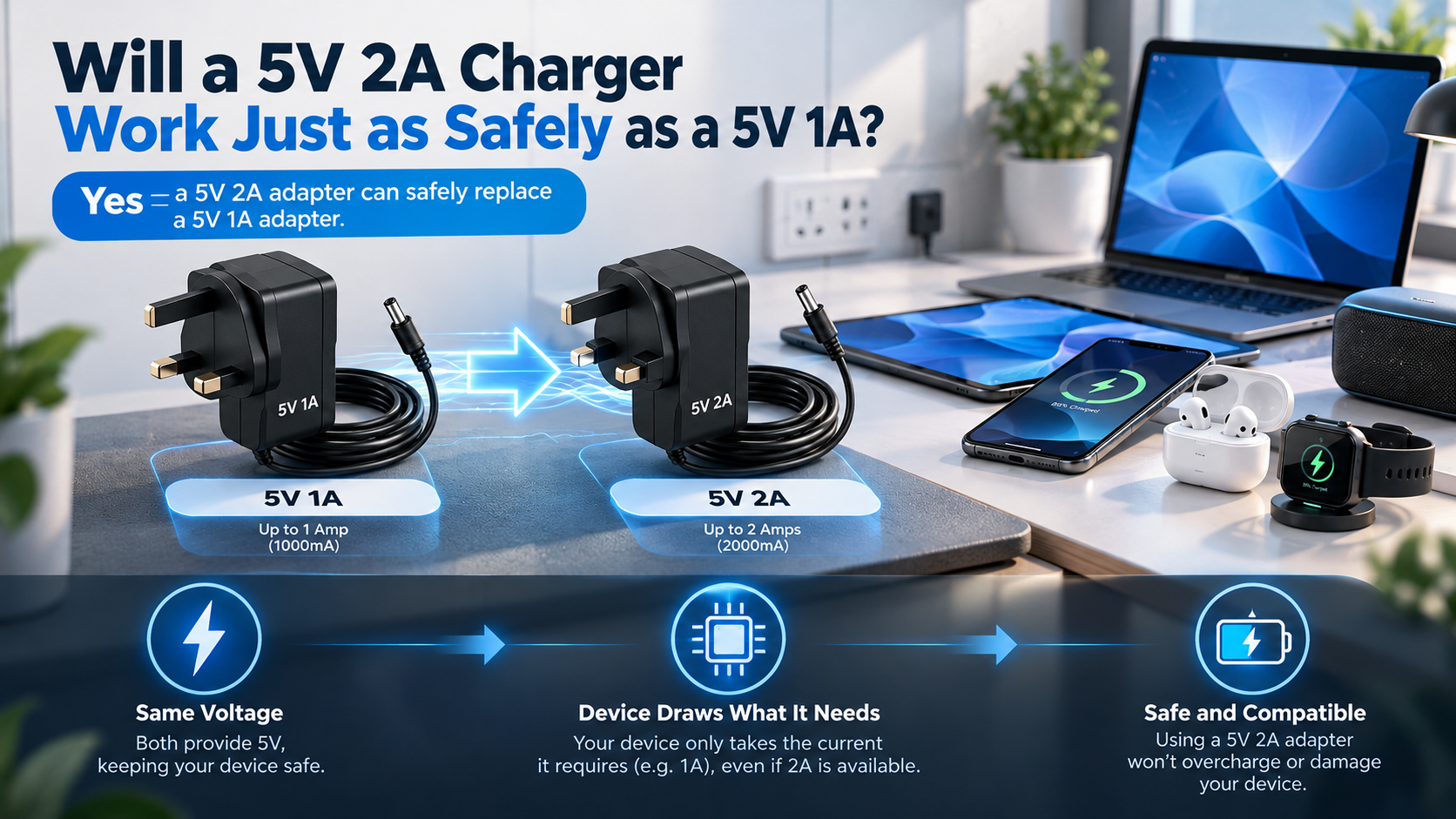
If you want to use a 5V 2A adapter instead of a 5V 1A adapter, you may wonder whether the higher current rating is safe. Generally, yes. A 5V 2A adapter can safely replace a 5V 1A supply when the device requires 5V and the connector, polarity, output type and other specifications match.
Losing or breaking a mains adapter is frustrating, but finding a suitable replacement does not have to be a guessing game. By understanding a few basic electrical principles about voltage and current capacity, you can confidently power your equipment without the fear of causing damage.
What Is the Difference Between 5V 1A and 5V 2A?
Both adapters provide the same 5V output voltage, but their current capacities are different. A 5V 1A adapter can provide up to 1A, or 1,000mA. A 5V 2A adapter can provide up to 2A, or 2,000mA.
The 5V 2A adapter has greater available current capacity. This does not mean that it automatically sends twice as much current into the device. Current is normally drawn by the equipment according to its electrical requirements.
The relationship between voltage, current and power is also explained by OpenStax’s electric power guidance.
When Can You Use a 5V 2A adapter instead of a 5V 1A Adapter?
A 5V 2A adapter can be a suitable replacement for a 5V 1A adapter when the original device requires 5V and the replacement meets the rest of the compatibility requirements.
Before connecting it, check:
- Output voltage is 5V
- Output type is correct, such as DC
- Current capacity is at least what the device requires
- Connector type and size match
- Polarity matches where applicable
- The adapter is suitable for the device model
The higher 2A rating gives the replacement more current capacity.
Is a 5V 2A Adapter Safe for a 5V 1A Device?
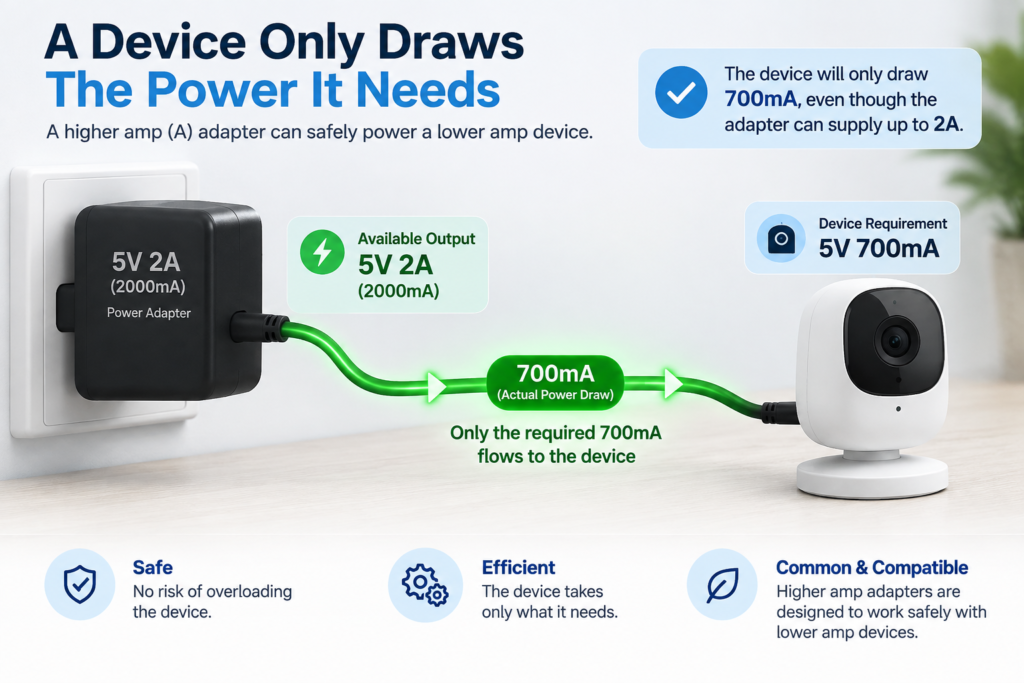
If a device requires 5V 1A, a compatible 5V 2A adapter has enough current capacity to meet that requirement.
The 2A rating describes what the adapter can provide at its rated output. It does not normally force 2A into the equipment. If the device needs 700mA, it can draw approximately 700mA rather than automatically receiving 2A.
Can a 5V 2A Adapter Be Too Powerful?
The phrase ‘too powerful’ can be misleading when discussing current ratings.
A 5V 2A adapter is not necessarily too powerful for equipment designed for 5V 1A simply because its current capacity is higher. Both adapters provide 5V. The difference is how much current capacity is available when the device needs it.
Voltage is different. You should not assume that a 9V or 12V adapter is safe for a 5V device simply because it has a higher current rating or a connector that appears to fit.
What Happens If the Adapter Has Less Than 1A?
Using a lower-rated adapter can be more problematic.
If your equipment requires up to 1A but the replacement is rated at only 500mA, the adapter may not have enough current capacity to meet the device’s demand. Depending on the equipment and supply, this can cause instability, restarts or failure to start.
A 5V 600mA mains adapter provides a useful comparison. Its 600mA rating is lower than 1A, so it should not automatically be treated as a replacement for equipment that requires 1A.
What Should You Check If the Replacement Has a Different Plug?
Matching 5V and 2A alone does not guarantee compatibility.
The connector must physically and electrically match the device. Some 5V adapters use USB connectors, while others use DC barrel plugs. Barrel connectors are available in different sizes, so two plugs can look similar while being incompatible.
A 5V 1A adapter with a Micro-USB cable demonstrates why connector type matters even when the voltage and current ratings look suitable.
Never force a connector into a device.
Does Polarity Still Matter?
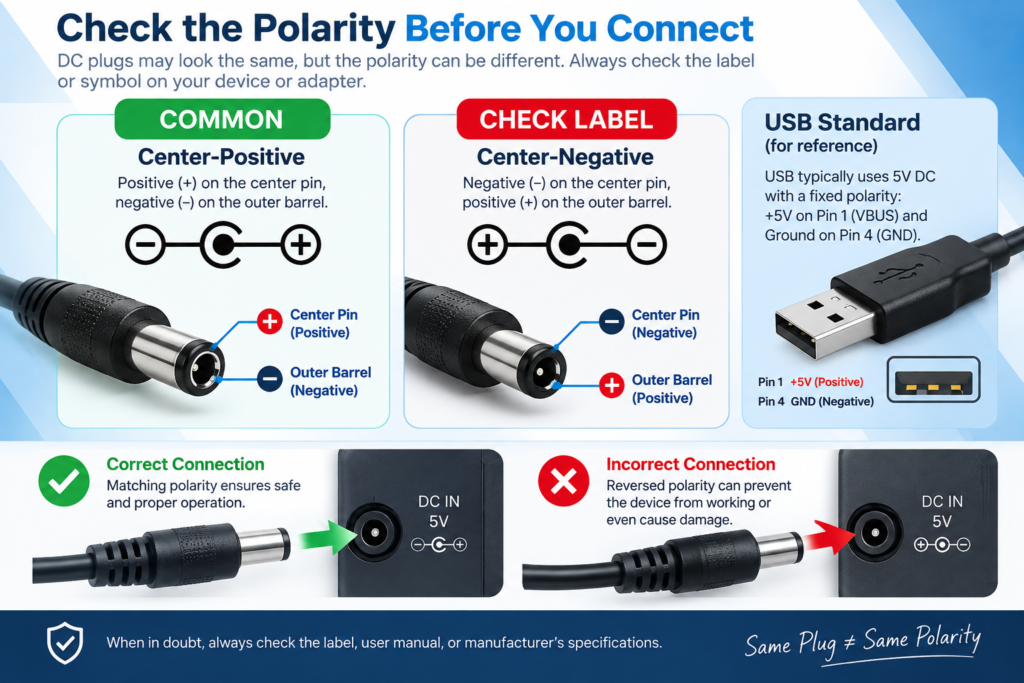
Yes. If the device uses a DC barrel connector, check the polarity before connecting a replacement.
Centre-positive is common, but centre-negative configurations also exist. The polarity symbol on the original adapter, device label or manufacturer documentation can show the required arrangement. The USB-IF document library provides further reference material for USB-related power and connector standards.
A connector can physically fit while having the wrong polarity. Therefore, physical compatibility is not enough.
If the original adapter is 5V 1A centre-positive, moving to a 5V 2A centre-negative adapter would not be a safe substitution simply because the voltage and current ratings appear correct.
What Should You Check Before Buying a 5V 2A Replacement?
Before replacing a 5V 1A adapter, compare the original and replacement carefully:
- Confirm the output voltage is 5V.
- Confirm the output type is correct.
- Make sure the current capacity is sufficient.
- Verify the connector type and physical size.
- Check polarity where applicable.
- Confirm the adapter is appropriate for the device model.
- Check the original label or manufacturer documentation. UK buyers can also review the GOV.UK UKCA marking guidance.
A 5V 1.5A AC/DC adapter is another example of a 5V supply with greater current capacity than a 1A adapter.
A 5V 1A adapter compatible with the Logik PF-A700S also illustrates why the exact device and connector specification should be checked rather than matching numbers alone.
FAQs
Can I use a 5V 2A adapter instead of 5V 1A?
Generally, yes, if the voltage, connector, polarity, output type and other requirements match.
Will a 5V 2A adapter force 2A into my device?
No. The 2A figure represents the adapter’s maximum available current capacity. A compatible device normally draws the current it requires.
Is 5V 2A more powerful than 5V 1A?
It has twice the rated current capacity and twice the theoretical maximum power output: 10W compared with 5W.
Can I use a 9V 2A adapter instead?
No. The voltage is different. Do not substitute a higher-voltage adapter for a 5V supply unless the device manufacturer specifically states that it supports it.
What if the connector is different?
Do not use the adapter simply because the voltage and current ratings match. The connector must be compatible, and polarity must match where applicable.
Conclusion
Compare the complete specification before connecting any replacement power adapter.
A 5V 2A adapter can generally replace a 5V 1A adapter when the device is designed for 5V and the connector, polarity, output type and other requirements all match.
The higher 2A rating provides more available current capacity; it does not normally force twice as much current into the device. Do not change the voltage without manufacturer approval.
Before connecting the replacement, compare the original adapter label with the new adapter. Check voltage first, then current capacity, connector and polarity. If the complete specification matches, a 5V 2A adapter can be a practical replacement for a 5V 1A supply.